































Table of Contents
- Key Points
- Understanding Generative AI Patterns
- Choosing the Right Pattern: Design vs. Architecture
- How to Implement Generative AI Design Patterns
- GAN Design Pattern: Pros and Cons
- Generative AI Design Pattern Examples
- Examples of Common Architectures
- FAQ
- Related Questions


Understanding Generative AI Patterns
Generative AI Design Patterns: A Template for Model Creation
What exactly constitutes a Generative AI design pattern?
At its core, it's a repeatable template designed to efficiently produce models within an organization. Think of it as a blueprint that guides the creation of AI models tailored for specific business use cases. It’s a well-tested, validated and repeatable template that can be applied to solve the problems specific to Gen-AI models. The value lies in its reusability and adaptability across various lines of business (LOBs), fostering consistency and accelerating development cycles.
For example, consider creating a large language model (LLM). You'd need to adhere to a particular design pattern to ensure the model is effectively trained and performs optimally. This pattern can then be replicated across different LOBs, ensuring each generates a model customized to its unique needs while maintaining a standard approach. It also makes model training easier, as the team is using the same data. Generative Adversarial Networks (GAN), Variational Auto Encoder(VAE), Autoregressive Model(AM), Diffusion Model(DM), Transformer-based Generation(TG), Sequence to Sequence(Seq2Seq), Conditional Generation(CG) are all parts of a Gen-Ai Design Patterns. The repeatable nature of these patterns make it easier for new members to onboard a project.
Generative AI Architecture Patterns: A Holistic Organizational View
Generative AI architecture Patterns take a broader perspective

. While design patterns focus on the model itself, architecture patterns extend to encompass the entire ecosystem, including data, applications, and the platform upon which the model operates. In short, It’s a well tested, validated and a repeatable template that can be applied to solve all your Gen-AI Use-cases along with the application, data and platforms.
This holistic view ensures that the AI model integrates seamlessly with existing infrastructure and contributes effectively to the overall business architecture. Rather than focusing solely on the model, the architecture pattern considers aspects such as data pipelines, application integration, and platform compatibility . This broader approach ensures a robust, scalable, and maintainable AI solution.
Imagine designing a system to automatically generate personalized marketing content. The architecture pattern would not only specify the LLM for content generation but also address how customer data is ingested, processed, and used by the model, as well as how the generated content is delivered to customers across different channels. Retrieval-Augmented Generation (RAG), ReAct (Reasoning and Acting), Agent (Reason, Plan and Act Autonomously), RAFT (Retrieval-Augmented Fine Tuning) are all Key Gen-Ai Architecture Patterns that have a proven track Record.
How to Implement Generative AI Design Patterns
Step-by-Step Implementation of GANs
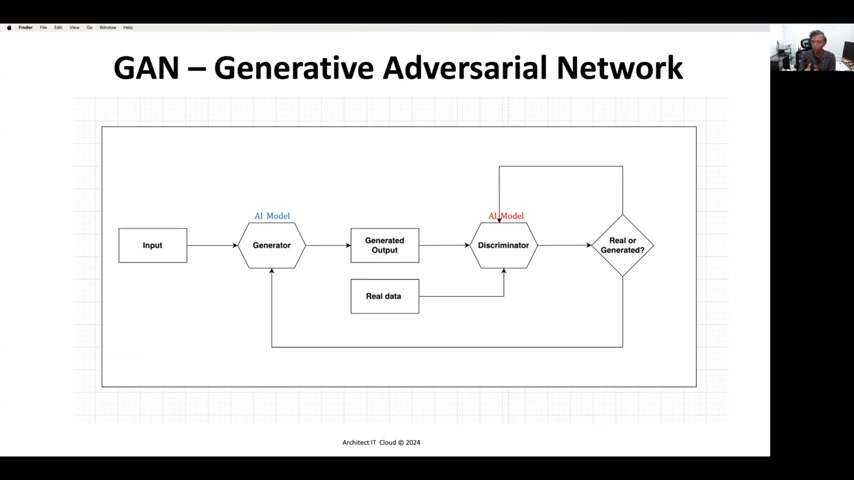
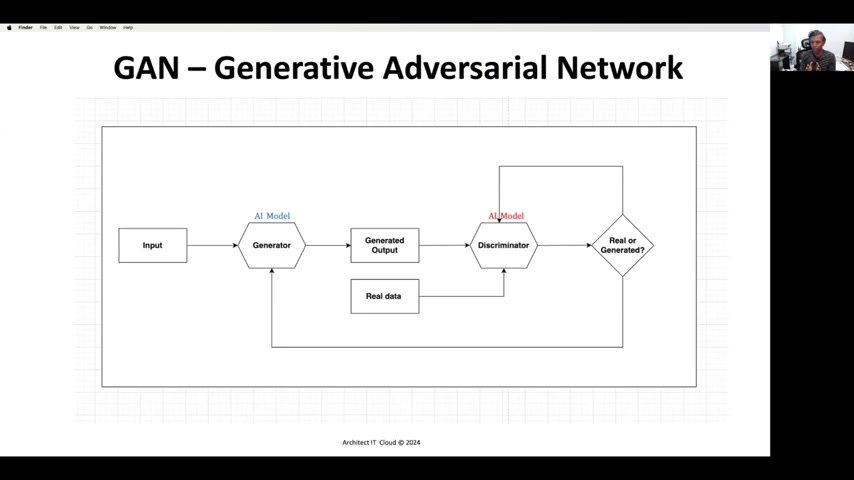
To effectively use GANs in your company, there are a few things you need to think about before you start doing this. First, it helps to understand what GANs are and what they are used for. GANs are a special kind of AI system that contains two parts: the Generator and the Discriminator. To use GANs effectively, follow the steps below:
- Set up the right AI infrastructure to give your GAN the tools it needs to work well
.
- Organize the input data carefully to help the Generator and Discriminator improve over time.
- Create the Generator and Discriminator by carefully setting their functions to make new data and recognize true vs. fake data.
- Set up a system for continuous training that involves carefully adjusting settings as the GAN learns.
- Perform lots of tests to see how well your GAN is doing, and make changes to improve its performance.
Generative AI Design Pattern Examples
Generative Adversarial Networks (GANs)
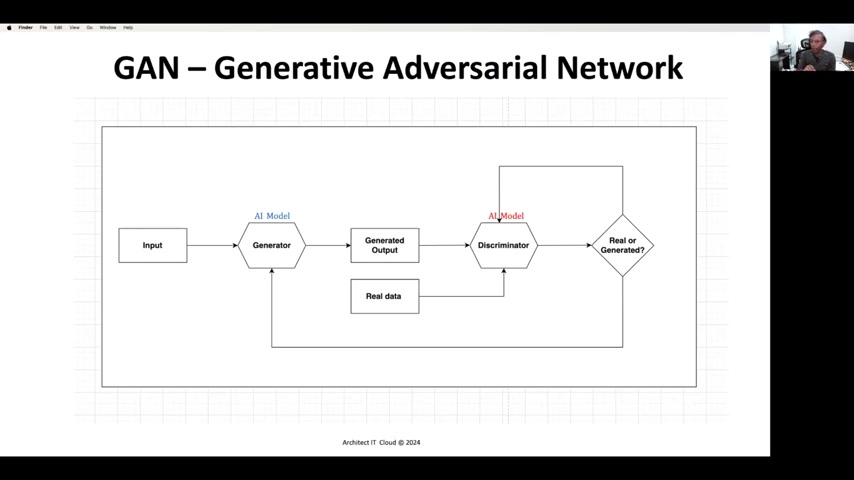
How They Work: GANs consist of two neural networks, a Generator and a Discriminator. The Generator creates new, synthetic data samples, while the Discriminator tries to distinguish between real and generated data.
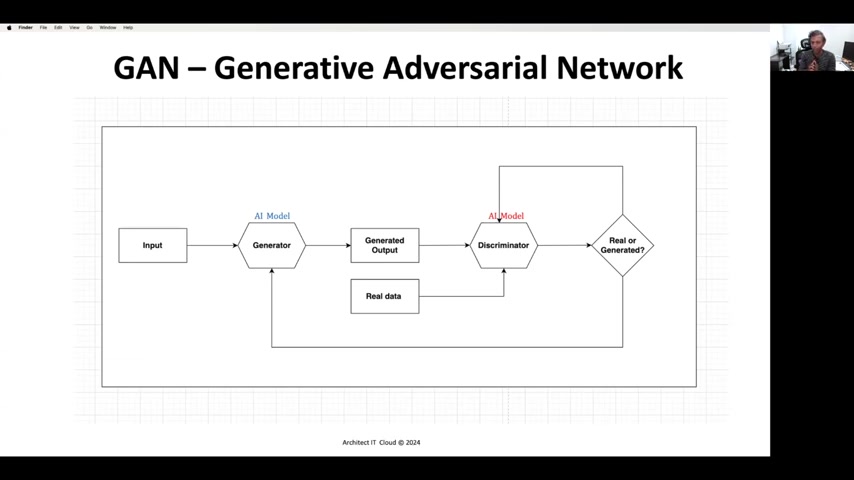
These two networks compete, driving each other to improve. Eventually, the Generator becomes capable of producing data that is indistinguishable from real data.
Key Uses: Image generation, style transfer, and data augmentation are some use cases. GAN's design pattern can be helpful when the organization is working towards creating image-to-image translation or creating realistic-looking deepfake videos. This design can greatly benefit the media, arts, and entertainment industry.
Variational Autoencoders (VAEs)
How They Work: VAEs encode input data into a latent space distribution and then decode it to generate new data
. They are useful for tasks where you want to generate variations of existing data while maintaining control over the generated output.
Key Uses: Anomaly detection and semi-Supervised learning are some use cases. The data is usually used to train a classifier, so that, the organisation or product can learn and use it in the long run.
Examples of Common Architectures
Retrieval Augmented Generation (RAG)
How They Work: In a RAG architecture, Large Language Models (LLMs) use external data, like a Knowledge Base, to ensure accuracy.
It has 3-steps: first, it retrieves the top-k relevant documents based on its query. Next, the LLM uses the documents to augment its queries. Finally, the relevant results are used to formulate a more accurate and informative answer.
Key Uses: These are used for customer support, where questions are answered automatically by going through specific data on the web and creating a final answer. Retail chatbots are a great application of this technology. It has been used in the retail industry to handle customer requests. It's also often used in a more general sense to help create data when its missing.








Most people like

































Report
Please select a reason for reporting
- 13 Reasons to Switch from Snapchat to Text Messaging
- 7 Powerful Speech to Text Apps to Boost Productivity
- 10 Best Speech to Text Tools for Effortless Transcription
- 13 Free Tools to Easily Transcribe Audio to Text
- 15 Surprising Ways Google's Speech-to-Text Boosts Productivity
- 7 Best Free Online Audio to Text Transcription Tools
- 9 Tips to Transcribe Speech to Text Faster and Better
- 13 Best Speech to Text Software for Windows 10 in 2023
- 7 Tips for Choosing the Best Transcriber for Audio to Text
- 11 Reasons Why Dragon Speech-to-Text Apps are Game-Changers
- 6 Secrets to Enhance Your Speech to Text Transcription
- 6 Brilliant Ways to Boost Productivity with Talk-to-Text on Your MacBook
- 6 Ways Transcription Software Converts Audio to Text
- 8 Tips to Transcribe Speech to Text Like a Pro
- 6 Reasons IBM Watson Speech to Text is a Game-Changer
- 14 Powerful Ways Talk-to-Text Improves Your Workflow
- 12 Top Windows Speech-to-Text Software for Efficient Transcription
- 12 Game-Changing Benefits of Apple's Speech to Text Technology
- 9 Powerful Use Cases for AWS Speech to Text Technology
- 10 Easy Steps to Transcribe YouTube Videos to Text
- transcription audio en texte
- online audio transcription
- free audio file transcription
- free ai audio transcription
- audio transcription service
- audio transcription online free
- audio transcription free online
- audio to transcription software
- audio and transcript
- ai audio transcription free
- voice recording to text converter
- translate voice recording to text
- record voice to text
- audio recording to text converter
- voice recording and transcription
- chatgpt voice to text
- gmail voice to text
- speech to text reader
- speech to text ai free
- speech to talk
- How to Use AI Tools to Find Internal Linking Opportunities Across a Business Website
- Discover Your Perfect Haircut with AI Hairstyle Apps
- Free Reputation Calculator Tools: How They're Adapting to Score AI Visibility, Not Just Rankings
- Design Professional Flyers for Free on Your Phone
- Best Free Flyer Maker Apps for Android: Design Like a Pro
- How to Know If Your Business Is Ready for an AI Customer Service Agent
- Revolutionizing Storytelling: From Novels to Screenplays with AI
- Create Engaging Animated Explainer Videos with a Free AI Tool
- Stop Multi-Subscribing: Benchmark Top AI Visual Models in One Canvas
- Best Seedance 2.5 API Provider: Every Price on the Market, Checked at Source
- Top AI Social Media Management Tools: Automate Your Content Strategy
- Free AI Text to Video Generator: Create Stunning Videos from Text
- Discover 17 ChatGPT Alternatives: A Comprehensive Comparison
- Character.AI vs. Janitor AI: Which AI Chat Platform Reigns Supreme?
- Top Virtual Assistant Companies in 2026: Reviews, Pricing, and Plans Compared
- Unveiling FaceCheck.ID: Revolutionizing Reverse Image Searches with AI
- 11 Best AI Dialers in 2026: Features, Pricing, Pros and Cons
- How I Direct Consistent AI Clips: A Hands-On Guide to Multi-Model Generation
- A Realistic Review of the Photo Generator Image Tool
- Playwright MCP Server: Automated Web Testing with Agent Mode

Copyright ©2026 toolify