































Table of Contents
- Key Points
- Understanding GraphRAG
- Deep Dive into GraphRAG Processes
- How to Get Started With GraphRAG
- FAQ
- Related Questions


Understanding GraphRAG
What is GraphRAG?
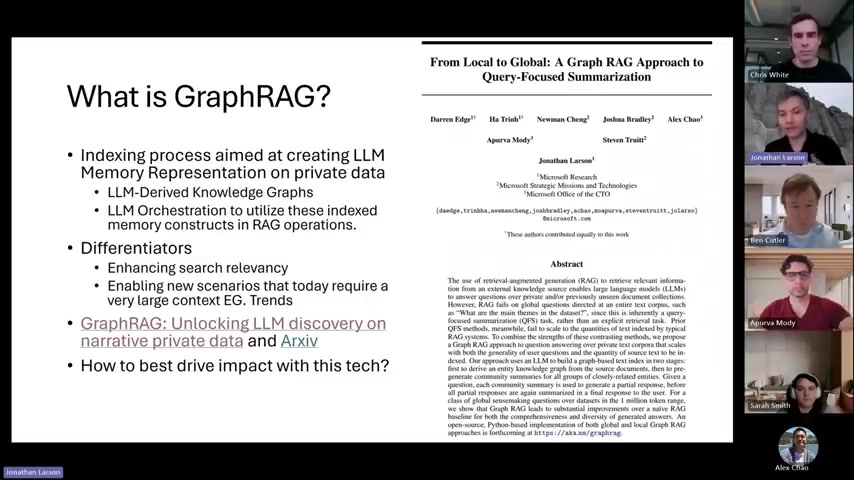
GraphRAG is a two-step process designed to optimize information retrieval from private data. It combines indexing and LLM orchestration to provide enhanced search capabilities. GraphRAG unlocks LLM discovery on private data and Arxiv.
-
Indexing Process: The initial step involves indexing private data to create LLM-derived knowledge graphs. These graphs serve as a memory representation for the LLM.
-
LLM Orchestration: The Second step utilizes an LLM orchestration mechanism to leverage the indexed memory for better retrieval. This orchestration constructs RAG operations. This process is about orchestrating these indexed memory constructs to improve RAG operations.
GraphRAG's design enhances search relevancy, enabling LLMs to understand data semantics and discover new trends within large datasets. It allows for new data discovery scenarios that would otherwise require a very large context. This creates a more empowered Retrieval Augmented Generation strategy. The intent is to create more empowered RAG operations using graph indexing for private data.
Differentiators of GraphRAG
GraphRAG unlocks the potential of narrative private data, and this makes it powerful.
The key differentiators offered by GraphRAG include:
-
Enhanced Search Relevancy: By providing a holistic view of the semantics across the entire dataset.
-
New Scenario Enablement: By facilitating analysis for trends, summarization, and aggregation.
GraphRAG improves relevancy by helping enable better LLM operations. To best drive impact with GraphRAG tech, consider enhancing search relevancy by discovering new trends. The ability to do so is the differentiator of GraphRAG.
Deep Dive into GraphRAG Processes
GraphRAG Processing Pipeline
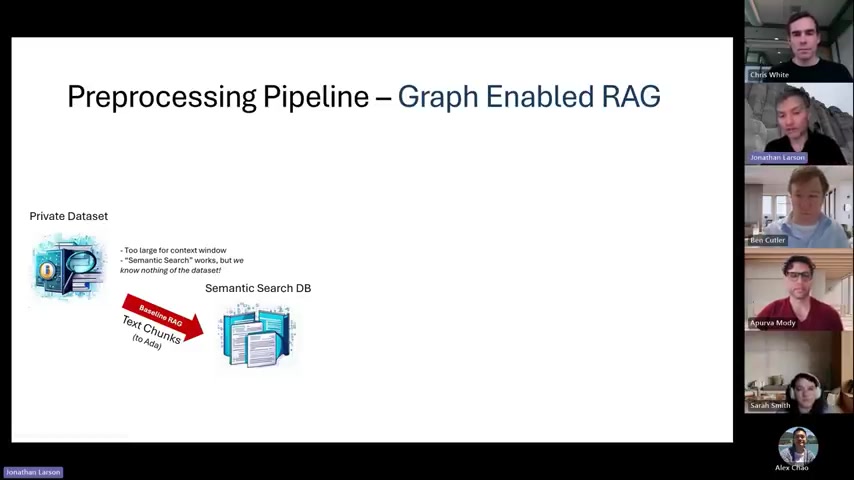
The presenter goes into a detailed description about how GraphRAG processing works. First, he gives an overview of how baseline RAG works.
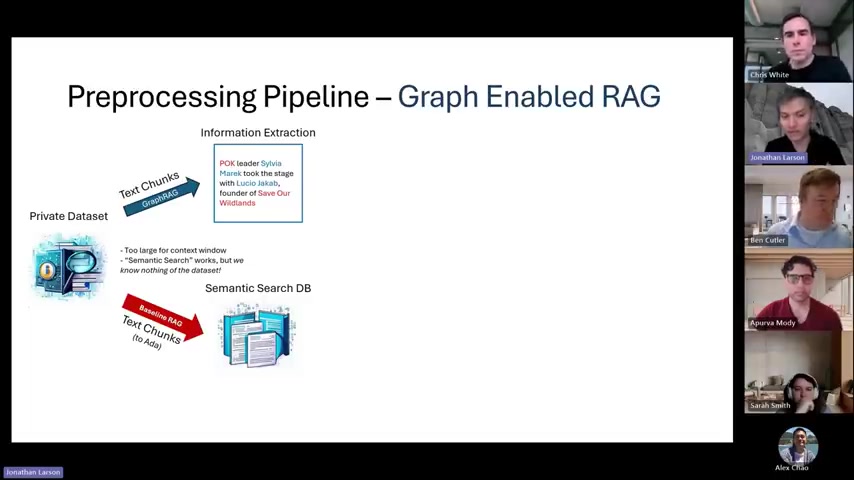
- Baseline RAG: You take your private dataset, chunk it up with embeddings, and store it into a vector database.
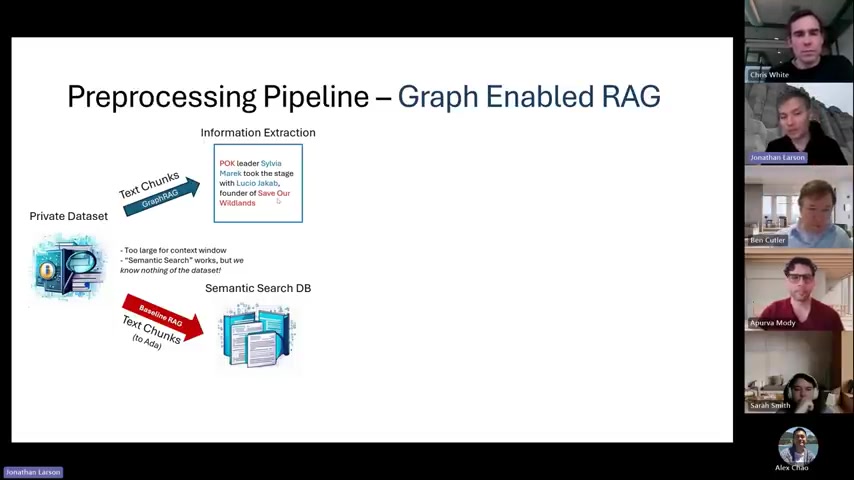
A nearest neighbor search is performed, and the nearest neighbor searches are used to augment the context window. This works, but knows nothing of the dataset.
-
GraphRAG : GraphRAG works in Parallel with the baseline RAG. It takes text chunks, and extracts information. LLMs perform reasoning operations over top of each sentence in a single pass. In a single pass, GPRT-4 does information extraction over all of the data.
The major differentiation here is to find the relationships between entities, and the strengths of those relationships.
An Example of Information Extraction with GraphRAG
Here is an example of information extraction with GraphRAG.
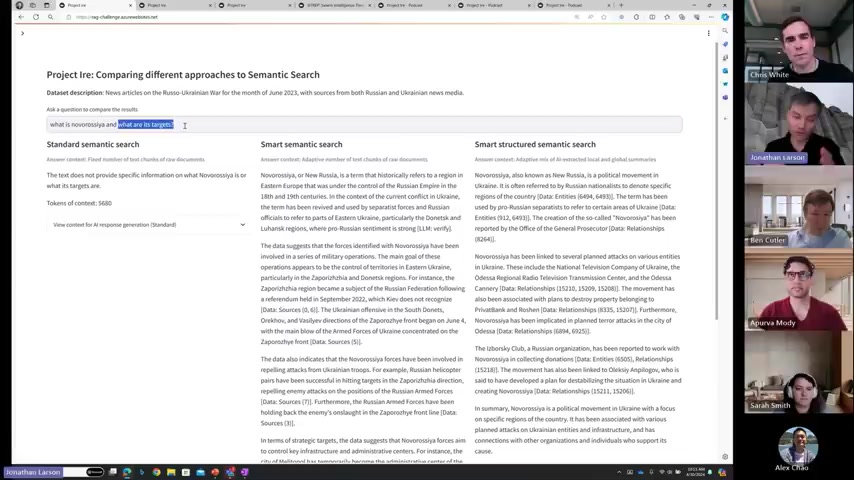
'POK leader Sylvia Marek took the stage with Lucio Jakab, founder of Save Our Wildlands'. The intent is to perform named entity recognition over the sentences. However, there is far more to GraphRAG than named entities: GraphRAG aims to understand the semantics of these relationships.
GPT-4 knows Sylvia Marek is strongly related to the POK because she is the leader. Marek is weakly related to Save Our Wildlands because she took the stage with the leader of Save Our Wildlands. GPT-4 gives us the means of understanding relationships between data.
GraphRAG can create a weighted graph from relationships. The graph can now construct more empowered RAG operations.
This allows unlocking of narrative private data and Arxiv.
Topic Detection with GraphRAG
GraphRAG allows Topic Detection. Take all the sentences across the dataset and create a Knowledge Graph. The weighted graphs are the series of nodes that are connected to each other via relationships. Now, graph machine learning can be leveraged.
Semantic aggregations and hierarchical agglomerations can now occur. This allows granular filter. RAG can now ask questions as any level of granularity across the dataset for a semantic topic.
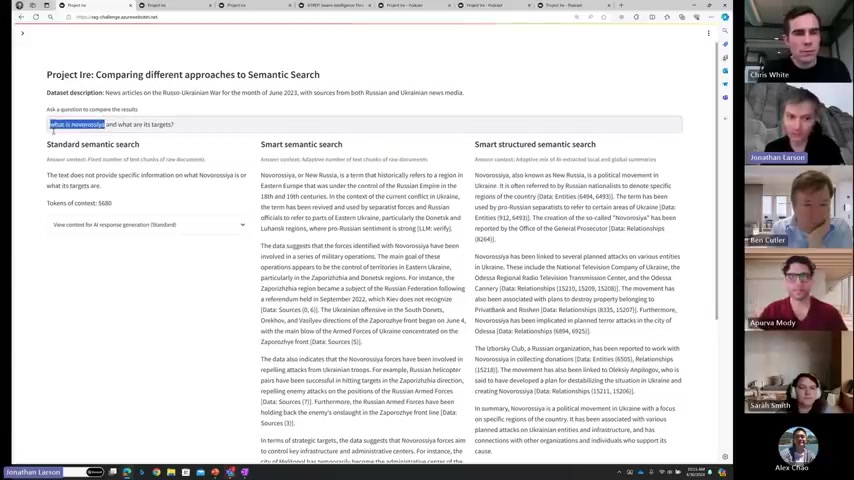
A granular filter effectively allows dataset question generation. These are the benefits of this tech.
As a result, graph machine learning makes graph embeddings possible, and hierarchy extraction.
How to Get Started With GraphRAG
Explore the Blog Post and Arxiv
To get started with GraphRAG, the presenter encourages people to check out the blog post and to look at the Arxiv. They have a lot more technical details and measurements.
GraphRAG works because of a holistic view of the semantics. The presenter asks how the best way to drive impact with the technology is.






Most people like





























Report
Please select a reason for reporting
- 13 Reasons to Switch from Snapchat to Text Messaging
- 7 Powerful Speech to Text Apps to Boost Productivity
- 10 Best Speech to Text Tools for Effortless Transcription
- 13 Free Tools to Easily Transcribe Audio to Text
- 15 Surprising Ways Google's Speech-to-Text Boosts Productivity
- 7 Best Free Online Audio to Text Transcription Tools
- 9 Tips to Transcribe Speech to Text Faster and Better
- 13 Best Speech to Text Software for Windows 10 in 2023
- 7 Tips for Choosing the Best Transcriber for Audio to Text
- 11 Reasons Why Dragon Speech-to-Text Apps are Game-Changers
- 6 Secrets to Enhance Your Speech to Text Transcription
- 6 Brilliant Ways to Boost Productivity with Talk-to-Text on Your MacBook
- 6 Ways Transcription Software Converts Audio to Text
- 8 Tips to Transcribe Speech to Text Like a Pro
- 6 Reasons IBM Watson Speech to Text is a Game-Changer
- 14 Powerful Ways Talk-to-Text Improves Your Workflow
- 12 Top Windows Speech-to-Text Software for Efficient Transcription
- 12 Game-Changing Benefits of Apple's Speech to Text Technology
- 9 Powerful Use Cases for AWS Speech to Text Technology
- 10 Easy Steps to Transcribe YouTube Videos to Text
- transcription audio en texte
- online audio transcription
- free audio file transcription
- free ai audio transcription
- audio transcription service
- audio transcription online free
- audio transcription free online
- audio to transcription software
- audio and transcript
- ai audio transcription free
- voice recording to text converter
- translate voice recording to text
- record voice to text
- audio recording to text converter
- voice recording and transcription
- chatgpt voice to text
- gmail voice to text
- speech to text reader
- speech to text ai free
- speech to talk
- Revolutionizing Storytelling: From Novels to Screenplays with AI
- Create Engaging Animated Explainer Videos with a Free AI Tool
- Stop Multi-Subscribing: Benchmark Top AI Visual Models in One Canvas
- Best Seedance 2.5 API Provider: Every Price on the Market, Checked at Source
- AI OnlyFans: How to Generate $30,000/Month (Legally)
- Transform Your Script into an Engaging Video with AI Video Maker!
- AI Marketing Automation: A Comprehensive Guide for Small Businesses
- Midjourney Alternative for Anime Art Creators: Why PixAI May Be Better for Character Workflows
- 10 Things Most People Get Wrong About AI Image Search
- AI Girlfriend Apps: Top Choices Redefining Relationships 2025
- Python Random Name Generator Tutorial
- Generate Unique Names with Python Random Name Generator
- Code a JavaScript Name Generator
- Create a Fun Name Generator App - Easy JavaScript Project!
- Experience Roblox's Avatar Creation for Karl Jacobs!
- May TBR Game: How a Letter Generator Chooses My Reads
- AI Celebrity Chat: Hilarious Pick-Up Lines & Chatbot Chaos!
- Embrace Chaos with the Random Makeup Challenge
- Boost Audience Engagement with the Wheel of Names
- Engage Your Audience with the Wheel of Names!

Copyright ©2026 toolify