






















Lithium Estimation Tool: Machine Learning in Geothermal

Updated on Oct 13,2025

Table of Contents

Unlock the potential of geothermal energy with the Lithium Estimation Tool, a cutting-edge AI-powered solution designed to refine lithium concentration estimates in geothermal fluids. This tool integrates machine learning and geological insights, creating a robust foundation for pioneering geothermal research and optimizing exploration efforts. Dive in and discover how this innovation is driving the future of geothermal energy.

Key Points

Intricate Relationship Analysis: The lithium estimation tool uncovers critical relationships between elemental features and lithium concentrations.

AI-Driven Precision: Accurate lithium estimation is emphasized through machine learning in geothermal wells.

Data Analysis Excellence: The tool ensures interpretive data analysis in geothermal settings.

Geothermal Research Foundation: This project establishes a robust foundation for advanced geothermal research.

Tree-Based Machine Learning: Regression Decision Tree algorithms are central to the tool's predictive modeling capabilities.

Understanding Lithium Estimation in Geothermal Research

The Role of Inlecom Innovation

Inlecom Innovation, established in 1996, spearheads advances in research and innovation across Europe. With a proposal success rate exceeding 40%, significantly above the EU average, Inlecom excels in EU-funded projects. Their expertise spans AI, digital simulations, and advanced security solutions. Their work in the lithium estimation project highlights their competencies in AI, digital solutions and machine learning. By leveraging digital twins and computer vision, predictive modeling and semantic analysis, they’re bringing innovation in material tracking solutions using Blockchain, smart contracts, and encryption. With Inlecom's expertise, organizations can optimize operational costs, enhance decision-making, and improve their resource management. Key focus areas are AI/ML digital simulations, digital twins, computer vision, material tracking and smart visualization.

Primary Aims of Lithium Concentration Analysis

The core objective is to identify and analyze relationships between chemical elements and lithium concentrations. By utilizing advanced machine learning coupled with geological insights, the team aims for accurate lithium estimation in geothermal wells. Ensuring data interpretability is also a priority, contributing to a robust foundation for future geothermal research. Unlocking these relationships makes geothermal extraction more effective. In essence, the main focus of the primary aim is to accurately model and estimate the lithium content in various geothermal fluids to enhance our knowledge and understanding.

AI Tool Deep Dive

Machine Learning Model: Regression Decision Tree

The lithium estimation tool employs a Regression Decision Tree, a robust and interpretable machine learning model. This model analyzes relationships between lithium and major cations, anions, and fluid characteristics, using data from the CRM fluid database. The lithium tool specifically focuses on key elements such as magnesium, potassium, sodium, chlorine, and calcium to build accurate predictive models. The model has been trained on a comprehensive data set to establish effective rules for making predictions based on relevant input variables. The approach offers Novel techniques for the detection to differentiate between genuine outliers and instances of variance. Understanding this machine learning model and its use is critical for utilizing this lithium estimation tool and understanding the data.

Regression Decision Tree Components

A decision tree operates like a flowchart, using a set of rules to make decisions based on input variables. Here's a breakdown of its components:

  • Nodes: Decision points within the tree. They split the data based on specific criteria, helping to separate data into smaller, more manageable subsets.
  • Leaves: Also known as terminal nodes, these are the endpoints of a tree. They contain the final predictions or outcomes. In each leaf, the final prediction corresponds to the mean value of samples in that leaf.
  • Data Separation: The nodes facilitate the separation of data into smaller subsets, enabling more focused and precise predictions. The mean value of samples in the leaf can provide us with more precise insight into lithium estimates.

This structure enhances the accuracy and interpretability of the lithium estimation process, making it a valuable tool for data analysis in geothermal research. Regression Decision Tree algorithms are central to the tool's predictive modeling capabilities, thus greatly improving its efficiency.

Utilizing the CRM AI Tool for Lithium Analysis

Manual Input of Elemental Concentrations

The user has the flexibility to manually input concentrations for magnesium (Mg), potassium (K), calcium (Ca), chlorine (Cl), and sodium (Na) in mg/L. This allows for the assessment of new samples against the existing model.
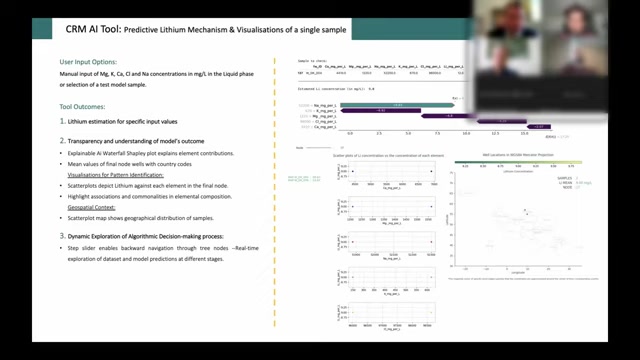
Alternatively, users can select from a range of test model samples within the CRM reflect dataset, allowing comparisons and validation against pre-existing data. This provides a baseline for the analysis, allowing users to understand the lithium tool data and its value.

Analyzing the Tool Output

The tool provides several outputs that provide an understanding of the lithium tool's potential value:

  1. Lithium Estimation: Accurate estimates for lithium concentrations based on the specified input values.
  2. Transparency of Model Outcome: Understand the contributions of different elements using Explainable AI Waterfall Shapley plots. A new Explainable AI plot is simultaneously generated in the application which transparently provides insights into the model's decision-making process.
  3. Dynamic Exploration: Use step sliders to navigate through tree nodes for real-time exploration of datasets and models predictions at different stages. The step slider enables backwards navigations, thus enabling a greater understanding of the datasets.

All components are presented together to give a greater overview of data provided.

Pricing and Availability

Access Options for the Lithium Tool

Currently, the details regarding the pricing and availability of the Lithium Estimation Tool are still under development. For specific inquiries and updates, reaching out through the contact information is essential. The Lithium Estimation Tool is likely to offer the following benefits to its potential users: a clearer understanding of geothermal systems, optimizing operational costs, enhancing decision making, improving resource management. These benefits offer great future value for its users.

Evaluating the Lithium Estimation Tool

👍 Pros

High Accuracy: The tool employs a Regression Decision Tree, providing high predictive accuracy in lithium concentration estimation. In the decision tree algorithm the leaves, which contain the outcomes, are split according to the training subset.

Transparent Data Analysis: Users gain insight into the elements and relationships. Each split can contain accurate data that has been calculated by our nodes.

Customizable Ranges: It allows users to filter data to achieve personalized and informative readings for the future

Geospatial Focus: It accounts for geospatial data to improve understanding and efficiency in our processes.

👎 Cons

Learning Curve: There may be a learning curve for users unfamiliar with the software, due to the complex calculations that can be used in it.

Development Stage: The tool’s pricing and availability details are currently under development and may not be as readily available. For particular use cases, it may be more relevant to consult individual teams or data experts.

Newness on the Market: Since its recent inception, data may be limited, which can impact potential data sets to be trained in this application.

Key Capabilities of the CRM AI Tool

Exploring Key Functionalities

The CRM AI Tool enables users to understand chemical and geospatial dynamics, offering unique visualizations that highlight key elemental influences. Here are the key tool outcomes:

  • Lithium estimation for specific input values to get a greater overview of sample data and potential value.
  • Dynamic exploration of datasets at different stages to create a greater view of data changes during different filter phases.
  • Dynamic adaptability that triggers the training of a new Decision Tree model to allow its adaptation to individual users.
  • Visualizations for pattern identification provide easily digestible data, thus allowing users to understand its key value.
  • Geospatial mapping of the graphical distribution of the test samples to allow users to understand its relevance to data.

Practical Applications of the Lithium Estimation Tool

Industry-Specific Use Cases

The lithium estimation tool is a crucial part of the geothermal industry, allowing for various applications that may greatly enhance its value:

  • Resource Assessment: Assesses the potential of geothermal resources by accurately estimating lithium concentrations, aiding in strategic resource assessment.
  • Exploration Optimization: Optimizes geothermal exploration efforts by pinpointing areas with high lithium concentration, which greatly enhances cost-effectiveness.
  • Data Interpretability: Provides clear, interpretive data analysis. By clarifying intricate data analysis, the tool greatly enhances geothermal research.
  • Geospatial Research: Establishes a strong foundation for novel geothermal studies, which can be used to refine processes or provide better estimates.
  • Real-Time Adaptations: Use step sliders to navigate through tree nodes for real-time exploration of datasets and models predictions at different stages. This allows real-time data exploration that is easy to visualize and understand.

Frequently Asked Questions

What are the main objectives of the lithium estimation tool?
The primary objective is to identify relationships between elemental features and lithium concentrations in geothermal fluids, using advanced machine learning techniques to enhance the accuracy and interpretability of geothermal data.
How does the tool ensure quality control and anomaly detection?
Quality control is maintained through dynamic data filtering, which triggers the training of new decision tree models. This process assesses the quality of data in each stage.
What makes the CRM AI tool different from other lithium estimation methods?
The CRM AI tool uniquely combines advanced machine learning with geological insights, focusing on transparency, dynamic adaptability, and geospatial analysis to provide detailed, accurate, and interpretable lithium estimations.

Related Questions

How does the use of a regression decision tree enhance the predictive accuracy of lithium estimation in geothermal wells?
Regression decision trees create a predictive accuracy. Here’s how each facet of the algorithm contributes to the whole: Data Segmentation: The model segregates a training subset by performing calculations based on the input variables. Data Interpretation: They split the data based on specific criteria, such as feature values, to direct the data toward different branches, making separate focus predictions. Accuracy of Estimates: The nodes split the data by calculating the value of variables, which allows for higher accuracy of the data estimates.

Most people like














