































Table of Contents
- Key Points
- Understanding LLMs and Knowledge Graphs
- GIVE: Graph-Inspired Veracity Extrapolation
- Implementing Think-on-Graph
- Accessibility and Cost Considerations
- Think-on-Graph: Weighing the Pros and Cons
- Core Features of the Integration of LLMs and KG
- Use Cases: Diverse Applications of LLM and KG
- Frequently Asked Questions
- Dive Deeper into Related Questions


Understanding LLMs and Knowledge Graphs
The Power and Limitations of LLMs
Large Language Models (LLMs) represent a significant leap forward in AI, demonstrating remarkable abilities in natural language processing, text generation, and more.
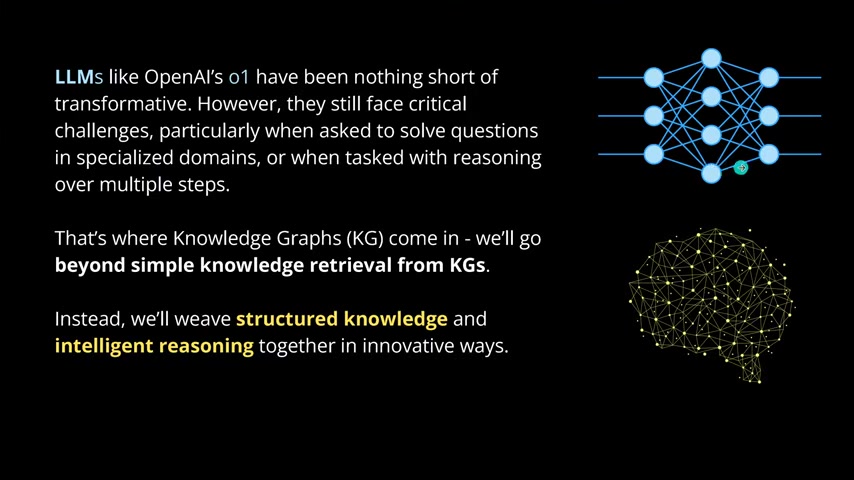
LLMs like OpenAI's models are revolutionizing how we interact with machines and access information. However, despite their impressive capabilities, LLMs have inherent limitations that need to be addressed to ensure reliable and accurate AI applications.
One key challenge is their reliance on vast amounts of training data, which can lead to superficial understanding and difficulties in reasoning about complex or specialized topics. LLMs sometimes struggle with questions in specialized domains, requiring reasoning over multiple steps, or dealing with scenarios not well-represented in their training data. This is where Knowledge Graphs (KGs) come into play, providing a structured and organized source of information that can augment LLMs' reasoning abilities.
Knowledge Graphs represent a structured approach to organizing knowledge, representing entities, concepts, and relationships in a graph format. They offer a way to represent real-world information and relationships in a machine-readable format, enabling AI systems to reason, infer, and make informed decisions. By integrating LLMs with KGs, we can overcome some of the limitations of LLMs and create more robust and reliable AI systems.
Think-on-Graph (ToG): Deep and Responsible Reasoning
Think-on-Graph (ToG) is a methodology designed to enhance the reasoning capabilities of LLMs by leveraging the structured knowledge of Knowledge Graphs.
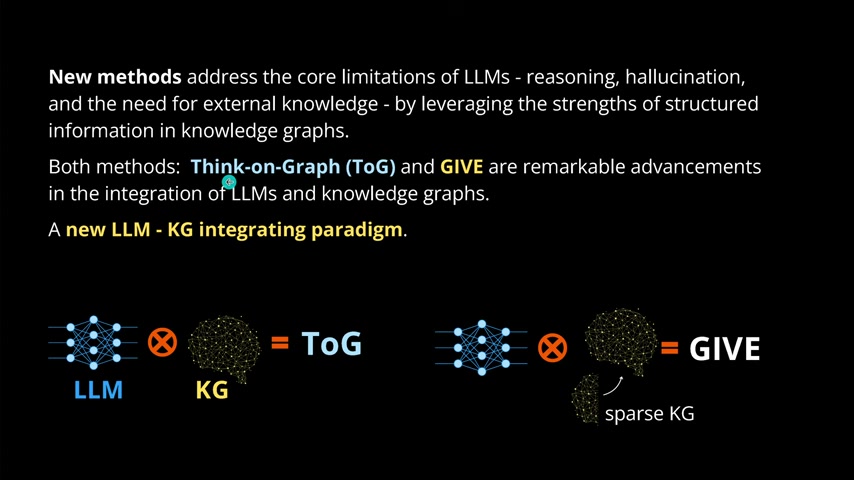
ToG goes beyond simple knowledge retrieval, allowing the LLM to "think" its way through the KG, exploring different reasoning paths like a detective gathering clues.
ToG couples the LLM with a KG using a Beam search algorithm. This allows the LLM to explore multiple possible reasoning paths at once and choose the most promising ones to follow. The LLM can then identify Canberra as a city, find its relation to Australia, and then Trace additional connections about the political system of the country if needed. This dynamic decision-making process enables more intelligent and reliable reasoning.
Think-on-Graph supports multi-hop reasoning, meaning that the model can connect multiple entities and relations across different steps to solve more complex queries. This capability is crucial for tasks requiring deep and responsible reasoning, such as understanding cause-and-effect relationships or drawing inferences from multiple sources.
GIVE: Graph-Inspired Veracity Extrapolation
Addressing Sparse Knowledge Graphs
While ToG excels in scenarios with well-structured Knowledge Graphs, GIVE (Graph-Inspired Veracity Extrapolation) addresses a different challenge: how to reason when the KG is sparse or incomplete. In real-world scenarios, Knowledge Graphs are often incomplete or lack specific information needed to answer certain queries. GIVE tackles this problem by extrapolating new relationships based on the LLM’s internal knowledge and Patterns in the data.
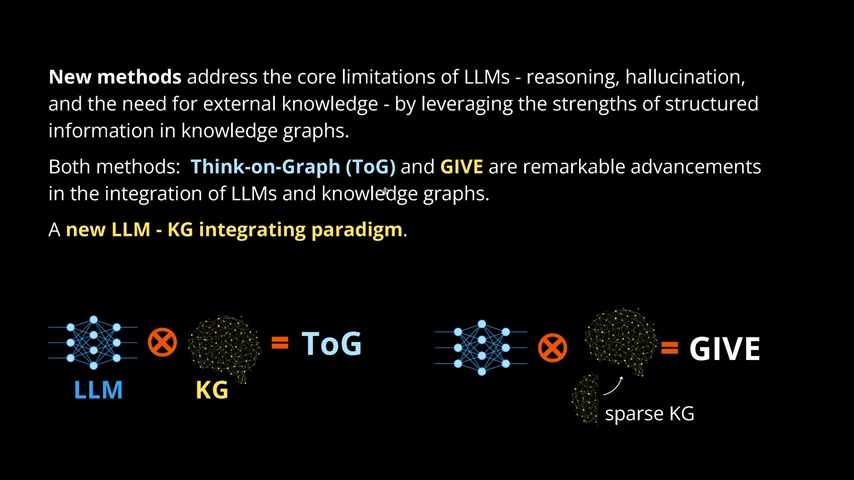
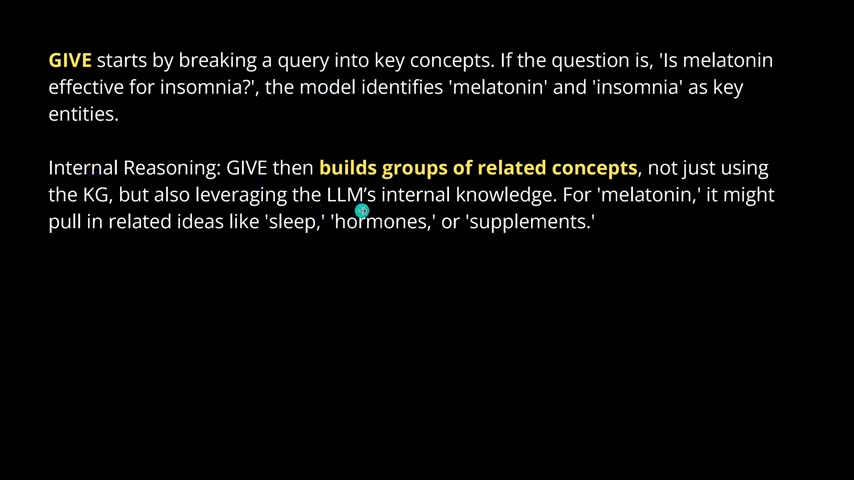
GIVE leverages the parametric knowledge of the LLM to fill in the gaps of the sparse KG. It builds an entity group for each query concept and induces inner-group connections using its internal knowledge. Then, it uses cross-group connections to provide evidence and guide LLM reasoning. This methodology allows GIVE to generate more complete and accurate answers, even when the underlying Knowledge Graph is incomplete.
A critical component of GIVE is its use of counterfactual reasoning. By exploring what might not be true, GIVE helps prevent the model from hallucinating or making unsupported claims. This approach ensures the model validates its own assumptions and considers alternative explanations, leading to more reliable outputs.
How ToG and GIVE Connect and Build Upon Each Other
Both Think-on-Graph and GIVE represent remarkable advancements in the integration of LLMs and Knowledge Graphs,
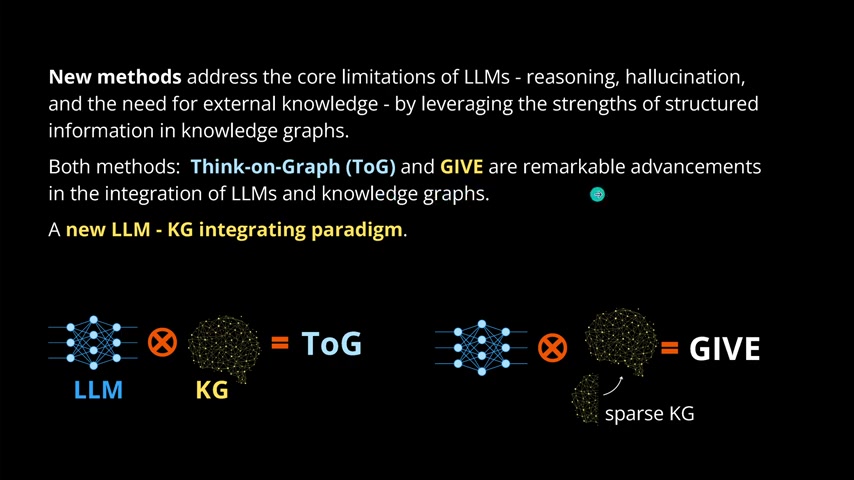
addressing core limitations of LLMs, such as reasoning and hallucination. These are two methods to create a flexible, powerful toolkit for enhancing LLM reasoning, independent of whether the domain is well-defined or still evolving. They both are about taking an LLM and providing it more data, to help the AI return a result that is better than relying on the AI's core knowledge only.
- ToG is ideal when dealing with rich, well-populated Knowledge Graphs, where the goal is to navigate the KG to find the most Relevant reasoning path.
- GIVE, on the other HAND, is particularly powerful when dealing with sparse KGs, like in biomedical research, where relationships between entities aren't fully mapped out.
Core Features of the Integration of LLMs and KG
Key Features and Benefits
The integration of LLMs and Knowledge Graphs offers a range of key features and benefits:
-
Enhanced Reasoning: By leveraging the structured knowledge in KGs, LLMs can perform more complex and accurate reasoning. They are both designed to work with LLM and can reduce hallucinations and improve reasoning, regardless of whether the data and domain is well-defined or not.
-
Improved Accuracy: Access to real-world information through KGs helps LLMs provide more reliable answers, therefore using external knowledge.
-
Specialized Knowledge: Combining LLMs with KGs enables AI systems to excel in specialized domains, offering expertise in areas like medicine, law, and engineering, therefore enhancing the strengths of structured information.
-
Reduced Hallucinations: ToG and GIVE frameworks help reduce hallucinations, a common flaw in LLMs, by grounding their responses in structured knowledge. GIVE employs counterfactual reasoning as an additional layer for models to rely on to be more accurate.






Most people like

































Report
Please select a reason for reporting
- 13 Reasons to Switch from Snapchat to Text Messaging
- 7 Powerful Speech to Text Apps to Boost Productivity
- 10 Best Speech to Text Tools for Effortless Transcription
- 13 Free Tools to Easily Transcribe Audio to Text
- 15 Surprising Ways Google's Speech-to-Text Boosts Productivity
- 7 Best Free Online Audio to Text Transcription Tools
- 9 Tips to Transcribe Speech to Text Faster and Better
- 13 Best Speech to Text Software for Windows 10 in 2023
- 7 Tips for Choosing the Best Transcriber for Audio to Text
- 11 Reasons Why Dragon Speech-to-Text Apps are Game-Changers
- 6 Secrets to Enhance Your Speech to Text Transcription
- 6 Brilliant Ways to Boost Productivity with Talk-to-Text on Your MacBook
- 6 Ways Transcription Software Converts Audio to Text
- 8 Tips to Transcribe Speech to Text Like a Pro
- 6 Reasons IBM Watson Speech to Text is a Game-Changer
- 14 Powerful Ways Talk-to-Text Improves Your Workflow
- 12 Top Windows Speech-to-Text Software for Efficient Transcription
- 12 Game-Changing Benefits of Apple's Speech to Text Technology
- 9 Powerful Use Cases for AWS Speech to Text Technology
- 10 Easy Steps to Transcribe YouTube Videos to Text
- transcription audio en texte
- online audio transcription
- free audio file transcription
- free ai audio transcription
- audio transcription service
- audio transcription online free
- audio transcription free online
- audio to transcription software
- audio and transcript
- ai audio transcription free
- voice recording to text converter
- translate voice recording to text
- record voice to text
- audio recording to text converter
- voice recording and transcription
- chatgpt voice to text
- gmail voice to text
- speech to text reader
- speech to text ai free
- speech to talk
- How to Use AI Tools to Find Internal Linking Opportunities Across a Business Website
- Discover Your Perfect Haircut with AI Hairstyle Apps
- Free Reputation Calculator Tools: How They're Adapting to Score AI Visibility, Not Just Rankings
- Design Professional Flyers for Free on Your Phone
- Best Free Flyer Maker Apps for Android: Design Like a Pro
- How to Know If Your Business Is Ready for an AI Customer Service Agent
- Revolutionizing Storytelling: From Novels to Screenplays with AI
- Create Engaging Animated Explainer Videos with a Free AI Tool
- Stop Multi-Subscribing: Benchmark Top AI Visual Models in One Canvas
- Best Seedance 2.5 API Provider: Every Price on the Market, Checked at Source
- Top AI Social Media Management Tools: Automate Your Content Strategy
- Free AI Text to Video Generator: Create Stunning Videos from Text
- Discover 17 ChatGPT Alternatives: A Comprehensive Comparison
- Character.AI vs. Janitor AI: Which AI Chat Platform Reigns Supreme?
- Top Virtual Assistant Companies in 2026: Reviews, Pricing, and Plans Compared
- Unveiling FaceCheck.ID: Revolutionizing Reverse Image Searches with AI
- 11 Best AI Dialers in 2026: Features, Pricing, Pros and Cons
- How I Direct Consistent AI Clips: A Hands-On Guide to Multi-Model Generation
- A Realistic Review of the Photo Generator Image Tool
- Playwright MCP Server: Automated Web Testing with Agent Mode

Copyright ©2026 toolify