






Table of Contents
- Key Points
- Understanding Input-Output Tables
- Advanced Problem Solving Techniques
- How to Complete Input-Output Tables
- Input-Output Tables: Pros and Cons
- FAQ
- Related Questions



Understanding Input-Output Tables
What are Input-Output Tables?
Input-output tables, sometimes called function tables, display the relationship between an input value and its corresponding output value based on a specific rule. The input is the position of a number, and the output is the value of the number at that position. The relationship is defined by the rule.
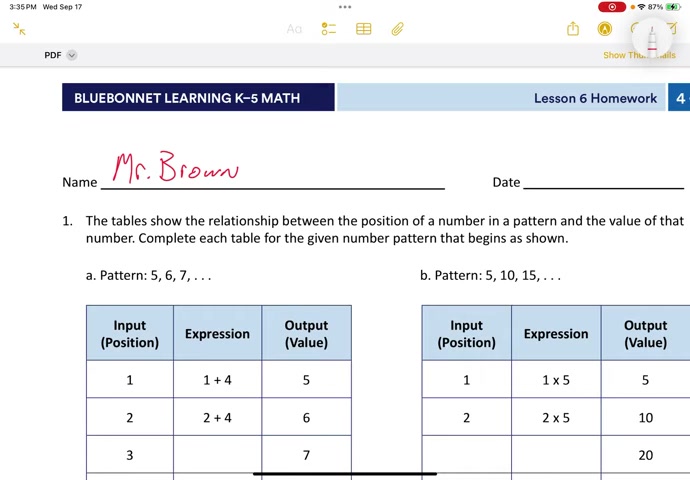
This rule represents a mathematical operation (or series of operations) that transforms the input into the output. Recognizing and understanding the rule is the core of solving problems involving input-output tables. For example, an expression such as ‘1 + 4’ defines a rule in an input-output table, where ‘1’ is the input and the value we get after applying the expression is the output. The ability to identify patterns is essential to be able to work with the rules within input-output tables.
The Importance of Recognizing Patterns
Math is all about patterns!
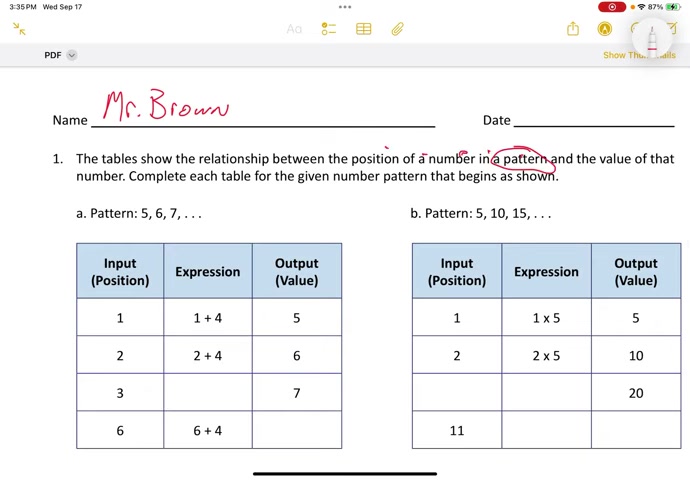
The ability to recognize numerical patterns is crucial for working with input-output tables. Patterns can be simple (e.g., adding a constant value to each successive term) or complex (e.g., involving multiplication, division, or more intricate operations). Identifying the pattern allows one to predict future terms and, therefore, determine the underlying rule that is the mathematical formula. Let’s imagine a basic pattern. Given the starting numbers 5, 6, 7… you can assume a constant addition of 1. This assumption then can be proven using input-output tables and expressions. If the starting numbers were 5, 10, 15, you could assume a constant addition of 5, or a multiplication pattern of 5. Again, using an input-output table, you would want to test your pattern assumption to confirm its accuracy.
Position and Value Relationship
In input-output tables, you will often come across two columns named 'Position' and 'Value'. These are the respective input and output headings that you will need to work with. Understanding the meaning of these terms and how to apply them is essential to working with the rules in the tables, and with input-output tables in general. Another term used to describe position is input. The output can also be referred to as the value. By understanding these synonymous terms, you can ensure the tables are correctly completed.
Advanced Problem Solving Techniques
Working Backwards
Sometimes, you're given the output and need to find the corresponding input. In this case, you need to work 'backwards' or 'opposite' to find the rule,
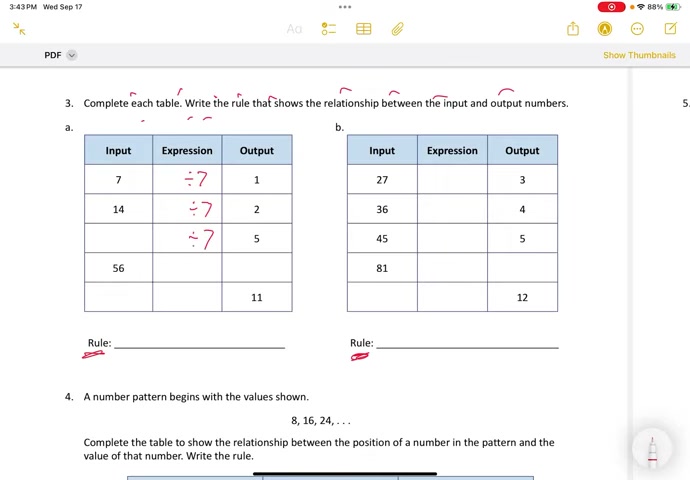
reversing the operations to solve for the unknown input. What was originally a plus sign might need to turn into a minus sign if you have been provided the output, but not the input. It can be tricky when the positions and the values within an expression are not in their appropriate places, and you might need to take the reverse or opposite approach to determining an expression. When going backwards, it's crucial to remember that this reversed operation needs to apply to all values within that input-output table to ensure the pattern can be followed and you can successfully complete the table.
Common Mathematical Operations used in Input-Output Tables
When working on Input-Output Tables, many of the same operations are used throughout. This includes:
- Addition: A constant value is added to each input.
- Subtraction: A constant value is subtracted from each input.
- Multiplication: Each input is multiplied by a constant value to produce the output.
- Division: Each input is divided by a constant value to generate the output.
- More Complex Operations: The order of operations, BEDMAS, must be understood and correctly implemented to complete more difficult tables.





Most people like



































Report
Please select a reason for reporting
- 13 Reasons to Switch from Snapchat to Text Messaging
- 7 Powerful Speech to Text Apps to Boost Productivity
- 10 Best Speech to Text Tools for Effortless Transcription
- 13 Free Tools to Easily Transcribe Audio to Text
- 15 Surprising Ways Google's Speech-to-Text Boosts Productivity
- 7 Best Free Online Audio to Text Transcription Tools
- 9 Tips to Transcribe Speech to Text Faster and Better
- 13 Best Speech to Text Software for Windows 10 in 2023
- 7 Tips for Choosing the Best Transcriber for Audio to Text
- 11 Reasons Why Dragon Speech-to-Text Apps are Game-Changers
- 6 Secrets to Enhance Your Speech to Text Transcription
- 6 Brilliant Ways to Boost Productivity with Talk-to-Text on Your MacBook
- 6 Ways Transcription Software Converts Audio to Text
- 8 Tips to Transcribe Speech to Text Like a Pro
- 6 Reasons IBM Watson Speech to Text is a Game-Changer
- 14 Powerful Ways Talk-to-Text Improves Your Workflow
- 12 Top Windows Speech-to-Text Software for Efficient Transcription
- 12 Game-Changing Benefits of Apple's Speech to Text Technology
- 9 Powerful Use Cases for AWS Speech to Text Technology
- 10 Easy Steps to Transcribe YouTube Videos to Text
- transcription audio en texte
- online audio transcription
- free audio file transcription
- free ai audio transcription
- audio transcription service
- audio transcription online free
- audio transcription free online
- audio to transcription software
- audio and transcript
- ai audio transcription free
- voice recording to text converter
- translate voice recording to text
- record voice to text
- audio recording to text converter
- voice recording and transcription
- chatgpt voice to text
- gmail voice to text
- speech to text reader
- speech to text ai free
- speech to talk
- Meshy AI: How to Create 3D Models from Text and Images
- How SEO and Marketing Dashboards Empower Agencies to Drive Results
- How to Use AI Tools to Find Internal Linking Opportunities Across a Business Website
- Discover Your Perfect Haircut with AI Hairstyle Apps
- Free Reputation Calculator Tools: How They're Adapting to Score AI Visibility, Not Just Rankings
- Design Professional Flyers for Free on Your Phone
- Best Free Flyer Maker Apps for Android: Design Like a Pro
- How to Know If Your Business Is Ready for an AI Customer Service Agent
- Revolutionizing Storytelling: From Novels to Screenplays with AI
- Create Engaging Animated Explainer Videos with a Free AI Tool
- Revideo.io: The Future of Reverse Video Search Technology
- Revolutionize Learning: Discover Quizzes AI for Engaging Interactive Quizzes
- Revolutionizing Email Marketing Agency with AI
- Breaking the Character Drift Dilemma: A Practical Test of Smart Shot
- Meshy AI: How to Create 3D Models from Text and Images
- ASOMobile Helps Teams Benchmark App Store Screenshots Against Competitors
- How to Match LMS Software With Your Organization's Training Plan
- How to Convert BTC to HNT
- Unleashing the Power of AI: Cognizant's Roadmap for Transformation
- Frame to Video Review: A Practical Look at Turning Two Still Frames Into Motion

Copyright ©2026 toolify