































Table of Contents
- Key Points
- Unveiling the Interleaving String Challenge
- Step-by-Step Guide to Implementing the Interleaving String Solution
- Assessing the Merits and Drawbacks
- Frequently Asked Questions
- Exploring Related Questions


Unveiling the Interleaving String Challenge
What is Interleaving String Problem?
The Interleaving String challenge involves determining whether a string, s3, can be formed by interleaving two other strings, s1 and s2
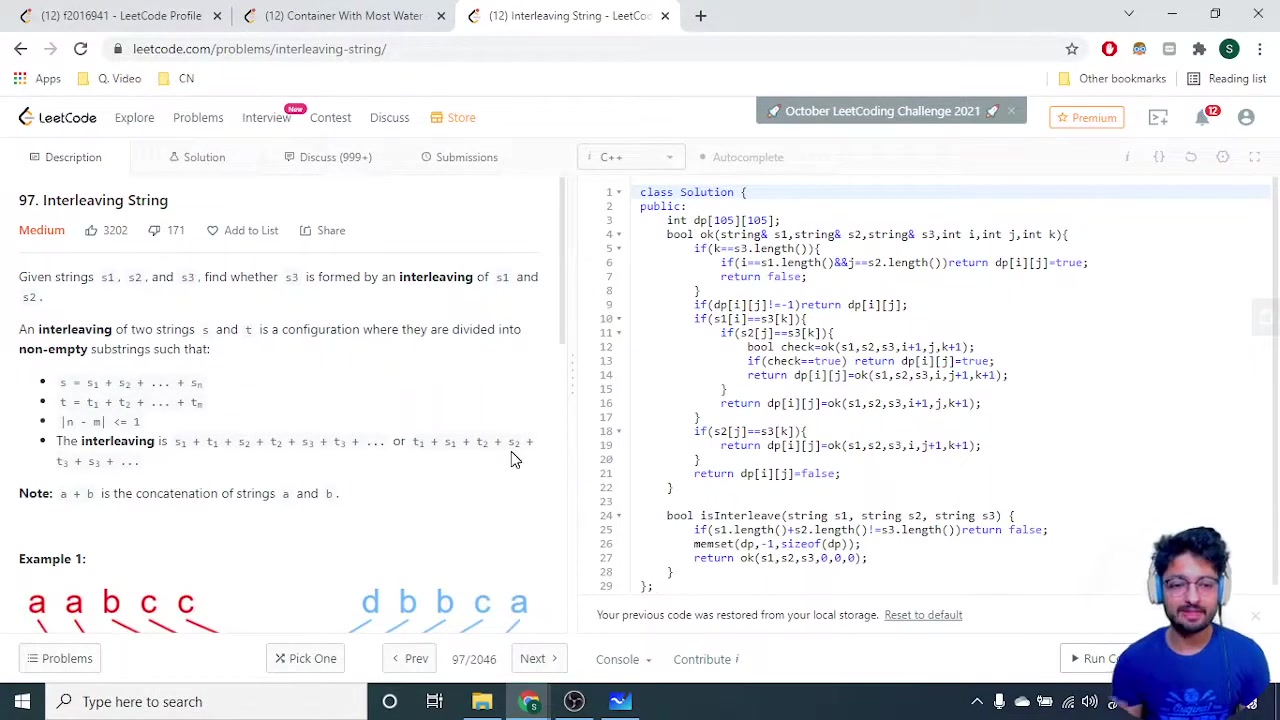
. String interleaving means that s3 is created by merging characters from s1 and s2 in such a way that the relative order of characters from each original string is preserved. This problem commonly appears in coding interviews and highlights a candidate's ability to apply dynamic programming to string-related tasks.
Understanding the Problem's Core: The heart of the problem lies in verifying if every character in 's3' can be traced back to either 's1' or 's2', while upholding the sequential integrity of both source strings.
Core Concepts to Consider:
- Dynamic Programming: The foundation of our approach, enabling us to solve the problem by breaking it down into overlapping subproblems.
- String Manipulation: Essential for extracting and comparing characters across the input strings.
- Prefixes and Substrings: Critical in formulating our dynamic programming states and transitions.
Why This Problem Matters:
- Enhances skills in using dynamic programming for string-based problems.
- Demonstrates algorithmic thinking and optimization techniques.
- Prepares candidates for similar challenges in technical interviews and software development scenarios.
Decoding the Dynamic Programming Approach to Interleaving Strings
Dynamic programming offers a systematic way to tackle the Interleaving String problem by breaking it into smaller, overlapping subproblems. Each subproblem's solution contributes to solving the larger, overall challenge.
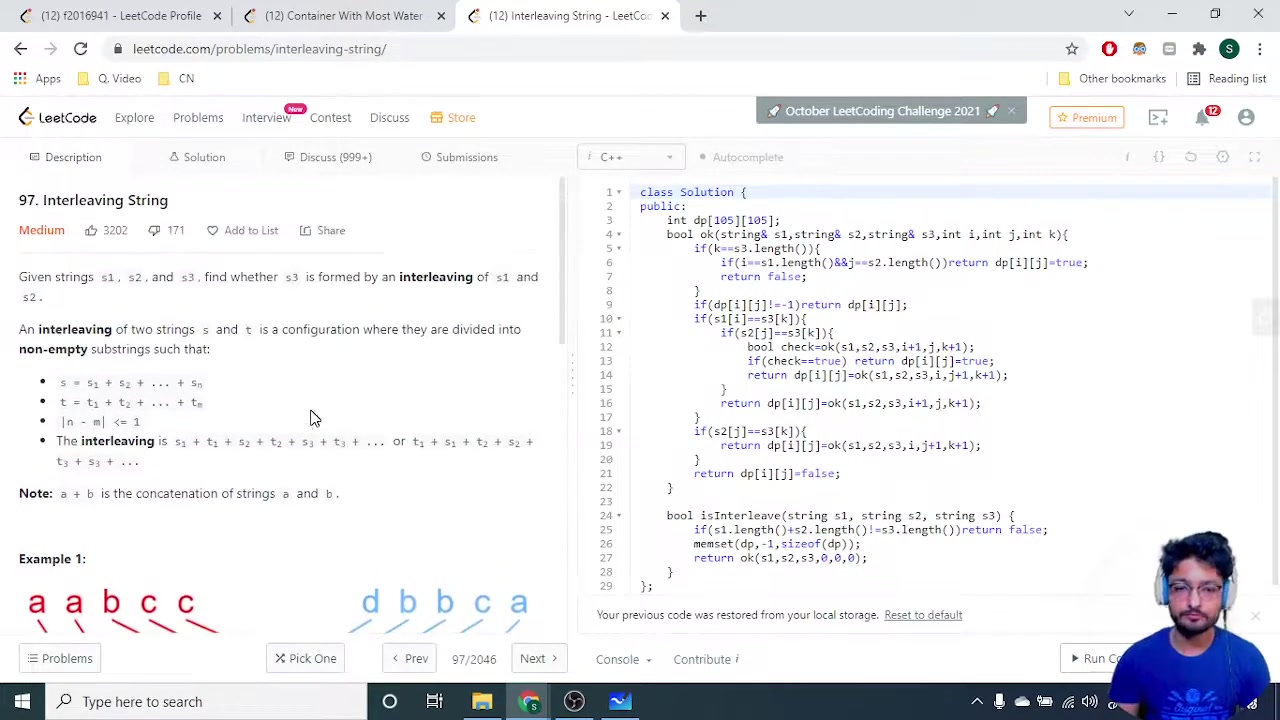
To understand this completely you must use two pointers on the string to fully examine it.
1. Defining the State:
- We establish a 2D boolean array, 'dp', where
dp[i][j]indicates whether the first 'i' characters of 's1' and the first 'j' characters of 's2' can form the first 'i+j' characters of 's3'.
2. Establishing Base Cases:
dp[0][0] = true: An empty 's1' and an empty 's2' can always form an empty 's3'.- For the first row and column,
dp[i][0]anddp[0][j], the value is 'true' only if the prefix of 's1' or 's2' matches the corresponding prefix of 's3'.
3. Formulating the Transitions:
dp[i][j] = trueif either:s1[i-1] == s3[i+j-1]anddp[i-1][j] == trues2[j-1] == s3[i+j-1]anddp[i][j-1] == true
4. Algorithm Implementation:
- Iterate through the 'dp' array, filling it based on the defined transitions.
- The final result,
dp[s1.length()][s2.length()], reveals whether 's3' is an interleave of 's1' and 's2'.
Benefits of Dynamic Programming:
- Avoids redundant calculations, optimizing time complexity.
- Provides a structured, bottom-up approach, ensuring all possibilities are considered.
This strategy, though methodical, transforms a complex problem into a manageable sequence of subproblems, perfectly suited for dynamic programming.
Step-by-Step Guide to Implementing the Interleaving String Solution
Setting Up the Dynamic Programming Table
Begin by initializing a 2D boolean array 'dp' of size (s1.length() + 1) x (s2.length() + 1)
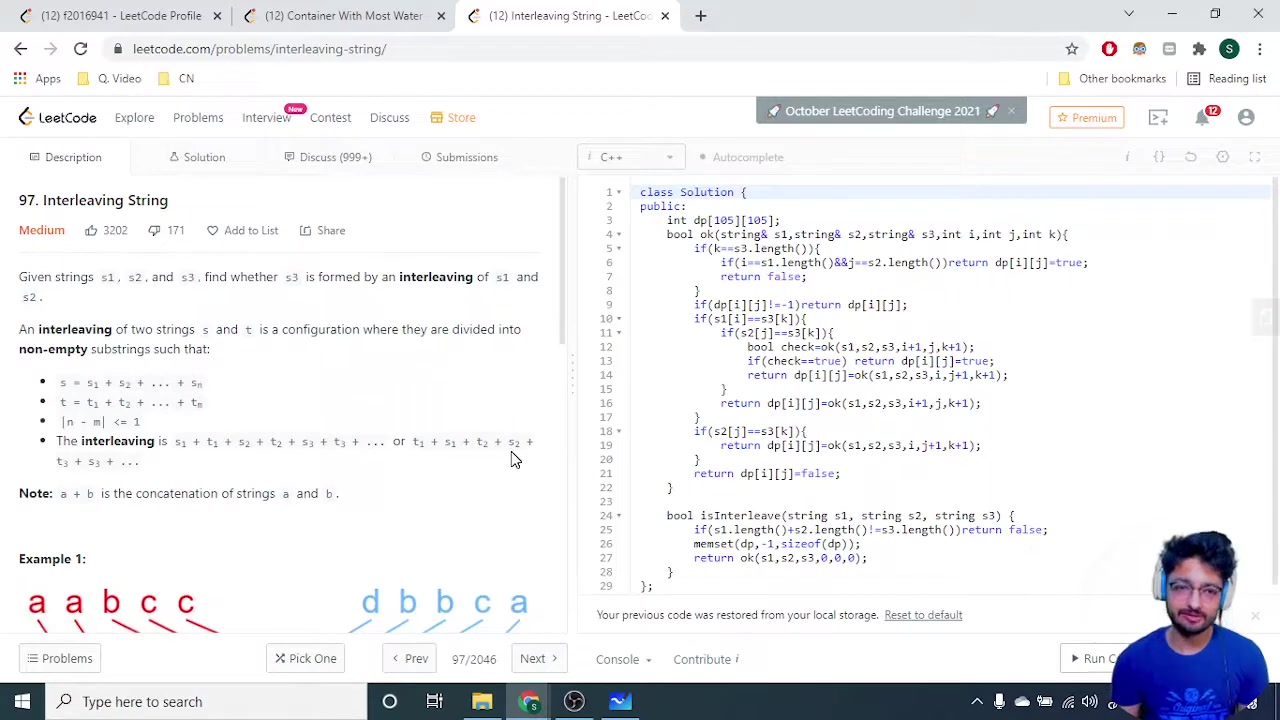
. This table will store the results of our subproblems, indicating whether a substring of 's3' can be formed by interleaving substrings from 's1' and 's2'. Make sure to initialize everything to zero. This way every slot is available.
bool dp[s1.length() + 1][s2.length() + 1];
memset(dp, 0, sizeof(dp));
Handling Base Cases
The base cases are critical. Set dp[0][0] = true
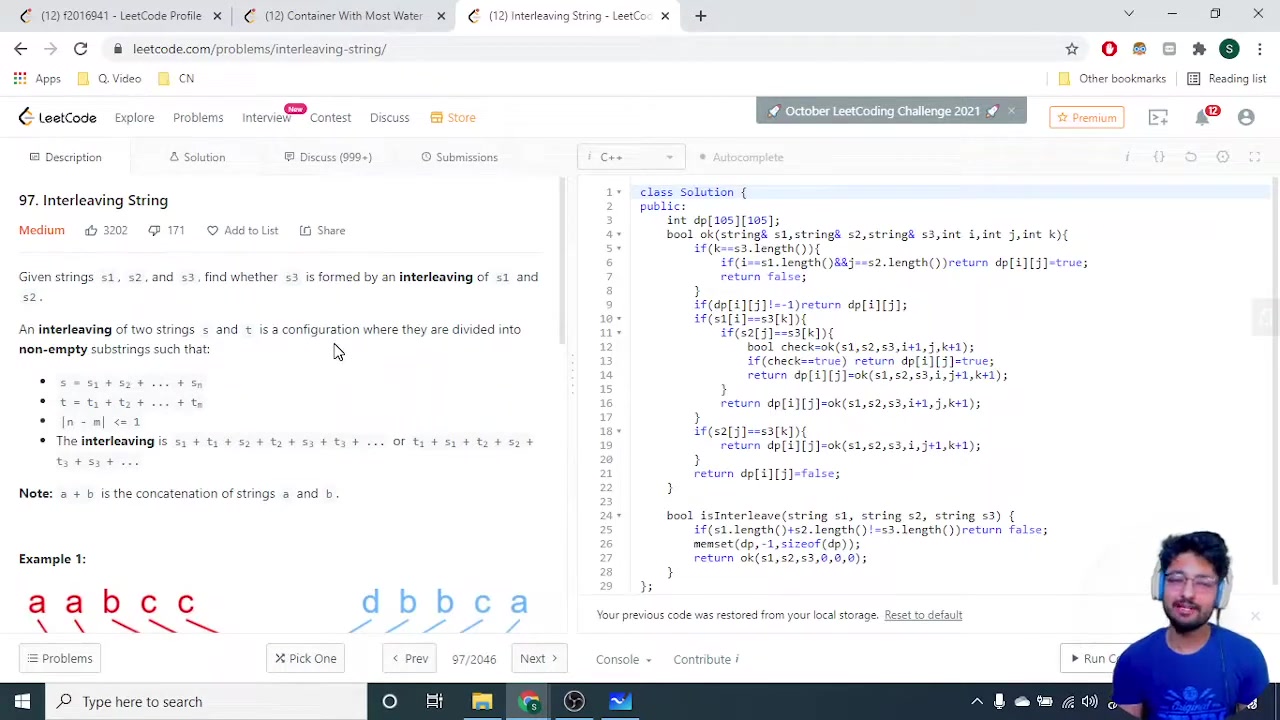
, because two empty strings can form another empty string. The rest are recursively generated by the algorithm.
Iterating and Computing DP Values
Iterate through the dp table using nested loops
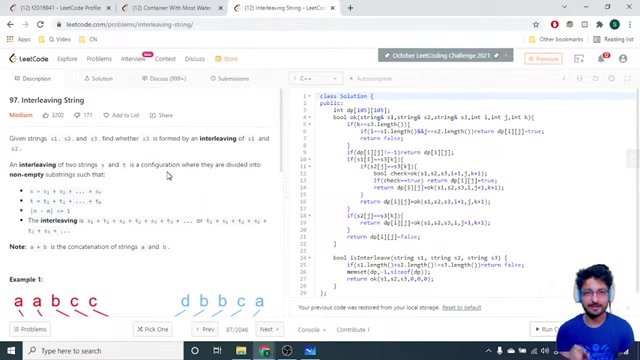
. Fill in each cell based on whether the current characters in 's1' or 's2' match the current character in 's3', and carry forward the 'true' values from the previous states.
The most important thing to check is if all of the if statements are followed through. The recursive function may not fully examine all values so it is essential all tests pass or the program may not work. Keep track of the variable names and follow the program closely.
for (int i = 1; i <= s1.length(); i++) {
    for (int j = 1; j <= s2.length(); j++) {
        if (s1[i - 1] == s3[i + j - 1] && dp[i - 1][j]) {
            dp[i][j] = true;
        }
        if (s2[j - 1] == s3[i + j - 1] && dp[i][j - 1]) {
            dp[i][j] = true;
        }
    }
}





Most people like

































Report
Please select a reason for reporting
- 13 Reasons to Switch from Snapchat to Text Messaging
- 7 Powerful Speech to Text Apps to Boost Productivity
- 10 Best Speech to Text Tools for Effortless Transcription
- 13 Free Tools to Easily Transcribe Audio to Text
- 15 Surprising Ways Google's Speech-to-Text Boosts Productivity
- 7 Best Free Online Audio to Text Transcription Tools
- 9 Tips to Transcribe Speech to Text Faster and Better
- 13 Best Speech to Text Software for Windows 10 in 2023
- 7 Tips for Choosing the Best Transcriber for Audio to Text
- 11 Reasons Why Dragon Speech-to-Text Apps are Game-Changers
- 6 Secrets to Enhance Your Speech to Text Transcription
- 6 Brilliant Ways to Boost Productivity with Talk-to-Text on Your MacBook
- 6 Ways Transcription Software Converts Audio to Text
- 8 Tips to Transcribe Speech to Text Like a Pro
- 6 Reasons IBM Watson Speech to Text is a Game-Changer
- 14 Powerful Ways Talk-to-Text Improves Your Workflow
- 12 Top Windows Speech-to-Text Software for Efficient Transcription
- 12 Game-Changing Benefits of Apple's Speech to Text Technology
- 9 Powerful Use Cases for AWS Speech to Text Technology
- 10 Easy Steps to Transcribe YouTube Videos to Text
- transcription audio en texte
- online audio transcription
- free audio file transcription
- free ai audio transcription
- audio transcription service
- audio transcription online free
- audio transcription free online
- audio to transcription software
- audio and transcript
- ai audio transcription free
- voice recording to text converter
- translate voice recording to text
- record voice to text
- audio recording to text converter
- voice recording and transcription
- chatgpt voice to text
- gmail voice to text
- speech to text reader
- speech to text ai free
- speech to talk
- How to Use AI Tools to Find Internal Linking Opportunities Across a Business Website
- Discover Your Perfect Haircut with AI Hairstyle Apps
- Free Reputation Calculator Tools: How They're Adapting to Score AI Visibility, Not Just Rankings
- Design Professional Flyers for Free on Your Phone
- Best Free Flyer Maker Apps for Android: Design Like a Pro
- How to Know If Your Business Is Ready for an AI Customer Service Agent
- Revolutionizing Storytelling: From Novels to Screenplays with AI
- Create Engaging Animated Explainer Videos with a Free AI Tool
- Stop Multi-Subscribing: Benchmark Top AI Visual Models in One Canvas
- Best Seedance 2.5 API Provider: Every Price on the Market, Checked at Source
- Top AI Social Media Management Tools: Automate Your Content Strategy
- Free AI Text to Video Generator: Create Stunning Videos from Text
- Discover 17 ChatGPT Alternatives: A Comprehensive Comparison
- Character.AI vs. Janitor AI: Which AI Chat Platform Reigns Supreme?
- Top Virtual Assistant Companies in 2026: Reviews, Pricing, and Plans Compared
- Unveiling FaceCheck.ID: Revolutionizing Reverse Image Searches with AI
- 11 Best AI Dialers in 2026: Features, Pricing, Pros and Cons
- How I Direct Consistent AI Clips: A Hands-On Guide to Multi-Model Generation
- A Realistic Review of the Photo Generator Image Tool
- Playwright MCP Server: Automated Web Testing with Agent Mode

Copyright ©2026 toolify