































Table of Contents
- Key Points
- Functional Skills Mathematics Level 2: Sample Questions and Solutions
- Extra Sample Questions
- Top Strategies for Level 2 Success
- Calculator Restrictions: The Pros and Cons of Non-Calculator Math
- FAQ
- Related Questions



Functional Skills Mathematics Level 2: Sample Questions and Solutions
Converting Fractions to Percentages: Question 1
The first question involves converting a fraction to a percentage. Specifically, the task is to express 2/3 as a percentage, rounded to two decimal places. This tests the fundamental understanding of the relationship between fractions and percentages. The key is to recognize that a fraction represents a division. Therefore, 2/3 means 2 divided by 3.
To solve this without a calculator, perform the division: 2 ÷ 3. The result is a recurring decimal: 0.6666...
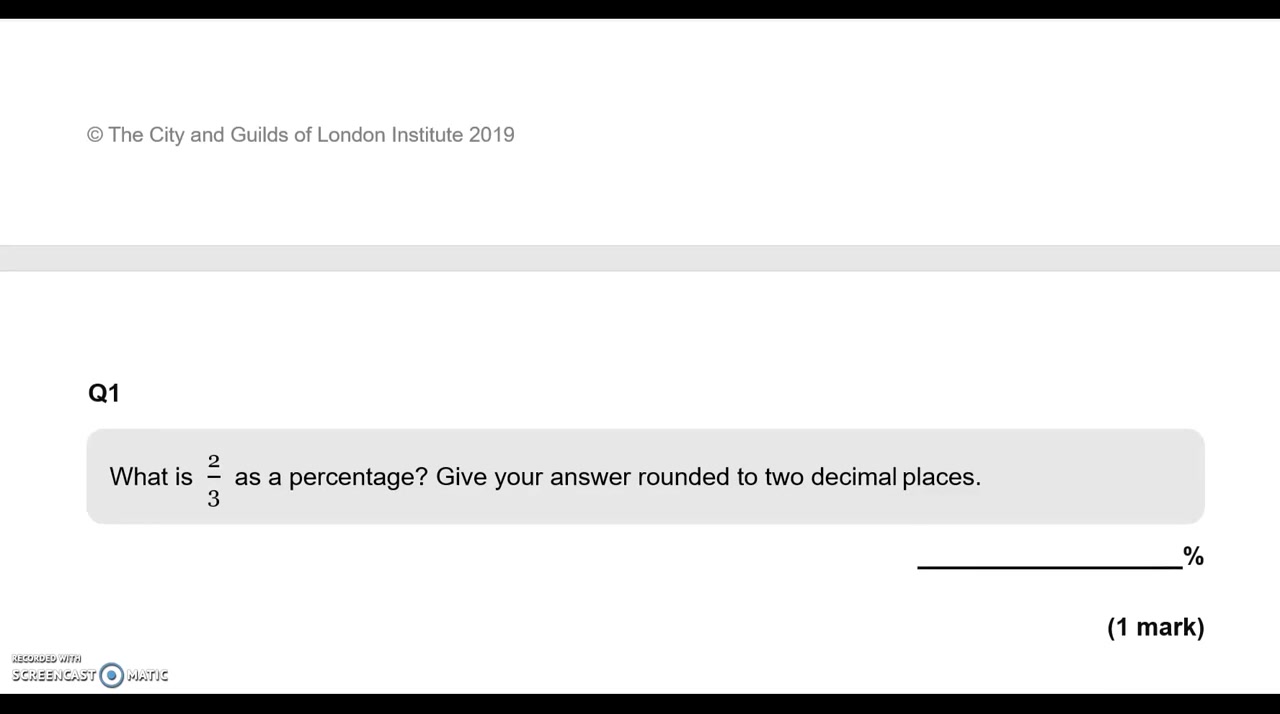
To convert this decimal to a percentage, multiply by 100, which shifts the decimal point two places to the right: 66.666...%. Now, round to two decimal places, resulting in 66.67%. Therefore, 2/3 as a percentage, rounded to two decimal places, is 66.67%.
This problem highlights the importance of understanding decimal representations of fractions and the ability to convert between decimals and percentages. These are essential skills for everyday calculations and critical for achieving success in Level 2 Functional Skills Mathematics.
Calculating Percentages: Question 2
The second question deals with calculating a percentage of a given amount. Here, you need to find 14% of 200. Since calculators are not allowed in this section, it's crucial to break down the calculation into manageable steps.
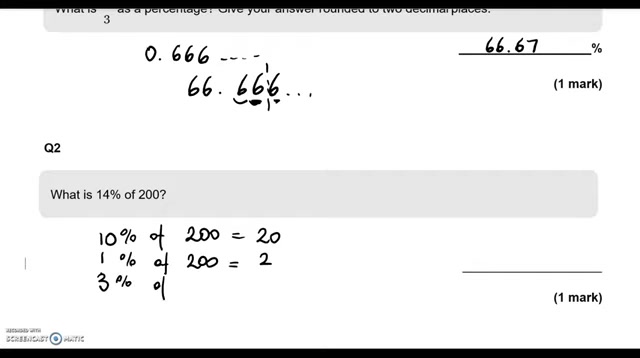
One effective approach is to first find 10% of 200, which is easily calculated by dividing 200 by 10, giving you 20. Then, find 1% of 200, which is 200 divided by 100, resulting in 2. Since 14% is the same as 10% + 1% + 3%, you simply calculate 3% of 200 by taking 3 lots of 1% from 200, which is 6. Add them all up: 20 + 2 + 6 = 28. Therefore, 14% of 200 is 28.
This question emphasizes the ability to decompose percentages and perform calculations mentally, demonstrating a solid understanding of percentage concepts. Mastering these techniques is essential for efficiently solving percentage-related problems in the exam.
Adding Fractions: Question 3
This question tests your ability to add fractions, specifically mixed numbers: 2 1/2 + 3 3/4. The goal is to find the correct answer from multiple choices.
One approach is to add the whole numbers first: 2 + 3 = 5. Then, focus on adding the fractions: 1/2 + 3/4. To add fractions, you need a common denominator. In this case, the lowest common denominator is 4. Convert 1/2 to 2/4, so now you have 2/4 + 3/4 = 5/4. The answer now is five and five quarters, reduce five quarters into a single number which is one and one quarter. Add one to five, which gets 6.
The ability to manipulate and combine fractions effectively is vital for various mathematical applications. This question evaluates your proficiency in handling mixed numbers and finding common denominators for accurate addition.
Simplifying Fractions: Question 4
This question focuses on the skill of simplifying fractions. The task is to express 75 as a fraction of 125 in its simplest form. This means representing 75/125 in a more concise form without changing its value.
To simplify the fraction, identify a common factor of both the numerator and the denominator. Both 75 and 125 are divisible by 5. However, a higher common factor is 25. Dividing both 75 and 125 by 25 yields 3/5. Since 3 and 5 have no common factors other than 1, the fraction 3/5 is the simplest form of 75/125.
Recognizing and extracting common factors is a critical skill for working with fractions. This question demonstrates your aptitude in finding the greatest common divisor and reducing fractions to their most basic, understandable form.
Subtracting Fractions: Question 5
The next question assesses the ability to subtract fractions. The problem presented is 1/2 - 2/7. To subtract these fractions, a common denominator is required. The least common multiple of 2 and 7 is 14. So, we will convert the fractions to new fractions with the denominator of 14
.
1/2 converted with a denominator of 14 is 7/14. 2/7 converted to the same denominator is 4/14. To subtract the fractions we need to take 4/14 away from 7/14, this leaves you with 3/14. Since 3 and 14 have no common factors, the answer is in its simplest form: 3/14.
Subtraction of fractions, much like addition, necessitates finding a common denominator. This question tests your competence in performing fraction subtraction accurately and expressing the result in its simplest form.
Order of Operations: Question 6
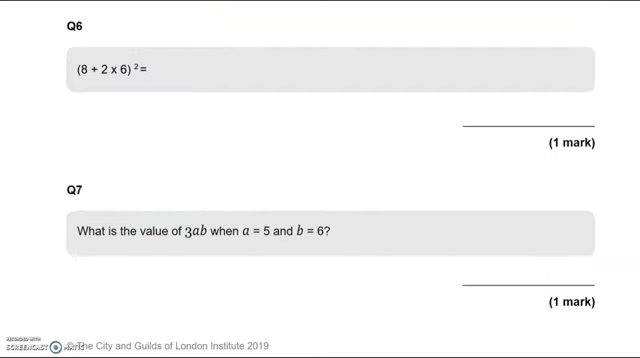
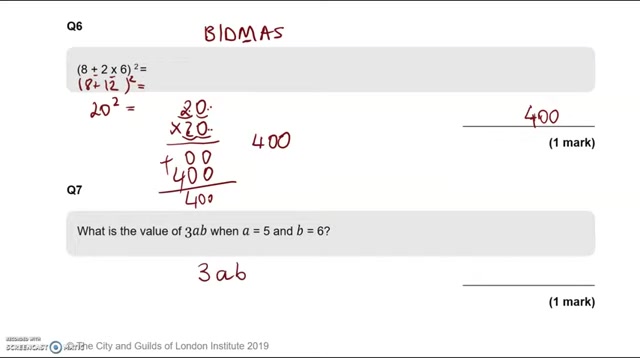
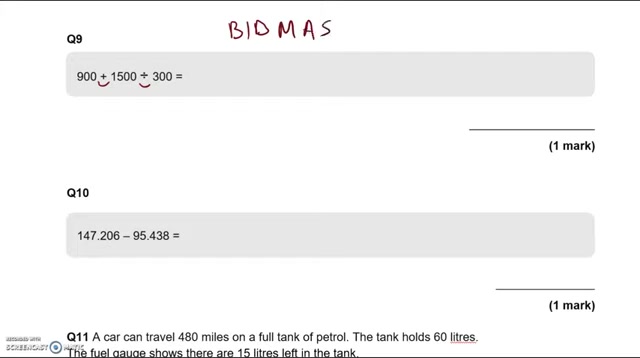
The question (8 + 2 x 6)^2 focuses on the importance of order of operations, often remembered by the acronym BIDMAS (Brackets, Indices, Division/Multiplication, Addition/Subtraction)
. The goal is to evaluate this expression correctly.
Begin by addressing the operations within the brackets. According to BIDMAS, multiplication takes precedence over addition. So, calculate 2 x 6 first, which equals 12. Now, add 8 to 12: 8 + 12 = 20. Finally, square the result: 20^2 = 400. Thus, the final answer is 400.
Adhering to the order of operations is paramount for accurate calculations. This question emphasizes the ability to prioritize operations within brackets, ensuring correct evaluation of mathematical expressions.
Algebraic Substitution: Question 7
This question tests basic algebraic substitution. It presents the expression 3ab, where 'a' is given as 5 and 'b' as 6. Substituting these values, the equation becomes 3 x 5 x 6.
Multiply 3 by 5, which gives 15, then multiply by 6. You can solve this using the column method. 15 x 6 = 90
Algebraic substitution is a fundamental skill in mathematics, and this question assesses your capability to replace variables with given values and perform the necessary arithmetic operations to determine the result.
Angle Calculation in Triangles: Question 8
The task is to calculate the size of angle A in a triangle, where two other angles are given as 30 degrees and 80 degrees. The core principle here is understanding that the sum of angles in a triangle always equals 180 degrees.
Add the two known angles: 30 + 80 = 110 degrees. Subtract that from 180: 180-110, to determine the size of the angle A, which would be 70.
Knowing the properties of geometric shapes and angle relationships is crucial for solving geometric problems. This question focuses on the fundamental knowledge that the angles of a triangle sum up to 180 degrees and tests your ability to apply this fact to find missing angles.
Applying the Order of Operations: Question 9
This question highlights the importance of applying the correct order of operations when solving math problems and the equation is 900 + 1500 / 300
.
The acronym BIDMAS teaches us that you need to address the divisions first, 1500/300 = 5. You are left with 900 + 5 =905.
Following the BIDMAS principles is necessary to get the problem right and is tested within this part of the paper.
Decimal Subtraction: Question 10
The question assesses the knowledge of decimal subtraction with the equation 147.206 - 95.438 = ? There is a need to manually perform the subtraction to answer this question and if done correctly you'll be left with 51.768
Problem Solving: Question 11
The question is an applied problem with the equation A car can travel 480 miles on a full tank of petrol. The tank holds 60 litres. The fuel gauge shows there are 15 litres left in the tank.
How many more miles can the car travel before it runs out of petrol? This is answered using ratio.
The ratio is 60 litres : 480 miles, so 15 litres will be four time smaller than 480. 480/4 = 120
Probability - Question 12
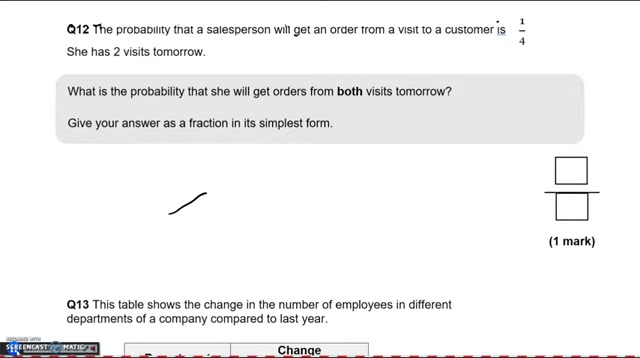
- The probability that a salesperson will get an order from a visit to a customer is ¼. She has 2 visits tomorrow.
What is the probability that she will get orders from both visits tomorrow? Give your answer as a fraction in its simplest form. To get an order for a customer A is ¼, To get an order for customer B is ¼. To get an order for both, will be ¼ * ¼ = 1/16
With the answer being 1/16, see image .
Working with table change data - Question 13
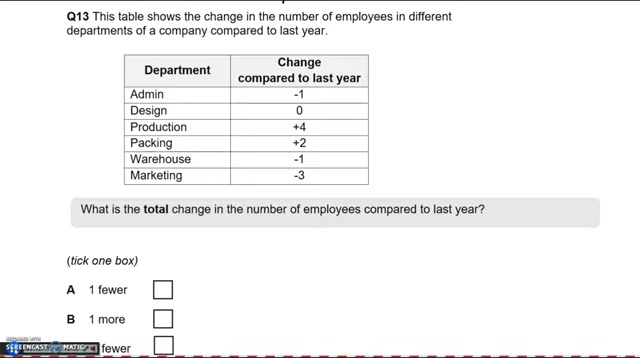
Question 13 looks into testing data analysis skill and table interpretation. The answer can only be found if the table is read to give the numbers required.
This table shows the change in the number of employees in different departments of a company compared to last year.





Most people like











































Report
Please select a reason for reporting
- 13 Reasons to Switch from Snapchat to Text Messaging
- 7 Powerful Speech to Text Apps to Boost Productivity
- 10 Best Speech to Text Tools for Effortless Transcription
- 13 Free Tools to Easily Transcribe Audio to Text
- 15 Surprising Ways Google's Speech-to-Text Boosts Productivity
- 7 Best Free Online Audio to Text Transcription Tools
- 9 Tips to Transcribe Speech to Text Faster and Better
- 13 Best Speech to Text Software for Windows 10 in 2023
- 7 Tips for Choosing the Best Transcriber for Audio to Text
- 11 Reasons Why Dragon Speech-to-Text Apps are Game-Changers
- 6 Secrets to Enhance Your Speech to Text Transcription
- 6 Brilliant Ways to Boost Productivity with Talk-to-Text on Your MacBook
- 6 Ways Transcription Software Converts Audio to Text
- 8 Tips to Transcribe Speech to Text Like a Pro
- 6 Reasons IBM Watson Speech to Text is a Game-Changer
- 14 Powerful Ways Talk-to-Text Improves Your Workflow
- 12 Top Windows Speech-to-Text Software for Efficient Transcription
- 12 Game-Changing Benefits of Apple's Speech to Text Technology
- 9 Powerful Use Cases for AWS Speech to Text Technology
- 10 Easy Steps to Transcribe YouTube Videos to Text
- transcription audio en texte
- online audio transcription
- free audio file transcription
- free ai audio transcription
- audio transcription service
- audio transcription online free
- audio transcription free online
- audio to transcription software
- audio and transcript
- ai audio transcription free
- voice recording to text converter
- translate voice recording to text
- record voice to text
- audio recording to text converter
- voice recording and transcription
- chatgpt voice to text
- gmail voice to text
- speech to text reader
- speech to text ai free
- speech to talk
- Meshy AI: How to Create 3D Models from Text and Images
- How SEO and Marketing Dashboards Empower Agencies to Drive Results
- How to Use AI Tools to Find Internal Linking Opportunities Across a Business Website
- Discover Your Perfect Haircut with AI Hairstyle Apps
- Free Reputation Calculator Tools: How They're Adapting to Score AI Visibility, Not Just Rankings
- Design Professional Flyers for Free on Your Phone
- Best Free Flyer Maker Apps for Android: Design Like a Pro
- How to Know If Your Business Is Ready for an AI Customer Service Agent
- Revolutionizing Storytelling: From Novels to Screenplays with AI
- Create Engaging Animated Explainer Videos with a Free AI Tool
- Meshy AI: How to Create 3D Models from Text and Images
- ASOMobile Helps Teams Benchmark App Store Screenshots Against Competitors
- How to Match LMS Software With Your Organization's Training Plan
- Revolutionizing Email Marketing Agency with AI
- How to Convert BTC to HNT
- Unleashing the Power of AI: Cognizant's Roadmap for Transformation
- Frame to Video Review: A Practical Look at Turning Two Still Frames Into Motion
- NVIDIA NIM: Revolutionizing Supply Chain Data Analysis with AI
- Top AI Tools That Help Brands Stand Out Offline (Not Just Online)
- Top 5 Cold Email Software: Maximize Your Outreach in 2025

Copyright ©2026 toolify