































Table of Contents
- Key Points
- Decoding the 'Luntik and Subsequences' Challenge
- Deep Dive into Ones, Zeros and Powers of Two
- Steps to solve it yourself!
- Weighing the Solution: Pros and Cons
- FAQ
- Related Questions



Decoding the 'Luntik and Subsequences' Challenge
What is 'Luntik and Subsequences'?
The 'Luntik and Subsequences' problem, featured in Codeforces Round #750, presents a unique challenge involving arrays and subsequences.
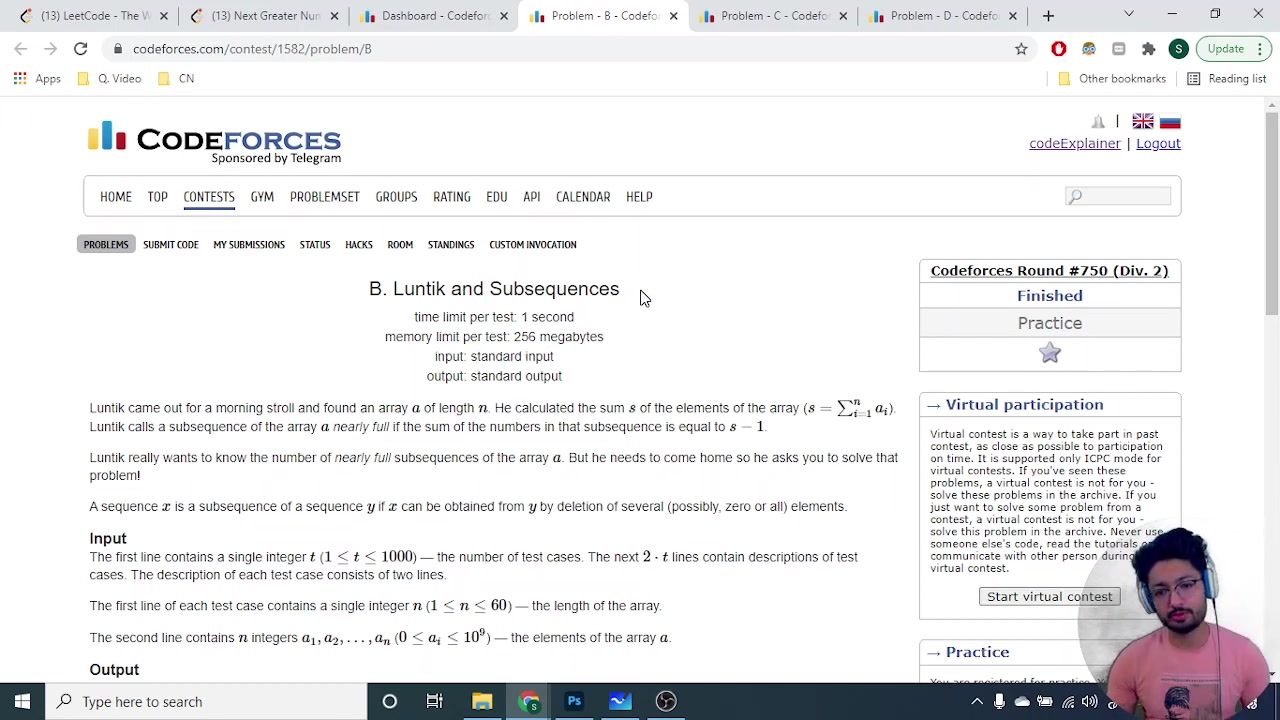
Luntik discovers an array a of length n, calculates the sum (s) of its elements, and defines a 'nearly full' subsequence as one where the sum of its elements equals s - 1. The goal is to determine the number of such nearly full subsequences. This problem blends mathematical insight with algorithmic thinking. Key constraints include the array's length (n ≤ 60) and the elements’ values (0 ≤ ai ≤ 10^9), requiring an efficient and clever solution. Understanding the problem's nuances is the first step toward crafting a successful strategy.
The core challenge lies in efficiently counting the subsequences that meet the 'nearly full' criterion without resorting to brute-force methods, which would be computationally prohibitive given the input size. We need to find ways to significantly reduce processing time.
The definition of a subsequence is crucial here: it is a sequence derived from the original array by deleting some (possibly none) of the elements without changing the order of the remaining elements. For instance, from the array [1, 2, 3, 4, 5], [1, 3, 5] is a valid subsequence, but [5, 3, 1] is not, as it violates the original order. Grasping this subtle difference is vital for correctly identifying and counting valid subsequences. The difficulty of this Codeforces problem is often underrated; it requires a solid foundation in discrete mathematics and efficient coding practices.
Formulating a Winning Strategy for Luntik and Subsequences
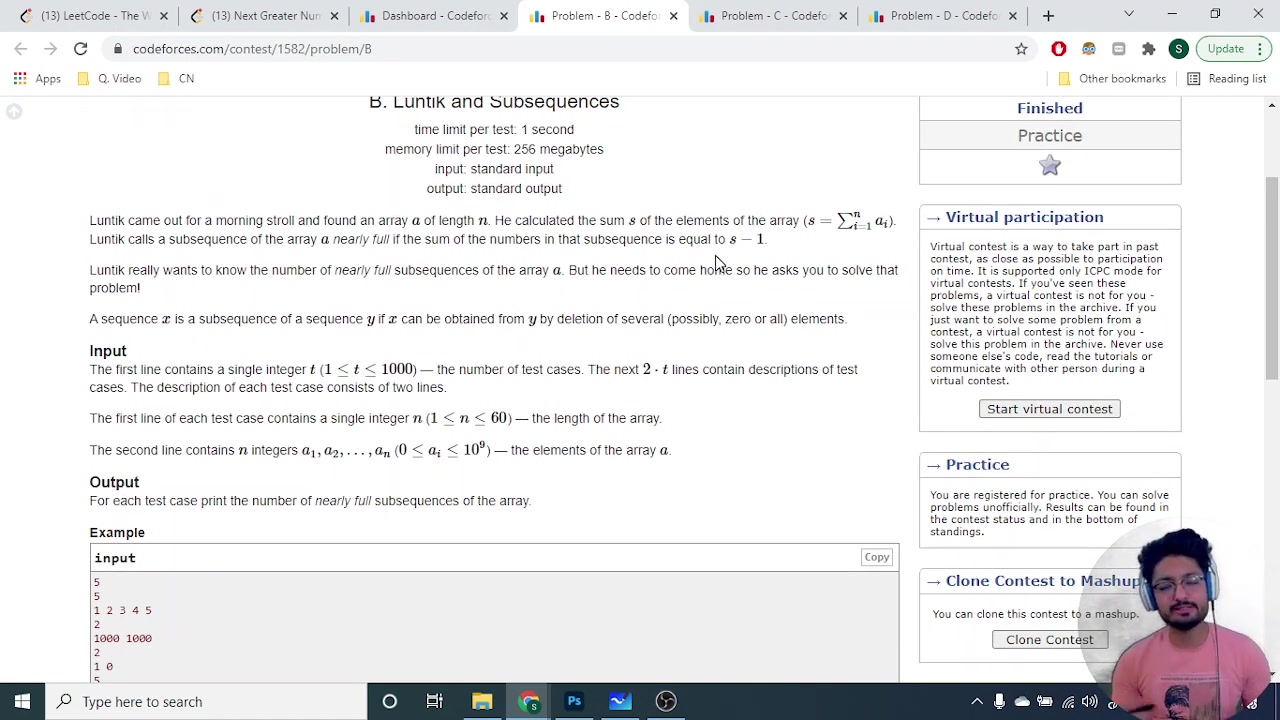
To conquer the 'Luntik and Subsequences' problem, a strategic approach is paramount. Start by calculating the total sum (s) of all elements in the array. Then, realize that a 'nearly full' subsequence is achieved by excluding exactly one element whose value effectively subtracts 1 from the total sum
.
The brilliance lies in identifying the elements that contribute to this near-fullness. Observe that only elements with a value of 1 can be excluded to meet the s - 1 condition. Therefore, the problem essentially boils down to counting the number of elements with a value of 1 in the array. After you have identified the elements with 1 and zero. The approach becomes:
Count the number of 1s and zeros within the array. Let’s call the count of ones one and the count of zeros zero.
The next step is realizing, that by the rules of the problem we need to calculate the number of sub sequences that have a sum of s-1
Then the number of the sub sequences, is simply:
one*(2^zero).
This can be translated to left shift operation on the ones variable. You can find it in the code section.
Deep Dive into Ones, Zeros and Powers of Two
The Critical Role of Ones in Subsequence Sums
Focus on the '1's in the given array, as removing a '1' reduces the total sum (s) by 1, thus potentially forming a 'nearly full' subsequence. This understanding is crucial, as it dramatically simplifies the solution. To find the count of ones and zeros:
int zero = 0, one = 0;
for (int i = 0; i < n; i++) {
 cin >> a[i];
 if (a[i] == 0) zero++;
 else if (a[i] == 1) one++;
}
Maximizing Subsequence Count with Zeros
The presence of zeros significantly impacts the final count. Zeros can either be included or excluded from a subsequence without altering its sum. Therefore, each zero contributes a factor of 2 to the total number of 'nearly full' subsequences. For each '1' you remove, you have 2^zero possible subsequences (where 'zero' is the number of zeros in the original array).
Calculating Nearly Full Subsequences
After determining the counts of ones and zeros, calculate the number of 'nearly full' subsequences. This can be achieved by multiplying the number of ones by 2 raised to the power of the number of zeros. Efficiently calculate the power of 2 using bitwise left shift operations:
long long ans = one * (1LL << zero);
cout << ans << "
";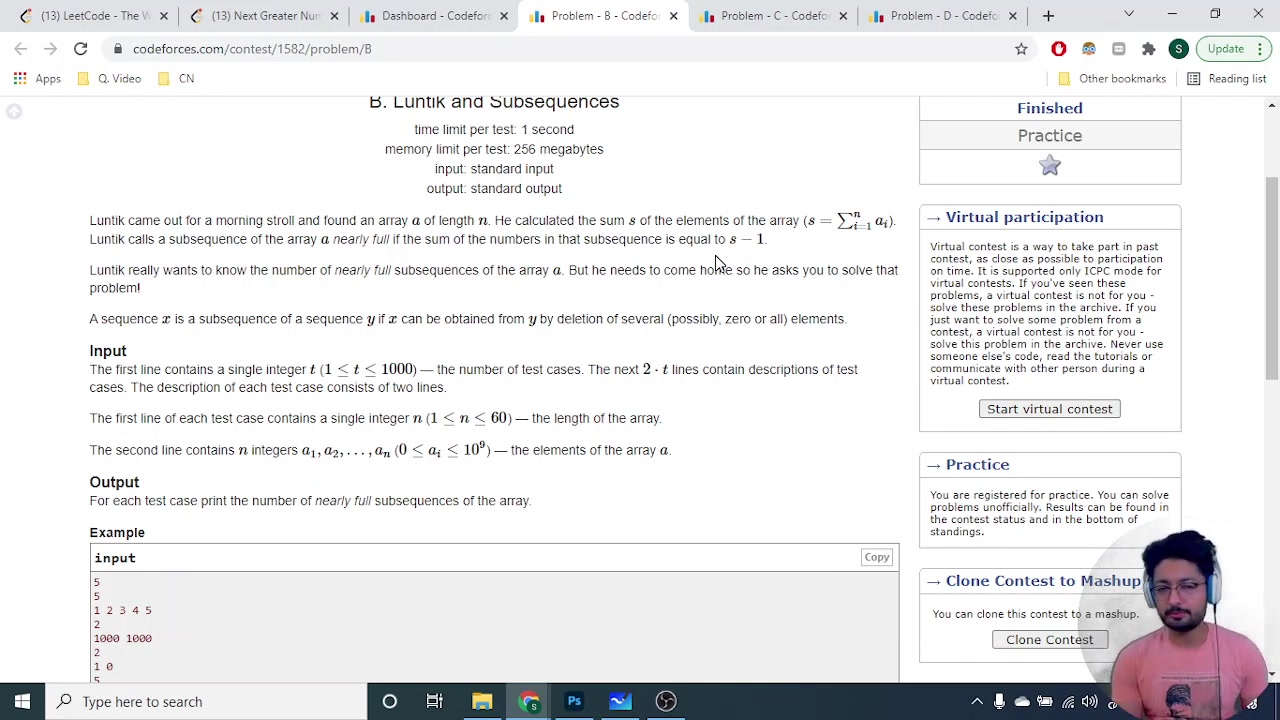
This calculation provides the answer in O(1) time, contributing to an overall efficient solution. In other words, shift the number one left by zero. And then multiple the result of that to one.








Most people like


































Report
Please select a reason for reporting
- 13 Reasons to Switch from Snapchat to Text Messaging
- 7 Powerful Speech to Text Apps to Boost Productivity
- 10 Best Speech to Text Tools for Effortless Transcription
- 13 Free Tools to Easily Transcribe Audio to Text
- 15 Surprising Ways Google's Speech-to-Text Boosts Productivity
- 7 Best Free Online Audio to Text Transcription Tools
- 9 Tips to Transcribe Speech to Text Faster and Better
- 13 Best Speech to Text Software for Windows 10 in 2023
- 7 Tips for Choosing the Best Transcriber for Audio to Text
- 11 Reasons Why Dragon Speech-to-Text Apps are Game-Changers
- 6 Secrets to Enhance Your Speech to Text Transcription
- 6 Brilliant Ways to Boost Productivity with Talk-to-Text on Your MacBook
- 6 Ways Transcription Software Converts Audio to Text
- 8 Tips to Transcribe Speech to Text Like a Pro
- 6 Reasons IBM Watson Speech to Text is a Game-Changer
- 14 Powerful Ways Talk-to-Text Improves Your Workflow
- 12 Top Windows Speech-to-Text Software for Efficient Transcription
- 12 Game-Changing Benefits of Apple's Speech to Text Technology
- 9 Powerful Use Cases for AWS Speech to Text Technology
- 10 Easy Steps to Transcribe YouTube Videos to Text
- transcription audio en texte
- online audio transcription
- free audio file transcription
- free ai audio transcription
- audio transcription service
- audio transcription online free
- audio transcription free online
- audio to transcription software
- audio and transcript
- ai audio transcription free
- voice recording to text converter
- translate voice recording to text
- record voice to text
- audio recording to text converter
- voice recording and transcription
- chatgpt voice to text
- gmail voice to text
- speech to text reader
- speech to text ai free
- speech to talk
- How SEO and Marketing Dashboards Empower Agencies to Drive Results
- How to Use AI Tools to Find Internal Linking Opportunities Across a Business Website
- Discover Your Perfect Haircut with AI Hairstyle Apps
- Free Reputation Calculator Tools: How They're Adapting to Score AI Visibility, Not Just Rankings
- Design Professional Flyers for Free on Your Phone
- Best Free Flyer Maker Apps for Android: Design Like a Pro
- How to Know If Your Business Is Ready for an AI Customer Service Agent
- Revolutionizing Storytelling: From Novels to Screenplays with AI
- Create Engaging Animated Explainer Videos with a Free AI Tool
- Stop Multi-Subscribing: Benchmark Top AI Visual Models in One Canvas
- My Brand New Logo: AI-Powered Logo Design for Startups
- Create Stunning Logos with Free AI Logo Generator!
- AI Logo Maker: Design a Stunning Logo in Minutes
- Elevate Your Zoom Experience with Enhanced Name Tags by Warmly
- Top 5 AI Logo Makers in 2025: Design a Stunning Brand
- Creative Fabrica's AI Tools: Flow, Studio, and Font Generator
- Create Stunning Logos with Canva's Free AI Logo Generator
- Create Professional and Memorable Logos with LogoMaker.ai
- Design Your Own Font: A Step-by-Step Guide with Vectornator Pro
- AI Font Generator: Revolutionizing Typeface Design with AI

Copyright ©2026 toolify