






















Mastering Text Classification with PyTorch: A Comprehensive Guide

Updated on Oct 18,2025

Table of Contents

Text classification is a fundamental task in natural language processing (NLP) with applications ranging from spam detection to sentiment analysis. This comprehensive guide provides a practical walkthrough of building a text classifier using PyTorch, a popular deep learning framework. We'll explore essential NLP techniques and data preprocessing steps to transform text into a format suitable for machine learning models. This article focus on bag-of-words model and TF-IDF models.

Key Points

Understanding the necessity of converting text data to a numeric format for machine learning.

Exploring the Bag-of-Words (BoW) model for text representation.

Leveraging Term Frequency-Inverse Document Frequency (TF-IDF) to weigh word importance.

Using NLTK for text preprocessing tasks like stop word removal and stemming.

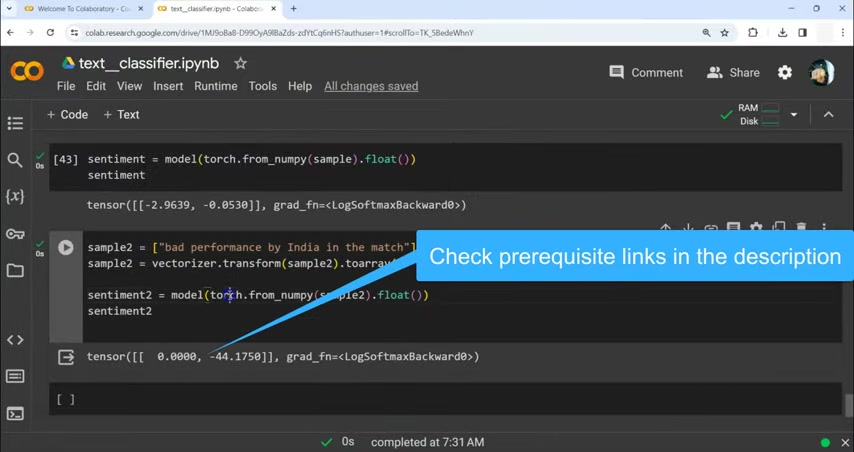
Building a PyTorch neural network for text classification.

Introduction to Text Classification and NLP

Why Text Classification Matters

Text classification is the process of assigning predefined categories to text documents. In an age where textual data is abundant, this technology helps to automate tasks such as:

  • Sentiment analysis: Determining the emotional tone (positive, negative, neutral) of text, which is useful for understanding customer feedback and brand perception.
  • Topic categorization: Organizing news articles, research Papers, or customer support tickets into relevant topics for efficient information retrieval.

  • Spam detection: Identifying and filtering out unwanted email or social media content to improve user experience.

  • Language detection: Automatically identifying the language of a given text, enabling multilingual content processing.

These are just a few examples, and the applications of text classification continue to expand across various industries.

The Role of Natural Language Processing (NLP)

NLP is a field of computer science and artificial intelligence concerned with enabling computers to understand and process human language. Because machine learning models require numeric data
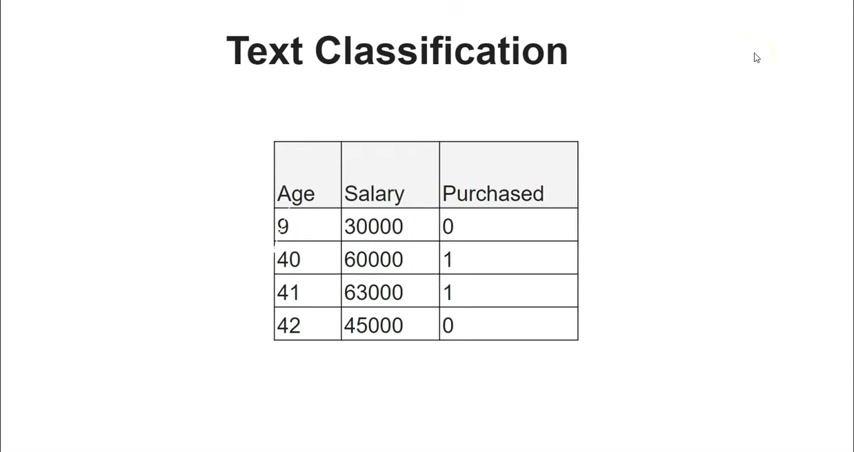
, NLP techniques are essential for transforming text into a format that these models can understand. NLP provides tools for tasks like:

  • Tokenization: Breaking down text into individual words or phrases (tokens).
  • Stemming and Lemmatization: Reducing words to their root form to minimize variations and improve accuracy.
  • Stop WORD removal: Eliminating common words like 'the', 'a', 'is' that don't carry much meaning for classification purposes.
  • Feature extraction: Converting text into numerical features that capture the essence of the text's meaning.

By combining NLP techniques with machine learning algorithms, we can build robust and accurate text classifiers.

Advanced NLP Techniques for Text Classification

Word Embeddings (Word2Vec, GloVe, FastText)

Word embeddings are a powerful technique that represents words as dense vectors in a high-dimensional space. Unlike BoW and TF-IDF, word embeddings capture semantic relationships between words, allowing the model to understand context and nuances in the text.

  • Word2Vec: Learns word embeddings by predicting neighboring words in a sentence.
  • GloVe: Combines global matrix factorization with local context window methods to learn word embeddings.
  • FastText: Extends Word2Vec by considering character n-grams, making it effective for handling rare words and morphological variations.

These embeddings can be used as input to deep learning models like CNNs or RNNs for text classification.

Recurrent Neural Networks (RNNs) and LSTMs

RNNs are designed to process sequential data, making them well-suited for text classification tasks where word order matters. However, basic RNNs suffer from the vanishing gradient problem, which limits their ability to capture long-range dependencies.

Long Short-Term Memory (LSTM) networks are a type of RNN that addresses this issue by incorporating memory cells that can store information over extended periods. LSTMs can effectively learn and use contextual information, leading to improved performance in text classification tasks. LSTMs has more accurate performance compared to RNNs model.

Transformers and BERT

Transformer-based models, such as BERT (Bidirectional Encoder Representations from Transformers), have revolutionized NLP by leveraging attention mechanisms to capture complex relationships between words in a sentence. BERT is pretrained on a large corpus of text and can be finetuned for specific tasks like text classification.

Transformers and BERT are able to learn contextual embeddings and have significantly outperformed previous models in various NLP benchmarks.

FAQ

What is text classification?
Text classification is the process of categorizing text documents into predefined groups or classes based on their content. It's used for sentiment analysis, spam detection, topic categorization, and more.
Why is text data preprocessed before training a machine learning model?
Machine learning models require numeric data to function effectively. Text data is often messy and needs cleaning to remove noise and reduce dimensionality. Preprocessing steps like stop word removal, stemming, and converting to lowercase improve model accuracy and efficiency.

What are stop words?
Stop words are commonly used words (e.g., 'the', 'a', 'is') that are often removed during text preprocessing because they don't carry much semantic meaning and can add noise to the data.
What is stemming?
Stemming is the process of reducing words to their root form. For example, stemming might convert 'running' and 'ran' to 'run'. It helps reduce the number of unique words and groups related words together.
How does TF-IDF improve upon the Bag-of-Words model?
TF-IDF (Term Frequency-Inverse Document Frequency) weighs words based on their importance in a document and across the entire corpus. This allows the model to prioritize words that are more unique and informative, unlike the Bag-of-Words model, which treats all words equally.

Related Questions

What are the advantages and disadvantages of using a Bag-of-Words model for text classification?
The Bag-of-Words (BoW) model is a fundamental technique in natural language processing (NLP) used for text representation. It involves converting text data into a numerical format that machine learning models can understand. Despite its simplicity and ease of implementation, the BoW model has certain advantages and disadvantages. Understanding these can help determine when and where to use this model effectively. Advantages of the Bag-of-Words Model Simplicity and Ease of Implementation: The BoW model is conceptually straightforward and easy to implement . This makes it accessible for beginners in NLP and machine learning. Its simplicity allows for quick prototyping and experimentation without the need for complex algorithms or extensive preprocessing steps. Computational Efficiency: BoW models are computationally efficient, especially when dealing with small to medium-sized datasets. The process of tokenizing and counting word frequencies is relatively fast, making it suitable for applications where speed is a priority. However, this efficiency can diminish with very large vocabularies. Baseline Performance: BoW models can provide a reasonable baseline performance for text classification tasks. They often serve as a good starting point for more complex models, allowing for incremental improvements by incorporating more advanced techniques. Versatility: The BoW model can be applied to various types of text data and classification tasks. Whether it's sentiment analysis, topic categorization, or spam detection, the BoW model can be adapted to fit different scenarios. Interpretability: The features generated by BoW models (i.e., word counts) are highly interpretable. It is easy to understand which words contribute most to a particular classification decision, aiding in model transparency and debugging. Disadvantages of the Bag-of-Words Model Ignores Word Order: The BoW model disregards the order in which words appear in a sentence. This can be a significant limitation because word order often carries crucial information about the meaning of the text. For example, the phrases 'This restaurant is not good' and 'This restaurant is good' would be treated the same, despite having opposite meanings. Loss of Semantic Meaning: Similar to ignoring word order, the BoW model also fails to capture the semantic meaning and context of words. It treats each word as an independent entity, without considering its relationship to other words in the sentence. Treats All Words Equally: In its basic form, the BoW model treats all words as equally important. This can lead to issues when common words (like 'the', 'a', 'is') dominate the feature set, overshadowing more meaningful terms. This issue can be somewhat mitigated using techniques like TF-IDF, which adjusts word frequencies based on their importance. Vocabulary Size: The vocabulary size can become very large, especially with extensive corpora. This leads to high-dimensional feature vectors, which can increase computational complexity and memory usage. Techniques like feature selection and dimensionality reduction may be necessary to manage the vocabulary size effectively. Sparse Data: The feature vectors generated by the BoW model are often sparse, meaning that most elements are zero. This is because each document typically contains only a small fraction of the total vocabulary words. Sparse data can pose challenges for certain machine learning algorithms. In summary, the Bag-of-Words model is a valuable tool for text classification due to its simplicity and efficiency. However, its limitations in capturing word order and semantic meaning should be considered. More advanced techniques like TF-IDF, word embeddings, and sequence models often provide better performance, especially for complex NLP tasks.
How do you decide the best parameters for the TF-IDF vectorizer in text classification?
Selecting the optimal parameters for a TF-IDF (Term Frequency-Inverse Document Frequency) vectorizer is a critical step in text classification. The right parameters can significantly improve the performance of your model by capturing the most relevant and informative features from the text data. Here are the key parameters to consider and strategies for optimizing them. Key Parameters in TF-IDF Vectorizer max_features: This parameter limits the vocabulary size by selecting only the top N most frequent terms. Reducing vocabulary size helps manage computational complexity and can prevent overfitting. Optimization: Start with a reasonable value (e.g., 5000) and experiment with different sizes. Use cross-validation to evaluate the impact on model performance. Monitor the trade-off between vocabulary size and classification accuracy. min_df (Minimum Document Frequency): Specifies the minimum number of documents in which a term must appear to be included in the vocabulary. This helps filter out rare words that may not be informative. Optimization: Experiment with values such as 2, 3, or 5. A higher value can help reduce noise, especially in large datasets. max_df (Maximum Document Frequency): Specifies the maximum proportion of documents in which a term can appear. Terms that appear in too many documents are likely to be common words and may not contribute much to classification accuracy. Optimization: Try values such as 0.5, 0.7, or 0.9. Another approach is to use a numeric value representing the maximum number of documents. ngram_range: This parameter defines the range of n-grams (sequences of n words) to be extracted. For example, ngram_range=(1, 2) includes both unigrams (single words) and bigrams (two-word phrases). Optimization: Experiment with different ranges. Start with unigrams and then add bigrams or trigrams if the context and word order are important for your task. Be cautious of increasing vocabulary size significantly. stop_words: Specifies a list of stop words to be excluded from the vocabulary. You can use NLTK's built-in stop word list or provide a custom list. Optimization: Compare model performance with and without stop word removal. Consider creating a custom stop word list based on your domain knowledge. norm: Specifies whether to normalize term vectors. Options include 'l1' (L1 normalization) and 'l2' (L2 normalization). Optimization: Experiment with different normalization schemes. L2 normalization is often a good default, but L1 can be useful when feature importance is desired. use_idf: Determines whether to use inverse document frequency weighting. If set to False, only term frequency is used. Optimization: In most cases, using IDF improves performance, but it's worth testing without IDF to see if it benefits your specific dataset.
What are the key differences between TF-IDF and Word Embeddings (Word2Vec, GloVe, FastText), and when should each be used?
TF-IDF (Term Frequency-Inverse Document Frequency) and word embeddings (Word2Vec, GloVe, FastText) are both techniques used to convert text data into a numerical format suitable for machine learning models. However, they differ significantly in how they represent words and capture semantic information. TF-IDF (Term Frequency-Inverse Document Frequency) Representation: TF-IDF represents documents as vectors where each element corresponds to a term in the vocabulary, and its value is the TF-IDF score for that term in the document. This score reflects the importance of the term in the document relative to its frequency across the entire corpus. Semantic Information: TF-IDF primarily captures the statistical importance of words within and across documents but lacks the ability to capture semantic relationships between words. It treats each word as an independent entity, disregarding word order and context. Dimensionality: TF-IDF typically results in high-dimensional and sparse feature vectors, especially with large vocabularies, because each unique term becomes a dimension. Computation: Calculating TF-IDF scores is computationally efficient, making it suitable for large datasets. However, managing the vocabulary and feature vectors can become challenging with very large corpora. Use Cases: TF-IDF is useful for tasks such as: Document retrieval, Spam detection, Topic modeling Advantages: Simple and easy to implement. Computationally efficient. Provides a baseline performance for text classification tasks. Disadvantages: Ignores word order and semantic meaning. Treats all words as independent entities. Can be less effective with very large vocabularies. Word Embeddings (Word2Vec, GloVe, FastText) Representation: Word embeddings represent words as dense, low-dimensional vectors in a continuous vector space. These vectors are learned from large amounts of text data such that words with similar meanings are located closer together in the vector space. Semantic Information: Word embeddings capture semantic relationships between words, including synonyms, antonyms, and contextual similarities. This allows the model to understand the meaning and nuances of words in a sentence. Dimensionality: Word embeddings have a fixed, relatively low dimensionality (e.g., 100-300 dimensions), regardless of the vocabulary size. This makes them more manageable and computationally efficient than TF-IDF for large vocabularies. Computation: Training word embeddings can be computationally intensive, but pretrained embeddings are often available, reducing the need for training from scratch. Using pretrained embeddings allows models to leverage knowledge learned from massive datasets. Use Cases: Semantic similarity analysis, Text classification (with CNNs or RNNs), Machine translation, Question answering Advantages: Captures semantic relationships between words. Lower dimensionality, making it more computationally efficient. Can be pretrained on large datasets. Disadvantages: Requires more computational resources for training. May not perform well for very specific or domain-dependent tasks if not finetuned. Key Differences: TF-IDF is a term-weighting scheme based on statistical properties, while word embeddings are learned representations that capture semantic relationships. TF-IDF results in sparse, high-dimensional vectors, while word embeddings produce dense, low-dimensional vectors. TF-IDF ignores word order and context, while word embeddings capture contextual information. When to Use Each: TF-IDF: Choose TF-IDF when: You need a simple and quick solution for text classification. Computational resources are limited. The task requires primarily statistical importance of words. Word Embeddings: Choose word embeddings when: Capturing semantic relationships between words is crucial. Word order and context are important for the task. Computational resources are available for training or using pretrained embeddings. Ultimately, the best choice depends on the specific task, dataset size, computational resources, and the importance of capturing semantic relationships.

Most people like