































Table of Contents
- Key Benefits of Optimized C Code Generation
- Understanding the Landscape of tinyML and C Code
- ImagiMob: Revolutionizing tinyML with Optimized C Code Generation
- Navigating ImagiMob Studio for Optimized tinyML Development
- The Advantages and Drawbacks of C Code Generation in tinyML
- Frequently Asked Questions about Optimized C Code Generation for tinyML
- Related Questions


Understanding the Landscape of tinyML and C Code
What is tinyML?
tinyML, or Tiny Machine Learning, represents a paradigm shift in the field of machine learning, bringing the power of AI to resource-constrained embedded systems. Unlike traditional machine learning models that require significant computational power and memory, tinyML focuses on creating highly compact and energy-efficient algorithms that can run on microcontrollers and other low-power devices.
This opens up a wide range of applications, from smart sensors and wearable devices to industrial automation and predictive maintenance. The key to successful tinyML implementation lies in efficient code generation, particularly the use of C code, which is known for its portability, speed, and control over hardware resources. By optimizing C code for tinyML applications, developers can unlock the full potential of these resource-constrained devices, enabling them to perform complex tasks with minimal energy consumption.
The essence of tinyML is to bring machine learning to the edge, empowering devices to make intelligent decisions locally without relying on cloud connectivity. This reduces latency, increases privacy, and enhances reliability, making tinyML a Game-changer for various industries. For instance, a smart sensor in a factory can use tinyML to detect anomalies in machine performance in real-time, triggering alerts and preventing costly breakdowns. A wearable Fitness tracker can utilize tinyML to track user activity and provide personalized feedback without transmitting sensitive data to the cloud. These are just a few examples of the transformative power of tinyML and optimized C code.
The Role of C Code in tinyML
C code plays a vital role in the world of tinyML, serving as the bridge between machine learning algorithms and the embedded hardware they run on. C is a highly versatile and efficient programming language, known for its ability to directly interact with hardware resources. This makes it an ideal choice for developing tinyML applications that need to optimize performance and minimize memory footprint.
Moreover, C code is highly portable, meaning it can be adapted to run on a wide range of microcontrollers and embedded systems. This is crucial in the tinyML space, where devices vary significantly in their processing power and memory capabilities. By generating optimized C code, developers can ensure their tinyML models can be easily deployed across different platforms without requiring extensive modifications.
In essence, C code acts as a translator, converting the complex mathematical operations of machine learning algorithms into a language that embedded systems can understand and execute efficiently. The quality of the C code directly impacts the performance of the tinyML application, making optimized code generation a critical aspect of the development process.
ImagiMob: Revolutionizing tinyML with Optimized C Code Generation
How ImagiMob Simplifies tinyML Development
ImagiMob is a company specializing in Edge AI, particularly tinyML, providing software-as-a-service (SaaS) development tools. Based in Stockholm, Sweden, and founded in 2013, the company is dedicated to simplifying the development process for efficient tinyML applications.
ImagiMob specializes in Edge AI (tinyML) projects and offer expertise in crafting software tools for various embedded systems.

ImagiMob’s offerings are tailored to meet customer needs. One thing that they highlight is its AI Software tools-as-a-Service.
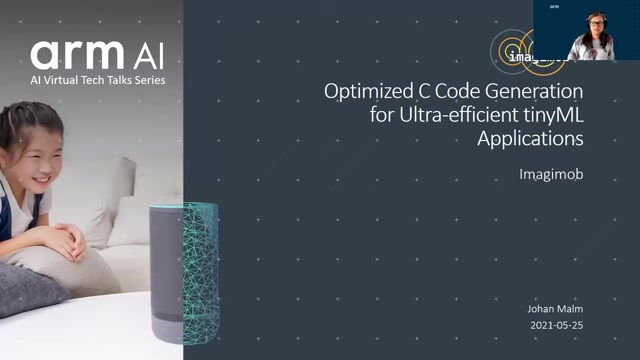
In this article, Johan Malm, an AI Engineer in the ImagiMob Product Team, shared a talk about optimized C Code Generation for Ultra-efficient tinyML Applications. ImagiMob simplifies tinyML Development in its core by building AI Software tools-as-a-service that includes expertise on:
- ML Signal processing
- Numerical methods
- Visualization
- Optimized c code generation for ultra-efficient tinyML applications.
The goal of ImagiMob’s is to minimize memory requirements for small devices, increase processing speed and optimize battery usage.
Why Optimize C Code for tinyML?
The importance of optimized C code generation can't be overstated due to the following reasons:
- Increased Efficiency: Optimized code ensures efficient use of memory and processing power.
- Flexibility: Optimized code adapts to specific hardware instructions, maximizing performance.
- Portability: C code is highly portable and compatible with various microcontrollers, making deployment easy.
Navigating ImagiMob Studio for Optimized tinyML Development
Streamlining Development: A Step-by-Step Guide
ImagiMob Studio presents a streamlined workflow that simplifies the creation of tinyML applications, even for those who might not be C code experts. Let's break down how to leverage its features:

Data Collection and Annotation:
- ImagiMob Studio provides a graphical user interface (GUI) to streamline this process. This tool can help you find the labels and annotate sample data for the most efficient label in your AI projects.
- You import your data into ImagiMob Studio.
- ImagiMob Studio allows you to label the data.
Model Building and Training:
- ImagiMob AI also provides Model building and training, making this process easier for everyone in a single platform.
Code Generation
- It also automatically generates optimized C code from TensorFlow or .h5 models. This eliminates the need for manual coding and reduces the risk of errors.
Deployment
- Deploy the generated C code to your target embedded platform to begin with inference.
The Core of Efficiency: The Compute Graph Optimization
Once you’ve done the groundwork, ImagiMob works its magic on a generated compute graph:
- Static Memory Allocation By pre-allocating memory, the system removes the overhead of dynamic allocation, leading to faster execution.
- Matrix Transposition: The technique ensures row-wise element access for memory efficiency. This means faster processing and less power drain.
- Compile-Time Constant Evaluation: Free resources by simplifying these operations upfront.
- Expression Simplification: Complex calculations are broken down into simpler, more manageable steps.
- Loop Optimization: Enhanced performance through loop efficiency.





Most people like































Report
Please select a reason for reporting
- 13 Reasons to Switch from Snapchat to Text Messaging
- 7 Powerful Speech to Text Apps to Boost Productivity
- 10 Best Speech to Text Tools for Effortless Transcription
- 13 Free Tools to Easily Transcribe Audio to Text
- 15 Surprising Ways Google's Speech-to-Text Boosts Productivity
- 7 Best Free Online Audio to Text Transcription Tools
- 9 Tips to Transcribe Speech to Text Faster and Better
- 13 Best Speech to Text Software for Windows 10 in 2023
- 7 Tips for Choosing the Best Transcriber for Audio to Text
- 11 Reasons Why Dragon Speech-to-Text Apps are Game-Changers
- 6 Secrets to Enhance Your Speech to Text Transcription
- 6 Brilliant Ways to Boost Productivity with Talk-to-Text on Your MacBook
- 6 Ways Transcription Software Converts Audio to Text
- 8 Tips to Transcribe Speech to Text Like a Pro
- 6 Reasons IBM Watson Speech to Text is a Game-Changer
- 14 Powerful Ways Talk-to-Text Improves Your Workflow
- 12 Top Windows Speech-to-Text Software for Efficient Transcription
- 12 Game-Changing Benefits of Apple's Speech to Text Technology
- 9 Powerful Use Cases for AWS Speech to Text Technology
- 10 Easy Steps to Transcribe YouTube Videos to Text
- transcription audio en texte
- online audio transcription
- free audio file transcription
- free ai audio transcription
- audio transcription service
- audio transcription online free
- audio transcription free online
- audio to transcription software
- audio and transcript
- ai audio transcription free
- voice recording to text converter
- translate voice recording to text
- record voice to text
- audio recording to text converter
- voice recording and transcription
- chatgpt voice to text
- gmail voice to text
- speech to text reader
- speech to text ai free
- speech to talk
- Create Engaging Animated Explainer Videos with a Free AI Tool
- Stop Multi-Subscribing: Benchmark Top AI Visual Models in One Canvas
- Best Seedance 2.5 API Provider: Every Price on the Market, Checked at Source
- AI OnlyFans: How to Generate $30,000/Month (Legally)
- Transform Your Script into an Engaging Video with AI Video Maker!
- AI Marketing Automation: A Comprehensive Guide for Small Businesses
- Midjourney Alternative for Anime Art Creators: Why PixAI May Be Better for Character Workflows
- 10 Things Most People Get Wrong About AI Image Search
- AI Girlfriend Apps: Top Choices Redefining Relationships 2025
- How to Reduce Quoting Errors in Salesforce with AI-Assisted Quote Creation
- Convert PDF to Audio: Free Urdu Text-to-Speech Tool
- Automatically Transcribe and Subtitle Audio and Video with Descript
- Revolutionize your video editing with AI-generated transcripts
- Mastering Wordpad: Essential Tips for Windows 10 Users
- AfirstSoft PDF Editor: The Ultimate PDF Solution of 2025
- UPDF: The Ultimate PDF Editor for iPadOS and macOS
- Translate PDF Documents: A Comprehensive Guide with OnlineDocTranslator
- Tenorshare PDNob PDF Editor: Smarter AI-Powered Editing
- uPDF Pro Review: AI-Powered PDF Editing for Professionals
- Master the Art of Wrapping Text in Illustrator CC

Copyright ©2026 toolify