































Table of Contents
- Key Points
- Understanding the Seven-Step Problem-Solving Method
- Leveraging Gemini for Physics Problem Solving
- Tips for Effective AI Problem Solving
- Gemini Pricing
- AI in Education: Weighing the Advantages and Disadvantages
- FAQ
- Related Questions



Understanding the Seven-Step Problem-Solving Method
Overview of the Seven Steps
The key to successfully tackling physics problems is a systematic approach. This involves breaking down the problem into smaller, manageable steps. While variations exist, a solid foundation often consists of these seven key components:
- Identify the Givens and Unknowns: This initial step is about carefully reading and understanding the problem statement.
- Draw a Simple Picture:
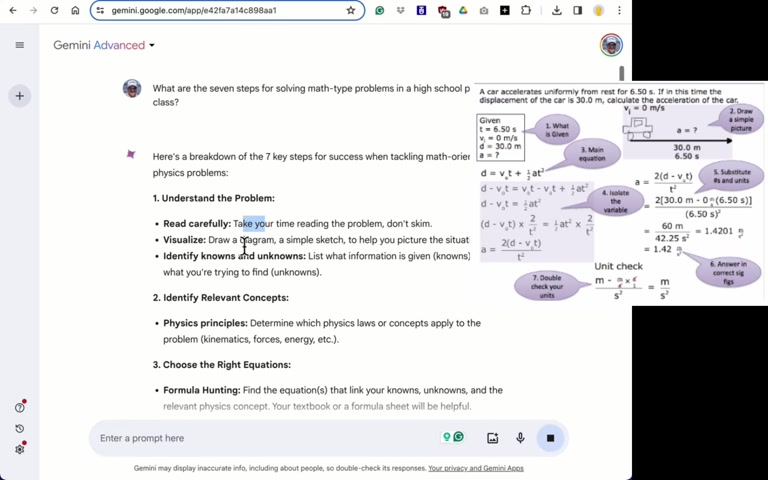
Visualizing the problem helps solidify your understanding.
- Write Down the Main Equation: Recognizing the correct equation that relates the variables in the problem is essential.
- Isolate the Variable: Algebraic manipulation is often needed to solve for the unknown.
- Substitute: Carefully plug in the values for the variables that you know into the equation.
- Find the Answer: Perform the calculations to arrive at the solution.
- Do a Unit Check: Verify that your final answer has the correct units, confirming the reasonableness of your solution.
The Importance of a Structured Approach
Using a structured method offers several benefits:
- Improved Accuracy: Each step is a checkpoint, reducing the chances of errors.
- Enhanced Understanding: Breaking down the problem increases comprehension.
- Increased Efficiency: A systematic approach saves time and effort.
- Better Problem-Solving Skills: The method becomes a habit, improving overall problem-solving abilities.
Leveraging Gemini for Physics Problem Solving
Using AI in Solving the Physics Problem
Gemini is an artificial intelligence platform that can be used as a learning tool to solve a physics problem and to enhance the seven-step method described above. Let’s explore how to use Gemini in solving physics problems.
Begin by going to the Gemini website. At the bottom of the screen, there is a Prompt box. Start by asking a general question like, "What are the seven steps for solving math-type problems in a high school physics class?"
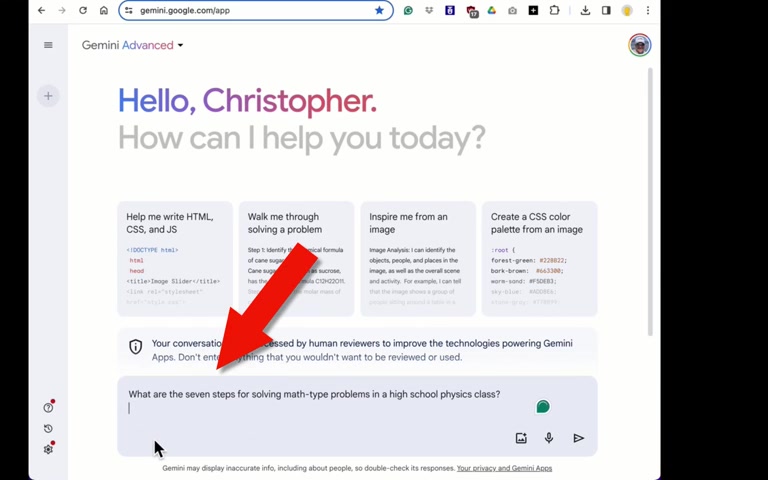
The AI will offer a breakdown of the steps. However, in your class, the steps may be a little different. Therefore, you must confirm that the AI understands the specific steps that you are using in class. This may require some prompt engineering to get the right answers.
Here’s Where To add something like, “Read the problem carefully and identify the underlying physics concepts.” This ensures that the students do not blindly hunt for equations. Add other information like “check to make sure any intermediate calculations are needed.”
To ensure the AI understands these steps, ask “Do you understand the following steps for solving math type problems in a high school physics class?” Now list out all of your steps. The AI will give feedback on the instructions.
Example: Acceleration Problem Using Gemini
Here is an example of how to use Gemini to solve an acceleration problem. The prompt you can give Gemini is: Use the above seven steps to solve this problem. Label each step.
A car accelerates uniformly from rest for 6.50 s. If this time, the car's displacement is 30.0 m, calculate the car's acceleration.
Follow along with Gemini as it leads you through the seven steps, including:
- Write down the givens:
- Displacement (d) = 30.0 m
- Time (t) = 6.50 s
- Initial velocity (u) = 0 m/s (since the car starts from rest)
- We need to find the acceleration (a)
- Draw a simple picture
- Write down the equation that is going to be used:
- We can use the kinematic equation for displacement under constant acceleration: d = ut + 1/2 a t^2
- Isolate the variable in the main equation
- Since we're solving for a, we need to rearrange the equation: a = 2(d - ut)/t^2
- Substitute what is given into the equation: a = 2 (30.0 - 0 6.50)/(6.50)^2
- Find the answer with proper significant figures:
- Calculate carefully: a = 1.42 m/s^2
- Round to match the least precise given value (30.0 has 3 significant figures): a = 1.42 m/s^2
- Do a unit check:
The units work out correctly: m (meters) divided by seconds squared (s^2) gives us the standard unit for acceleration. Therefore, the car’s acceleration is 1.42 m/s^2






Most people like




































Report
Please select a reason for reporting
- 13 Reasons to Switch from Snapchat to Text Messaging
- 7 Powerful Speech to Text Apps to Boost Productivity
- 10 Best Speech to Text Tools for Effortless Transcription
- 13 Free Tools to Easily Transcribe Audio to Text
- 15 Surprising Ways Google's Speech-to-Text Boosts Productivity
- 7 Best Free Online Audio to Text Transcription Tools
- 9 Tips to Transcribe Speech to Text Faster and Better
- 13 Best Speech to Text Software for Windows 10 in 2023
- 7 Tips for Choosing the Best Transcriber for Audio to Text
- 11 Reasons Why Dragon Speech-to-Text Apps are Game-Changers
- 6 Secrets to Enhance Your Speech to Text Transcription
- 6 Brilliant Ways to Boost Productivity with Talk-to-Text on Your MacBook
- 6 Ways Transcription Software Converts Audio to Text
- 8 Tips to Transcribe Speech to Text Like a Pro
- 6 Reasons IBM Watson Speech to Text is a Game-Changer
- 14 Powerful Ways Talk-to-Text Improves Your Workflow
- 12 Top Windows Speech-to-Text Software for Efficient Transcription
- 12 Game-Changing Benefits of Apple's Speech to Text Technology
- 9 Powerful Use Cases for AWS Speech to Text Technology
- 10 Easy Steps to Transcribe YouTube Videos to Text
- transcription audio en texte
- online audio transcription
- free audio file transcription
- free ai audio transcription
- audio transcription service
- audio transcription online free
- audio transcription free online
- audio to transcription software
- audio and transcript
- ai audio transcription free
- voice recording to text converter
- translate voice recording to text
- record voice to text
- audio recording to text converter
- voice recording and transcription
- chatgpt voice to text
- gmail voice to text
- speech to text reader
- speech to text ai free
- speech to talk
- How SEO and Marketing Dashboards Empower Agencies to Drive Results
- How to Use AI Tools to Find Internal Linking Opportunities Across a Business Website
- Discover Your Perfect Haircut with AI Hairstyle Apps
- Free Reputation Calculator Tools: How They're Adapting to Score AI Visibility, Not Just Rankings
- Design Professional Flyers for Free on Your Phone
- Best Free Flyer Maker Apps for Android: Design Like a Pro
- How to Know If Your Business Is Ready for an AI Customer Service Agent
- Revolutionizing Storytelling: From Novels to Screenplays with AI
- Create Engaging Animated Explainer Videos with a Free AI Tool
- Stop Multi-Subscribing: Benchmark Top AI Visual Models in One Canvas
- Top 5 Cold Email Software: Maximize Your Outreach in 2025
- Magic School AI: Revolutionizing Quiz & Assessment Generation
- Create Your Own Email Bot and Automate Your Email Tasks
- Beyond Pure Prompts: Optimizing Production with 'Text With Reference' Generation
- Stop Using Boring TTS: My Honest Deep Dive Into VideoAI and the Hunt for the Perfect Custom Voices
- AI & Elections: Defending Democracy Against Misinformation
- Navigating Political Discourse: AI, Deepfakes, and Reality Checks
- Detecting Political Bias in News Articles: A Powerful AI Algorithm
- AI Bias Unveiled: Political Leanings in ChatGPT & Beyond
- Revolutionize Learning: Discover Quizzes AI for Engaging Interactive Quizzes

Copyright ©2026 toolify