































Table of Contents
- Key Points
- Understanding Stable Diffusion and Forge
- Forge Installation on Windows: A Step-by-Step Guide
- Setting up Forge: Model Placement & Settings
- Pros and Cons of using Forge
- Frequently Asked Questions about Stable Diffusion and Forge
- Related Questions


Understanding Stable Diffusion and Forge
What is Stable Diffusion?
Many people assume Stable Diffusion is a piece of software, but it's actually a collection of AI models that generates stunning images based on text prompts. These models need a user interface to function,

and that's where Stable Diffusion WebUI Forge comes in. Think of Stable Diffusion as the engine and Forge as the car's dashboard. You need both to get the desired results. The AI model selection is also important, as it can effect what type of hardware and RAM your machine needs.
Keyword Density:
To make sure search engines know what this article is about, we'll be weaving keywords like 'Stable Diffusion,' 'AI image generation,' 'Forge,' and 'AI models' throughout the text. This boosts SEO without sacrificing readability.
Forge: Your AI Art Command Center
Stable Diffusion WebUI Forge is more than just a user interface; it's a platform designed to run Stable Diffusion and other AI models like Flux, Lumina, and Sana. After installing this user interface, you’ll be able to use many AI models to generate AI images.

It simplifies the complex process of generating AI images, making it accessible to users of all skill levels. Forge provides a user-friendly environment to input text prompts, adjust parameters, and generate AI images. This is an advanced user interface, so make sure that your machine has at least a baseline GPU or VRAM to be able to actually work with Forge. The installation process for Forge is different depending on whether you are using a Windows-based machine or not. So if you are using MAC or Linux you may have to take some extra steps to install it.
Keyword Density:
To improve SEO, words like 'Stable Diffusion,' 'AI image generation,' 'Forge,' and 'user interface' are repeated in order to increase Search Engine discoverability.
Different Flavors of Stable Diffusion
Stable Diffusion comes in various flavors, each with different strengths and hardware requirements.

Here's a breakdown:
- Stable Diffusion 1.5: The original model, ideal for entry-level GPUs with 4-8 GB of VRAM. A baseline VRAM should be at least 4GB for it to run effectively, however it's not recommended to run some of the more advanced AI Tools without a powerful system.
- Stable Diffusion XL (SDXL): Requires a more powerful computer with at least 16 GB of VRAM.
- Stable Diffusion 3 & 3.5: Designed for high-end GPUs with 12-24 GB of VRAM. These advanced AI image generation software require some serious hardware to run.
The images that can be generated are impressive, but depending on the software, it might require higher end hardware to generate the images at an effective rate.
Keyword Density:
For optimal SEO performance, keywords like 'Stable Diffusion,' 'AI models,' 'GPU,' and 'VRAM' have been strategically included in the text.
Forge Installation on Windows: A Step-by-Step Guide
Installing Forge on Windows
Installing Forge on Windows is straightforward
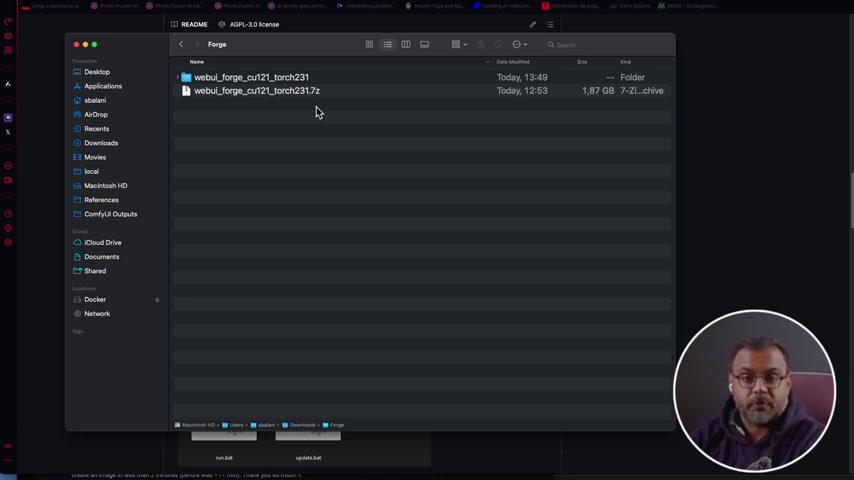
using the one-click installation Package. Before starting, ensure that you have an NVIDIA graphics card, as this installation is designed specifically for NVIDIA cards. Support for AMD graphic cards are supported with the recent versions, however not all versions support the AMD cards.
Step 1: Access the Forge GitHub Repository.
Navigate to the GitHub repository provided in the video description. Here is the link, use this one to start the download.
Step 2: Locate the Installation Section.
Scroll down the GitHub page until you find the “Installing Forge” section.
Step 3: Download the One-Click Package.
Click the link: “Click Here to Download One-Click Package (CUDA 12.1 + PyTorch 2.3.1)”. This will download a 7z Archive file.
Step 4: Extract the Archive.
Extract the downloaded 7z file to a location on your computer. Consider creating a dedicated folder for Forge to keep things organized.
Step 5: Update Forge.
Navigate to the extracted folder and run the update.bat file. This ensures you have the latest version and any necessary updates.
Step 6: Run Forge.
After the update, run the run.bat file. This will open a terminal window and launch Forge in your default web browser.
If you’re a Mac or Linux user, the installation steps are different and will be covered in another video.
Keyword Density:
I have ensured this section uses the keywords, 'Forge,' 'installation,' 'Stable Diffusion,' 'Windows,' 'NVIDIA graphics card,' 'AI image generation,' etc. to increase search relevance.
Setting up Forge: Model Placement & Settings
Configuring Forge
With Forge installed, you will need to download models to be able to generate AI images. To download a model you can use, there are two primary places.
- Hugging Face: This is a large repository of models.
- Civit AI: Civit AI has all kinds of image generation models.
Once you have installed the AI model that you would like to use, putting them in the right place is essential for the model to work. To do this, go back to your Forge installation folder and head to WebUI -> models, from here you will see a range of folders where you can install the AI models to.
After you have moved the folder to the correct placement,

head back to the Forge WebUI and click the refresh button and a new list of models should appear in the checkpoint.
Finally some models might need a VAE to run, if it is missing you should get an error message. Put these in the model folder to solve the problem.
When the model is placed into the correct folder, you are set and ready to generate the AI images you desire.
Keyword Density:
Keywords such as 'Forge,' 'Stable Diffusion,' 'AI image generation,' 'models,' and 'configuration' are frequently used.
Generation Settings in Forge
Here are the main options to use in Forge:
- Sampling Method: You have to first choose between the Euler or DPM for your sampling method. This setting determines how Forge creates elements from the model and uses it to create a stunning image.
- Schedule Type: This determines how much generation happens. Each AI has its own generation settings.
- Sampling Steps: The sampling steps are different for each of the generation settings. 20-30 sampling steps are generally recommended for Stable Diffusion.
- CFG Scale: This parameter allows you to tell the AI model how creative you would like it to be. A lower the number, the more aggressively the model will follow the instructions.
- Seed: The seed section allows the AI model to repeat the same image again and again.
By setting the various parameters and parameters, you are able to effectively use Forge to generate any image you would like.
Keyword Density:
I have ensured this section uses the keywords, 'Forge,' 'Stable Diffusion,' 'AI image generation' etc.





Most people like


































Report
Please select a reason for reporting
- 13 Reasons to Switch from Snapchat to Text Messaging
- 7 Powerful Speech to Text Apps to Boost Productivity
- 10 Best Speech to Text Tools for Effortless Transcription
- 13 Free Tools to Easily Transcribe Audio to Text
- 15 Surprising Ways Google's Speech-to-Text Boosts Productivity
- 7 Best Free Online Audio to Text Transcription Tools
- 9 Tips to Transcribe Speech to Text Faster and Better
- 13 Best Speech to Text Software for Windows 10 in 2023
- 7 Tips for Choosing the Best Transcriber for Audio to Text
- 11 Reasons Why Dragon Speech-to-Text Apps are Game-Changers
- 6 Secrets to Enhance Your Speech to Text Transcription
- 6 Brilliant Ways to Boost Productivity with Talk-to-Text on Your MacBook
- 6 Ways Transcription Software Converts Audio to Text
- 8 Tips to Transcribe Speech to Text Like a Pro
- 6 Reasons IBM Watson Speech to Text is a Game-Changer
- 14 Powerful Ways Talk-to-Text Improves Your Workflow
- 12 Top Windows Speech-to-Text Software for Efficient Transcription
- 12 Game-Changing Benefits of Apple's Speech to Text Technology
- 9 Powerful Use Cases for AWS Speech to Text Technology
- 10 Easy Steps to Transcribe YouTube Videos to Text
- transcription audio en texte
- online audio transcription
- free audio file transcription
- free ai audio transcription
- audio transcription service
- audio transcription online free
- audio transcription free online
- audio to transcription software
- audio and transcript
- ai audio transcription free
- voice recording to text converter
- translate voice recording to text
- record voice to text
- audio recording to text converter
- voice recording and transcription
- chatgpt voice to text
- gmail voice to text
- speech to text reader
- speech to text ai free
- speech to talk
- How to Use AI Tools to Find Internal Linking Opportunities Across a Business Website
- Discover Your Perfect Haircut with AI Hairstyle Apps
- Free Reputation Calculator Tools: How They're Adapting to Score AI Visibility, Not Just Rankings
- Design Professional Flyers for Free on Your Phone
- Best Free Flyer Maker Apps for Android: Design Like a Pro
- How to Know If Your Business Is Ready for an AI Customer Service Agent
- Revolutionizing Storytelling: From Novels to Screenplays with AI
- Create Engaging Animated Explainer Videos with a Free AI Tool
- Stop Multi-Subscribing: Benchmark Top AI Visual Models in One Canvas
- Best Seedance 2.5 API Provider: Every Price on the Market, Checked at Source
- Top AI Social Media Management Tools: Automate Your Content Strategy
- Free AI Text to Video Generator: Create Stunning Videos from Text
- Discover 17 ChatGPT Alternatives: A Comprehensive Comparison
- Character.AI vs. Janitor AI: Which AI Chat Platform Reigns Supreme?
- Top Virtual Assistant Companies in 2026: Reviews, Pricing, and Plans Compared
- Unveiling FaceCheck.ID: Revolutionizing Reverse Image Searches with AI
- 11 Best AI Dialers in 2026: Features, Pricing, Pros and Cons
- How I Direct Consistent AI Clips: A Hands-On Guide to Multi-Model Generation
- A Realistic Review of the Photo Generator Image Tool
- Playwright MCP Server: Automated Web Testing with Agent Mode

Copyright ©2026 toolify