































Table of Contents
- Key Points
- Understanding Text Summarization in NLP
- Exploring Real-World Applications of Text Summarization
- Implementing Text Summarization with Gensim
- Pros and Cons of Using Gensim for Text Summarization
- Frequently Asked Questions
- Related Questions


Understanding Text Summarization in NLP
What is Text Summarization?
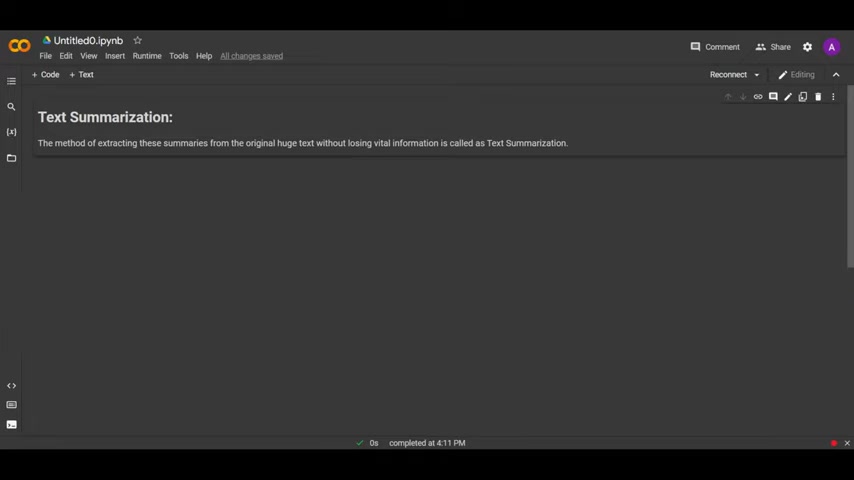
Text summarization, in the context of Natural Language Processing (NLP), refers to the method of extracting the most important information from a source text to produce a concise and coherent summary. The core objective is to shorten the original text while preserving its meaning and crucial information. It's an automated process that leverages algorithms to understand and condense text, making it easier to Consume large documents or articles efficiently.
Why is Text Summarization Important?
Text summarization addresses a real-world need. Think about the countless articles, reports, and documents we encounter daily. The task of reading each one thoroughly is often impractical. Text summarization offers a solution by:
- Saving Time: Quickly grasp the main points without spending hours reading the full text.
- Improving Comprehension: Focused summaries can highlight key information, aiding better understanding.
- Enhancing Information Retrieval: Summaries act as effective previews, helping you determine if the original source is Relevant to your needs.
- Supporting Decision-Making: Executives and analysts can swiftly access summarized insights for strategic decisions.
How Does Text Summarization Work?
Text summarization techniques typically fall into two main categories:
- Extractive Summarization: This approach identifies and extracts important sentences or phrases directly from the original text, combining them to form the summary. The extracted sentences are generally left unaltered.
- Abstractive Summarization: This method goes beyond simply extracting content. It involves understanding the text and then generating new sentences that convey the main ideas, similar to how a human would summarize. Abstractive summarization is more complex as it requires advanced NLP techniques to paraphrase and create new text.
The Power of NLP in Text Summarization
NLP provides the foundation for text summarization by enabling computers to:
- Understand Language: Analyze sentence structure, identify keywords, and interpret meaning.
- Assess Importance: Determine the significance of different parts of the text based on frequency, context, and other factors.
- Generate Text: Create coherent and grammatically correct summaries.
Techniques such as TextRank, Latent Semantic Analysis (LSA), and deep learning models are frequently employed to achieve effective text summarization.
Text Summarizer: A Web-Based Application
Imagine a tool that can automatically condense lengthy articles, reports, or documents into concise, easily digestible summaries. This is the power of a text summarizer application, and more specifically, a web-based text Summarizer.
A web-based text summarizer is an application accessible through a web browser that uses NLP techniques to automatically generate summaries of input text. Users can simply upload their text, and the application will analyze it, extract the most relevant information, and Present it in a summarized form.
Key Benefits of a Web-Based Text Summarizer:
- Accessibility: Accessible from any device with a web browser and internet connection.
- Convenience: Easy to use, requiring no software installation.
- Efficiency: Quickly summarize text, saving time and effort.
- Scalability: Handles varying text lengths and complexities.
A text summarizer is an excellent tool for:
- Students: Summarizing research Papers and articles for efficient study.
- Researchers: Quickly surveying large volumes of literature.
- Professionals: Condensing reports, memos, and other business documents.
- Journalists: Extracting key information from news articles.
How to Choose a Text Summarizer:
When selecting a text summarizer, consider the following factors:
- Accuracy: How well does it retain the core meaning of the original text?
- Coherence: Is the summary well-organized and easy to understand?
- Customization: Can you adjust the summary length or focus on specific aspects?
- Speed: How quickly does it generate summaries?
- Cost: Is it free, subscription-based, or a one-time purchase?
Project Objectives and Tools
Embarking on a text summarization project has distinct objectives. It primarily aims to help you understand and apply the principles of Natural Language Processing (NLP). By building a functional summarization tool, you Deepen your knowledge of NLP techniques and their practical uses. The ultimate goal is to create software capable of automatically condensing text effectively.
Key Objectives:
- NLP Mastery: Strengthen understanding of NLP concepts like tokenization, stemming, and part-of-speech tagging.
- Algorithm Implementation: Learn to apply summarization algorithms, such as TextRank.
- Practical Application: Build a functional text summarization tool that works on real-world data.
- Problem-Solving: Address challenges in text analysis, such as handling ambiguity and noisy data.
Tools for the Project:
- Programming Language: Python is the go-to language for NLP due to its libraries and ease of use.
Its clear syntax and extensive community support make it ideal for this project.
- IDE (Integrated Development Environment): Google Colab or other IDEs such as Visual Studio or Python's IDLE will be your coding workspace. Google Colab, being cloud-based, is particularly handy as it removes the need for local setup and provides access to computing resources.
- Gensim: Gensim is a Python library focused on topic modeling, document indexing, and similarity retrieval. Its summarization capabilities, particularly the summarize function, will be essential for creating summaries. Gensim relies on other libraries such as NumPy and SciPy.
- Text Data: You'll require text data (e.g., articles, reports) to test and refine your summarization tool. Ensure the text data is available and accessible in a suitable format.
Implementing Text Summarization with Gensim
Step 1: Importing Libraries
Start by importing the necessary libraries into your Python environment. The gensim library provides pre-built functionalities for text summarization, which simplifies the process. Specifically, you'll need to import the summarize and keywords functions from the gensim.summarization module. NumPy and SciPy libraries are required to load into Gensim libraries.
from gensim.summarization import summarize, keywordsStep 2: Providing the Data
Next, provide the text data you want to summarize. This can be a paragraph, a document, or any text STRING. For demonstration purposes, let's use a sample Paragraph:
paragraph = """Defence Minister Nirmala Sitharaman, replying to an acrimonious debate in parliament on the Rafale jet deal today, accused the Congress of scrapping an earlier deal when it was in power. The deal didn't get you money. We don't do defence dealings. We deal in defence with national security as our priority."""Replace this with your own text data for summarization.
Step 3: Summarizing the Text
Gensim provides multiple ways to summarize text. We'll explore three approaches:
-
Percentage-Based Summarization: Summarize the text based on a percentage of its original length.
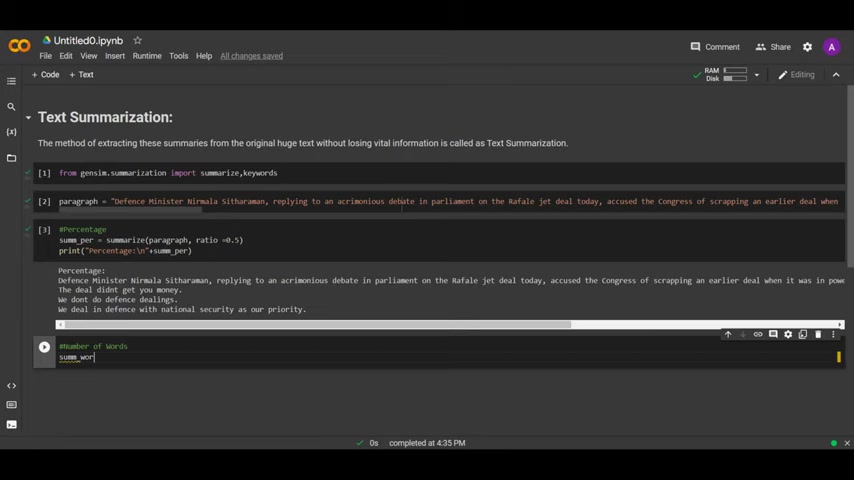
summary_percentage = summarize(paragraph, ratio=0.5)
print("Percentage:
", summary_percentage)
This summarizes the text to 50% of its original length.
-
Word-Count Based Summarization: Summarize the text to a specific number of words.
summary_words = summarize(paragraph, word_count=50)
print("Number of words:
", summary_words)
This generates a summary with approximately 50 words.
-
Keyword Extraction: Extract the most relevant keywords from the text.
keywords_txt = keywords(paragraph)
print("Keywords:
", keywords_txt)
This identifies key terms that best represent the content.










Most people like


























Report
Please select a reason for reporting
- 13 Reasons to Switch from Snapchat to Text Messaging
- 7 Powerful Speech to Text Apps to Boost Productivity
- 10 Best Speech to Text Tools for Effortless Transcription
- 13 Free Tools to Easily Transcribe Audio to Text
- 15 Surprising Ways Google's Speech-to-Text Boosts Productivity
- 7 Best Free Online Audio to Text Transcription Tools
- 9 Tips to Transcribe Speech to Text Faster and Better
- 13 Best Speech to Text Software for Windows 10 in 2023
- 7 Tips for Choosing the Best Transcriber for Audio to Text
- 11 Reasons Why Dragon Speech-to-Text Apps are Game-Changers
- 6 Secrets to Enhance Your Speech to Text Transcription
- 6 Brilliant Ways to Boost Productivity with Talk-to-Text on Your MacBook
- 6 Ways Transcription Software Converts Audio to Text
- 8 Tips to Transcribe Speech to Text Like a Pro
- 6 Reasons IBM Watson Speech to Text is a Game-Changer
- 14 Powerful Ways Talk-to-Text Improves Your Workflow
- 12 Top Windows Speech-to-Text Software for Efficient Transcription
- 12 Game-Changing Benefits of Apple's Speech to Text Technology
- 9 Powerful Use Cases for AWS Speech to Text Technology
- 10 Easy Steps to Transcribe YouTube Videos to Text
- transcription audio en texte
- online audio transcription
- free audio file transcription
- free ai audio transcription
- audio transcription service
- audio transcription online free
- audio transcription free online
- audio to transcription software
- audio and transcript
- ai audio transcription free
- voice recording to text converter
- translate voice recording to text
- record voice to text
- audio recording to text converter
- voice recording and transcription
- chatgpt voice to text
- gmail voice to text
- speech to text reader
- speech to text ai free
- speech to talk
- Revolutionizing Storytelling: From Novels to Screenplays with AI
- Create Engaging Animated Explainer Videos with a Free AI Tool
- Stop Multi-Subscribing: Benchmark Top AI Visual Models in One Canvas
- Best Seedance 2.5 API Provider: Every Price on the Market, Checked at Source
- AI OnlyFans: How to Generate $30,000/Month (Legally)
- Transform Your Script into an Engaging Video with AI Video Maker!
- AI Marketing Automation: A Comprehensive Guide for Small Businesses
- Midjourney Alternative for Anime Art Creators: Why PixAI May Be Better for Character Workflows
- 10 Things Most People Get Wrong About AI Image Search
- AI Girlfriend Apps: Top Choices Redefining Relationships 2025
- Master Canva's Video Background Remover with 5 Essential Tips
- Mastering Microsoft Stream: Video Management Tips & Tricks
- AI Video Generation: Extend AI Videos for Free
- Master Loom: Create and Share Professional Videos with AI
- Create Captivating AI News Videos: Step-by-Step Guide
- Create Your Own AI News Channel with AI-Powered News Video Generator and AI Lip Sync
- Unleash the Power of Heygen AI: Create Unlimited Videos for Free!
- Kapwing Smart Cut: AI Video Editing for Creators & Marketers
- Upscale Video Quality with UniFab Upscaler AI: A Complete Guide
- Automate Cutting Long Videos with AI for Engaging Clips

Copyright ©2026 toolify