























Understanding Artificial Intelligence: A Comprehensive Guide

Updated on Aug 27,2025








Table of Contents
- Key Points
- Defining Artificial Intelligence
- The Future of Artificial Intelligence: Opportunities and Challenges
- How to Use AI Effectively: A Practical Guide
- Pros and Cons of Artificial Intelligence
- Core Technologies of Artificial Intelligence
- Diverse Applications of Artificial Intelligence
- Frequently Asked Questions About Artificial Intelligence
- Related Questions About Artificial Intelligence


Defining Artificial Intelligence
What is Artificial Intelligence?
Artificial Intelligence (AI), at its core, is the simulation of human intelligence in machines that are programmed to think, learn, and solve problems like humans.
It encompasses a wide range of techniques and technologies designed to enable computers to perform tasks that typically require human intelligence, such as visual perception, Speech Recognition, decision-making, and language translation. The goal of AI is to create systems that can reason, generalize, and learn from experience, ultimately augmenting or even replacing human capabilities in various domains.
AI is not a monolithic entity but rather a collection of different approaches, each with its strengths and weaknesses. These approaches include:
- Machine Learning (ML): ML is the most important subset of AI. This enables machines to learn from data without explicit programming, improving their performance over time.
- Deep Learning (DL): DL is a subfield of machine learning that uses artificial neural networks with multiple layers to analyze data with complex patterns.
- Natural Language Processing (NLP): NLP focuses on enabling computers to understand, interpret, and generate human language.
- Computer Vision: Computer vision equips machines with the ability to 'see' and interpret images, videos, and other visual data.
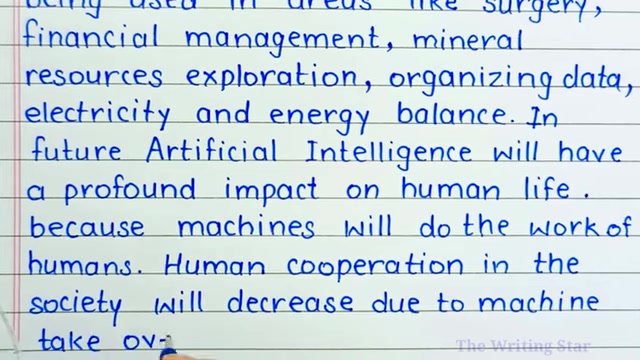
AI systems are designed to mimic human cognitive functions. They work by understanding the given instructions and acting accordingly. The purpose of AI is to make machines work more effectively and efficiently. In the future, AI will have a profound impact on our life as machines take over repetitive tasks. However, there are concerns about human corporation in the workplace.
AI is now being used in areas like Surgery, Financial Management and Mineral resource exploration. Therefore, it is very important for us to understand how AI works.
The Future of Artificial Intelligence: Opportunities and Challenges
Potential Impact on Employment
One of the most significant concerns surrounding AI is its potential impact on employment. As AI systems become more capable, they may automate tasks that are currently performed by humans, leading to job displacement in some industries.

However, AI is also expected to create new jobs in areas such as AI development, data science, and AI ethics. To mitigate the negative impacts of automation, it is important to invest in education and training programs that prepare workers for the jobs of the future. Additionally, policymakers may need to consider policies such as universal basic income to support those who are displaced by AI.
Ethical Considerations
AI raises a number of ethical considerations that must be addressed to ensure that AI systems are used responsibly and for the benefit of society.
One key issue is bias in AI algorithms. If AI systems are trained on biased data, they may perpetuate and amplify existing inequalities. Another concern is the potential for AI to be used for malicious purposes, such as surveillance, manipulation, and autonomous weapons. To address these ethical challenges, it is important to develop ethical guidelines for AI development and deployment, as well as mechanisms for accountability and oversight.
Societal Norms
AI has the potential to significantly impact societal norms, altering the way we interact with technology, each other, and the world around us. As AI systems become more integrated into our lives, they may influence our decision-making, our relationships, and our sense of identity. It is important to consider the potential societal impacts of AI and to engage in public discussions about how to shape the future of AI in a way that aligns with our values and aspirations. This includes addressing issues such as data privacy, algorithmic transparency, and the potential for AI to exacerbate social divisions.
Core Technologies of Artificial Intelligence
Machine Learning (ML)
Machine learning (ML) is a cornerstone of modern AI, enabling computers to learn from data without explicit programming.
Instead of being explicitly programmed, ML algorithms identify patterns, make predictions, and improve their performance over time through experience. This is achieved by feeding the algorithms large amounts of data, allowing them to adjust their internal parameters to better fit the data and generalize to new, unseen instances.
There are several types of machine learning algorithms:
- Supervised Learning: In supervised learning, the algorithm is trained on labeled data, where the correct output is known for each input. The algorithm learns to map inputs to outputs, allowing it to make predictions on new data. Examples include classification and regression.
- Unsupervised Learning: Unsupervised learning involves training the algorithm on unlabeled data, where the correct output is not known. The algorithm must discover patterns and structures in the data on its own. Examples include clustering and dimensionality reduction.
- Reinforcement Learning: Reinforcement learning involves training an agent to make decisions in an environment to maximize a reward. The agent learns through trial and error, receiving feedback in the form of rewards or penalties. This approach is often used in robotics and Game playing.
ML algorithms are used in a wide variety of AI applications, including Image Recognition, fraud detection, and recommendation systems. As more data becomes available, ML algorithms are becoming increasingly powerful and accurate.
Deep Learning (DL)
Deep Learning (DL) is a subfield of machine learning that uses artificial neural networks with multiple layers (hence 'deep') to analyze data.
These neural networks are inspired by the structure and function of the human brain, and they are capable of learning complex patterns and representations from data.
The key innovation in deep learning is the use of many layers of interconnected nodes, which allows the network to automatically learn hierarchical representations of the data. Each layer extracts increasingly abstract features from the input, enabling the network to handle complex tasks such as image recognition, speech recognition, and natural language processing.
DL algorithms require large amounts of data to train effectively, but they can achieve state-of-the-art performance on many tasks that were previously difficult for traditional machine learning algorithms. Deep learning is used in applications such as self-driving cars, medical diagnosis, and financial modeling.
Natural Language Processing (NLP)
Natural Language Processing (NLP) focuses on enabling computers to understand, interpret, and generate human language.
It combines computational linguistics with machine learning techniques to allow computers to process and analyze large amounts of natural language data.
NLP tasks include:
- Sentiment Analysis: Determining the sentiment or emotion expressed in a text.
- Machine Translation: Automatically translating text from one language to another.
- Chatbots and Virtual Assistants: Creating conversational agents that can interact with humans in natural language.
- Text Summarization: Generating concise summaries of longer texts.
NLP is used in a wide range of applications, including customer service, content creation, and information retrieval. With the rise of Large Language Models, NLP is becoming even more powerful and capable of handling complex language tasks.
Computer Vision
Computer vision equips machines with the ability to 'see' and interpret images, videos, and other visual data.
It uses algorithms to analyze visual inputs, identify objects, and extract meaningful information. Computer vision tasks include:
- Image Recognition: Identifying objects, people, and scenes in images.
- Object Detection: Locating and classifying objects within an image.
- Image Segmentation: Partitioning an image into multiple regions or objects.
- Facial Recognition: Identifying individuals based on their facial features.
Computer vision is used in a variety of applications, including self-driving cars, medical imaging, and security systems. It enables machines to automate tasks that require visual perception, improving efficiency and accuracy.
Diverse Applications of Artificial Intelligence
AI in Healthcare
AI is revolutionizing Healthcare, impacting everything from diagnostics to treatment. Machine learning algorithms can analyze medical images to detect diseases such as cancer with greater accuracy than human radiologists.

AI is also used to personalize treatment plans based on individual patient data, improving outcomes and reducing costs. Virtual assistants and chatbots provide patients with 24/7 access to medical information and support, while robotic surgery enhances precision and minimizes invasiveness.
AI in Finance
AI is transforming the financial industry, enabling greater efficiency, accuracy, and personalization. AI algorithms are used to detect fraudulent transactions, assess credit risk, and automate trading.
Chatbots provide customers with instant access to financial information and support, while robo-advisors offer personalized investment advice based on individual financial goals. AI is also used to optimize pricing and risk management, improving profitability and stability.
AI in Transportation
AI is reshaping the transportation industry, paving the way for safer, more efficient, and more sustainable mobility. Self-driving cars use computer vision, machine learning, and sensor technology to navigate roads and avoid collisions.
AI is also used to optimize traffic flow, reduce congestion, and improve public transportation. Predictive maintenance algorithms analyze data from vehicles to identify potential problems before they occur, reducing downtime and improving safety.
AI in Customer Service
AI is enhancing customer service, providing faster, more personalized, and more efficient support. Chatbots and virtual assistants answer customer inquiries, resolve issues, and provide recommendations 24/7.
Sentiment analysis algorithms analyze customer feedback to identify areas for improvement, while personalized recommendations increase customer satisfaction and loyalty. AI is also used to automate repetitive tasks, freeing up human agents to focus on more complex issues.







Most people like






























Report
Please select a reason for reporting
- 13 Reasons to Switch from Snapchat to Text Messaging
- 7 Powerful Speech to Text Apps to Boost Productivity
- 10 Best Speech to Text Tools for Effortless Transcription
- 13 Free Tools to Easily Transcribe Audio to Text
- 15 Surprising Ways Google's Speech-to-Text Boosts Productivity
- 7 Best Free Online Audio to Text Transcription Tools
- 9 Tips to Transcribe Speech to Text Faster and Better
- 13 Best Speech to Text Software for Windows 10 in 2023
- 7 Tips for Choosing the Best Transcriber for Audio to Text
- 11 Reasons Why Dragon Speech-to-Text Apps are Game-Changers
- 6 Secrets to Enhance Your Speech to Text Transcription
- 6 Brilliant Ways to Boost Productivity with Talk-to-Text on Your MacBook
- 6 Ways Transcription Software Converts Audio to Text
- 8 Tips to Transcribe Speech to Text Like a Pro
- 6 Reasons IBM Watson Speech to Text is a Game-Changer
- 14 Powerful Ways Talk-to-Text Improves Your Workflow
- 12 Top Windows Speech-to-Text Software for Efficient Transcription
- 12 Game-Changing Benefits of Apple's Speech to Text Technology
- 9 Powerful Use Cases for AWS Speech to Text Technology
- 10 Easy Steps to Transcribe YouTube Videos to Text
- transcription audio en texte
- online audio transcription
- free audio file transcription
- free ai audio transcription
- audio transcription service
- audio transcription online free
- audio transcription free online
- audio to transcription software
- audio and transcript
- ai audio transcription free
- voice recording to text converter
- translate voice recording to text
- record voice to text
- audio recording to text converter
- voice recording and transcription
- chatgpt voice to text
- gmail voice to text
- speech to text reader
- speech to text ai free
- speech to talk
- Create Engaging Animated Explainer Videos with a Free AI Tool
- Stop Multi-Subscribing: Benchmark Top AI Visual Models in One Canvas
- Best Seedance 2.5 API Provider: Every Price on the Market, Checked at Source
- AI OnlyFans: How to Generate $30,000/Month (Legally)
- Transform Your Script into an Engaging Video with AI Video Maker!
- AI Marketing Automation: A Comprehensive Guide for Small Businesses
- Midjourney Alternative for Anime Art Creators: Why PixAI May Be Better for Character Workflows
- 10 Things Most People Get Wrong About AI Image Search
- AI Girlfriend Apps: Top Choices Redefining Relationships 2025
- How to Reduce Quoting Errors in Salesforce with AI-Assisted Quote Creation
- AI Resume Builders: EnhanceCV, ResumeNerd AI, & Teal Compared
- ResumeAI: Crafting ATS-Optimized Resumes with AI
- AI in Resume Writing: A New Era for Job Seekers
- AI Resume Tools: Streamline Your Job Search and Land Your Dream Role
- AI Resume Optimization: The Right Way to Land Interviews
- Crafting a Killer Resume with AI: A Step-by-Step Guide
- Crafting a Winning Resume: AI Tools and Expert Tips
- AI Job Search: Level Up Your Career with AI Automation
- Empower Your Career Journey: Dynamic Resumes with AI
- AI Resume Builder: Create Professional Resumes Effortlessly

Copyright ©2026 toolify