































Table of Contents
- Key Points
- The Three Pillars of Structured Programming
- Building Complex Programs
- Applying Programming Structures in Code
- Structured Programs vs Spaghetti Code
- FAQ
- Related Questions



The Three Pillars of Structured Programming
What is Structure in Programming?
In programming, a structure serves as the basic building block of logical organization, defining how instructions are sequenced and executed within a program. These structures are designed to eliminate ambiguity and promote a clear, predictable flow of control. Think of them as the fundamental units of programming thought, offering a structured approach to tackle complex problems.
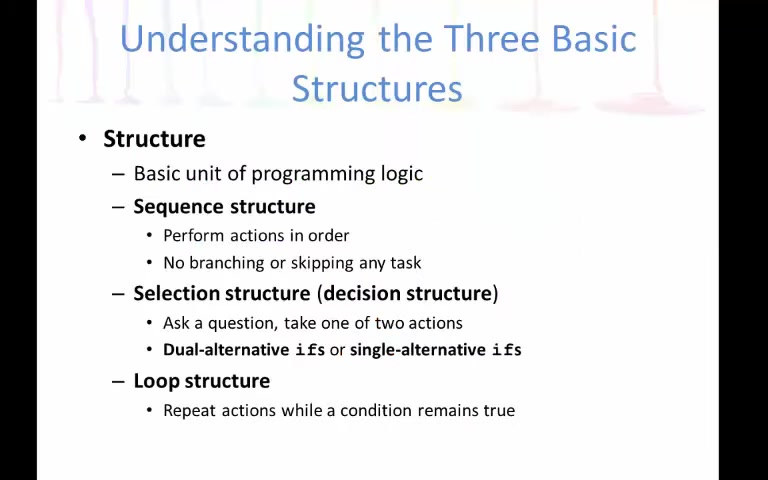
Without structured programming, code can become complex and unmanageable, akin to a plate of tangled spaghetti. The main goal is to write code that’s not only functional but also readable, maintainable, and scalable.
Structured programming relies on three core types of structures. Each type of unit plays a role to ensure the clarity and efficiency of code.
- Sequence Structure: Performing actions in a specific order
- Selection Structure: Choosing an action from a set of actions, or making decisions
- Loop Structure: Repeating a set of actions
Sequence Structure: The Foundation of Order
The sequence structure is the most straightforward and fundamental of the three. It dictates that actions are performed in a specific, linear order, one after the other. Each step in the sequence is executed in the order it appears, without any branching or skipping. This structure is perfect for tasks that naturally follow a step-by-step process.
In a sequence structure, instructions flow straight through the code, just as they’re written. There are no conditional statements or loops, resulting in a deterministic execution path. Think about a basic recipe, each step has to be performed in the order presented to achieve the desired outcome.
Here are some characteristic of Sequence Structures:
- Actions are performed in order.
- No branching or skipping.
- Clear and deterministic execution path.
Selection Structure: Making Decisions
The selection structure, also known as the decision structure, introduces the ability to make choices in a program. It allows the program to ask a question and then take one of two possible actions based on the answer. This structure uses conditional statements like 'if-then-else' to control the flow of execution.
The selection structure enables programs to respond differently depending on the input or state. This introduces flexibility and adaptability, allowing the program to handle multiple scenarios. The use of 'if-then-else' statements is crucial for creating this type of structure.
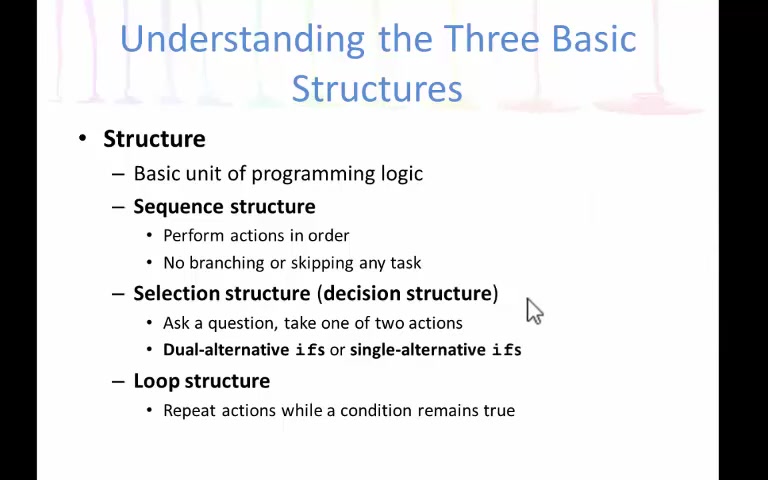
Selection structure is often called an if-then-else structure. There are also dual-alternative ifs or single-alternative ifs. Dual-alternative if statements provide two distinct execution paths, while single-alternative if statements define an action to take only when the condition is true.
Here are some characteristics of Selection Structures:
- Allows making a decision based on a question.
- Involves conditional statements ('if-then-else').
- Enables programs to handle multiple scenarios.
Loop Structure: Repeating Actions
The loop structure provides the ability to repeat a set of actions until a specific condition is met. This structure is invaluable for tasks that need to be performed multiple times, such as processing a list of data, validating user input, or running a simulation.
Loops can continue iterating as long as the defined condition remains true. There are different types of loops, including 'while loops' and 'for loops,' each with its characteristics and use cases.
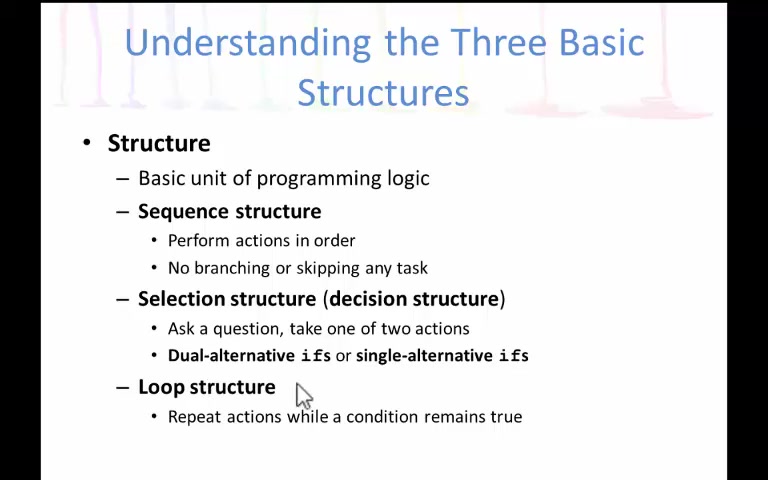
Loop structures are essential for tasks requiring repetition, improving the power and flexibility of code.
Here are some characteristics of Loop Structures:
- Repeats actions while a condition remains true.
- Involves loops like 'while' and 'for'.
- Useful for repetitive tasks, data processing, and validation.






Most people like





























Report
Please select a reason for reporting
- 13 Reasons to Switch from Snapchat to Text Messaging
- 7 Powerful Speech to Text Apps to Boost Productivity
- 10 Best Speech to Text Tools for Effortless Transcription
- 13 Free Tools to Easily Transcribe Audio to Text
- 15 Surprising Ways Google's Speech-to-Text Boosts Productivity
- 7 Best Free Online Audio to Text Transcription Tools
- 9 Tips to Transcribe Speech to Text Faster and Better
- 13 Best Speech to Text Software for Windows 10 in 2023
- 7 Tips for Choosing the Best Transcriber for Audio to Text
- 11 Reasons Why Dragon Speech-to-Text Apps are Game-Changers
- 6 Secrets to Enhance Your Speech to Text Transcription
- 6 Brilliant Ways to Boost Productivity with Talk-to-Text on Your MacBook
- 6 Ways Transcription Software Converts Audio to Text
- 8 Tips to Transcribe Speech to Text Like a Pro
- 6 Reasons IBM Watson Speech to Text is a Game-Changer
- 14 Powerful Ways Talk-to-Text Improves Your Workflow
- 12 Top Windows Speech-to-Text Software for Efficient Transcription
- 12 Game-Changing Benefits of Apple's Speech to Text Technology
- 9 Powerful Use Cases for AWS Speech to Text Technology
- 10 Easy Steps to Transcribe YouTube Videos to Text
- transcription audio en texte
- online audio transcription
- free audio file transcription
- free ai audio transcription
- audio transcription service
- audio transcription online free
- audio transcription free online
- audio to transcription software
- audio and transcript
- ai audio transcription free
- voice recording to text converter
- translate voice recording to text
- record voice to text
- audio recording to text converter
- voice recording and transcription
- chatgpt voice to text
- gmail voice to text
- speech to text reader
- speech to text ai free
- speech to talk
- Midjourney Alternative for Anime Art Creators: Why PixAI May Be Better for Character Workflows
- 10 Things Most People Get Wrong About AI Image Search
- AI Girlfriend Apps: Top Choices Redefining Relationships 2025
- How to Reduce Quoting Errors in Salesforce with AI-Assisted Quote Creation
- How AI Is Changing Back Office Outsourcing And Why It Matters
- How AI Helps You Spot the Next Friendslop Hit on Steam (Dear Passengers Case)
- AI Angels Review: Create Your Own AI Companion with Voice, Images & Videos
- AI and Real Estate: A New Era for Property Search, Pricing and Investment
- Best AI Sales Training Tools in 2026: Roleplay, Coaching & Onboarding
- How to Turn Business Reports into Client-Ready Presentations with AI
- Unlocking the Power of Artificial Intelligence: A Comprehensive Guide
- Toolify.ai: Your Ultimate AI Tools Directory & Resource Hub
- Generative AI: Understanding Models, Datasets, and Applications
- Unleashing the Future: Are We Ready for Artificial General Intelligence?
- Model Context Protocol (MCP): Connecting AI Agents to Data
- Understanding Artificial Intelligence: An In-Depth Guide
- Demystifying Artificial Intelligence: A Comprehensive Guide to AI Concepts
- Perplexity AI: Revolutionizing Research Beyond Google and ChatGPT
- Salesforce Never Sold You Software. It Sold You the Fact That You Couldn't Build It.
- The API Infrastructure Behind Global Digital Rewards and Payouts

Copyright ©2026 toolify