































Table of Contents
- Key Points
- Delving into Electromagnetic Induction
- Real-World Applications of the Generator Effect
- Experimenting with Electromagnetic Induction: A Simple Demonstration
- Weighing the Advantages and Disadvantages of Electromagnetic Induction
- Frequently Asked Questions about Electromagnetic Induction
- Exploring Further: Related Questions and Concepts


Delving into Electromagnetic Induction
What is the Generator Effect (Electromagnetic Induction)?
The generator effect, more formally known as electromagnetic induction, is the process where a changing magnetic field creates a voltage (potential difference) in a conductor. This voltage can then drive an electrical current if the conductor is part of a closed circuit.
The key WORD here is 'changing.' A static magnetic field will not induce a voltage; there needs to be a relative motion or change in the magnetic field's strength.
To visualize this, imagine a scenario with two magnets creating a magnetic field between them. Now, introduce a piece of wire into this field. If you move the wire through the magnetic field, a voltage will be induced in the wire. This is the generator effect in action. The faster you move the wire, or the stronger the magnetic field, the greater the induced voltage will be. This fundamental principle is the backbone of electrical generators, which convert mechanical energy into electrical energy by continuously moving conductors through magnetic fields.
This phenomenon was discovered by Michael Faraday in the 1830s, marking a pivotal moment in the understanding of electromagnetism. His experiments demonstrated that electricity and magnetism are not separate forces but are, in fact, interconnected aspects of a single electromagnetic force. This discovery paved the way for the development of electric motors, generators, and countless other technologies that define modern life. Without electromagnetic induction, our ability to generate and utilize electricity would be drastically limited.
The Essential Role of Motion and Change
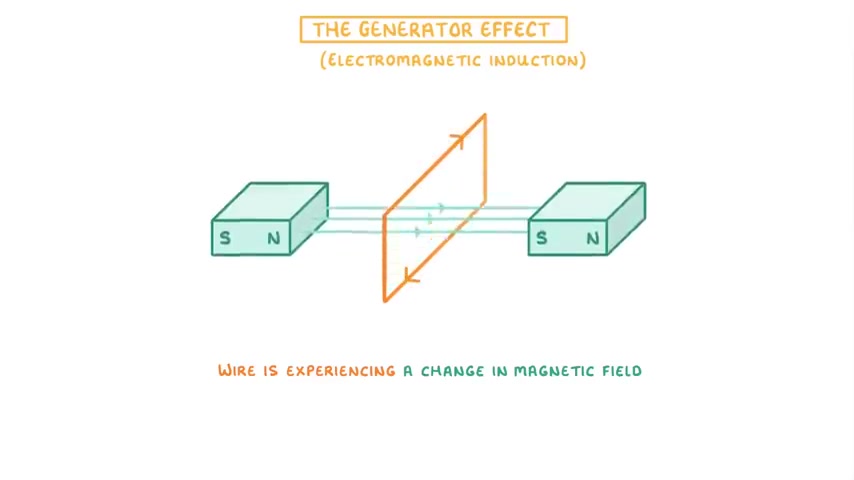
One of the most critical aspects of the generator effect is the necessity of motion or change. A stationary wire in a static magnetic field will not experience any induced voltage. For electromagnetic induction to occur, there must be a change in the magnetic flux – the amount of magnetic field 'lines' passing through the conductor.
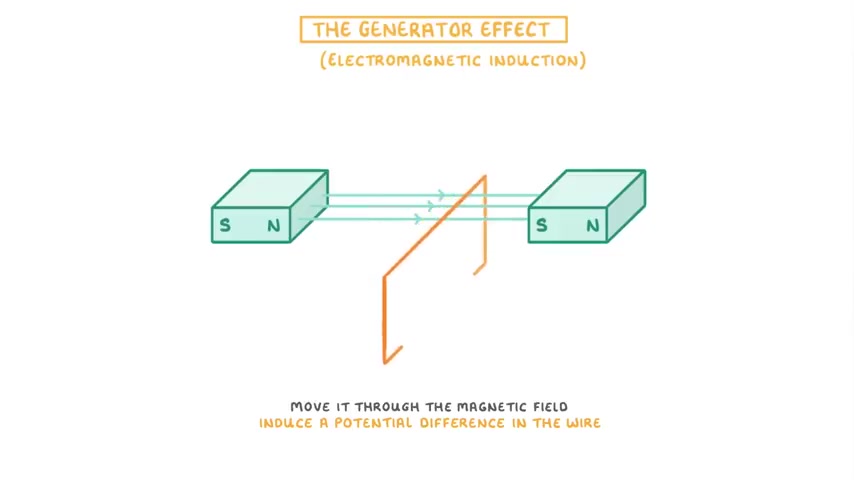
This change can be achieved in several ways:
- Moving the Conductor: If the wire moves through the magnetic field, it experiences a changing magnetic flux, inducing a voltage.
- Moving the Magnet: Alternatively, keeping the wire stationary and moving the magnet also creates a changing magnetic flux, resulting in voltage induction.
- Changing the Magnetic Field Strength: Varying the strength of the magnetic field around the conductor (e.g., by using an electromagnet with a fluctuating current) also induces a voltage.
The rate of change is directly proportional to the induced voltage. A faster movement or a more rapid change in magnetic field strength will generate a higher voltage. This is why generators are often designed with rapidly rotating coils and strong magnetic fields to maximize electrical output. It's this dynamic interaction between the conductor and the magnetic field that truly defines the generator effect.
Here's a table summarizing the factors affecting induced potential difference:
| Factor | Effect on Induced Potential Difference | Example |
|---|---|---|
| Magnetic Field Strength | Higher strength = Higher voltage | Using stronger magnets in a generator |
| Speed of Movement | Higher speed = Higher voltage | Rotating the coil faster in a generator |
| Number of Turns (in coil) | More turns = Higher voltage | Increasing the number of wire loops in a generator's coil |
| Angle of Movement | Optimal angle = Maximum voltage | Moving the wire perpendicular to the magnetic field lines for maximum effect |
Understanding these factors is crucial for optimizing the design and performance of electrical generators and other devices that rely on electromagnetic induction.
Circuits: The Pathway for Current Flow
While electromagnetic induction creates a voltage, a voltage alone doesn't guarantee an electrical current. For a current to flow, there needs to be a closed circuit, a complete path for electrons to move.
Imagine the wire as a section of a water pipe. The induced voltage is like water pressure – it creates the potential for flow. However, if the pipe is not connected to form a complete loop, the water (electrons) cannot circulate, and there is no current.
Therefore, to harness the generator effect effectively, the conductor (wire) must be part of a circuit. This typically involves connecting the ends of the wire to a load – a device that consumes electrical energy, such as a light bulb or a motor. When the circuit is complete, the induced voltage drives electrons through the circuit, powering the load. Without this closed loop, the induced voltage remains merely a potential, unable to perform any useful work.









Most people like


























Report
Please select a reason for reporting
- 13 Reasons to Switch from Snapchat to Text Messaging
- 7 Powerful Speech to Text Apps to Boost Productivity
- 10 Best Speech to Text Tools for Effortless Transcription
- 13 Free Tools to Easily Transcribe Audio to Text
- 15 Surprising Ways Google's Speech-to-Text Boosts Productivity
- 7 Best Free Online Audio to Text Transcription Tools
- 9 Tips to Transcribe Speech to Text Faster and Better
- 13 Best Speech to Text Software for Windows 10 in 2023
- 7 Tips for Choosing the Best Transcriber for Audio to Text
- 11 Reasons Why Dragon Speech-to-Text Apps are Game-Changers
- 6 Secrets to Enhance Your Speech to Text Transcription
- 6 Brilliant Ways to Boost Productivity with Talk-to-Text on Your MacBook
- 6 Ways Transcription Software Converts Audio to Text
- 8 Tips to Transcribe Speech to Text Like a Pro
- 6 Reasons IBM Watson Speech to Text is a Game-Changer
- 14 Powerful Ways Talk-to-Text Improves Your Workflow
- 12 Top Windows Speech-to-Text Software for Efficient Transcription
- 12 Game-Changing Benefits of Apple's Speech to Text Technology
- 9 Powerful Use Cases for AWS Speech to Text Technology
- 10 Easy Steps to Transcribe YouTube Videos to Text
- transcription audio en texte
- online audio transcription
- free audio file transcription
- free ai audio transcription
- audio transcription service
- audio transcription online free
- audio transcription free online
- audio to transcription software
- audio and transcript
- ai audio transcription free
- voice recording to text converter
- translate voice recording to text
- record voice to text
- audio recording to text converter
- voice recording and transcription
- chatgpt voice to text
- gmail voice to text
- speech to text reader
- speech to text ai free
- speech to talk
- Create Engaging Animated Explainer Videos with a Free AI Tool
- Stop Multi-Subscribing: Benchmark Top AI Visual Models in One Canvas
- Best Seedance 2.5 API Provider: Every Price on the Market, Checked at Source
- AI OnlyFans: How to Generate $30,000/Month (Legally)
- Transform Your Script into an Engaging Video with AI Video Maker!
- AI Marketing Automation: A Comprehensive Guide for Small Businesses
- Midjourney Alternative for Anime Art Creators: Why PixAI May Be Better for Character Workflows
- 10 Things Most People Get Wrong About AI Image Search
- AI Girlfriend Apps: Top Choices Redefining Relationships 2025
- How to Reduce Quoting Errors in Salesforce with AI-Assisted Quote Creation
- Summarize PDFs on Mobile with AI: A Simple Guide
- Translate Documents Easily: Canva's AI Translation Tool
- DTP AI: Revolutionizing Document Conversion & Translation
- UPDF AI: Revolutionizing PDF Editing with AI Power
- Foxit PDF Editor AI Assistant: Boost PDF Accessibility Effortlessly
- Wondershare PDFelement: Best AI PDF Editor for 2025
- Wondershare PDFelement 11: AI-Powered PDF Editor Review
- Wondershare PDFelement: The Ultimate AI-Powered PDF Editor Review
- Immersive Translate: Break Language Barriers in Web3
- Immersive Translate: AI-Powered Bilingual Website & PDF Translation

Copyright ©2026 toolify