































Table of Contents
- Key Points
- Understanding Knowledge Graphs
- Creating Knowledge Graphs: A Data-Model-First Approach
- Converting Text To Knowledge Graphs (Walkthrough)
- LLMs for Knowledge Graph Creation: Weighing the Pros and Cons
- FAQ
- Related Questions



Understanding Knowledge Graphs
What is a Knowledge Graph?
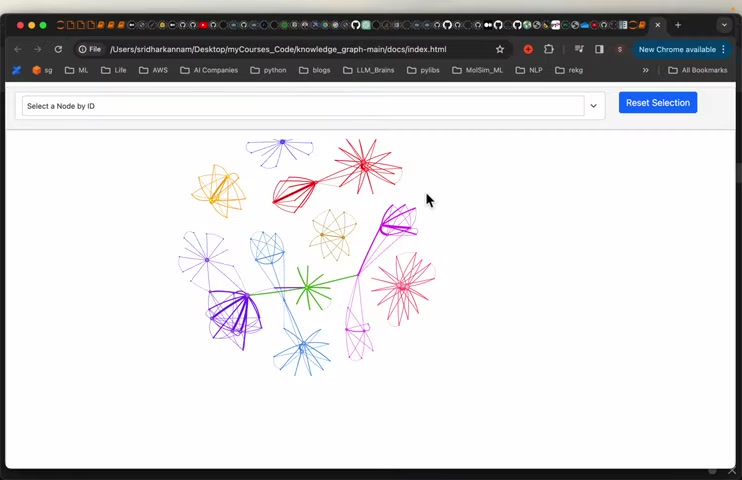
A knowledge graph is a structured representation of knowledge comprising entities, concepts, and relationships between them. Essentially, it's a network of interconnected data points, allowing for a more comprehensive understanding of information than traditional databases or unstructured text. In a Knowledge Graph:
- Nodes: These represent entities or concepts. For example, in the context of Sports, a node might represent a player, a team, or a coach. Nodes are also known as entities.
- Edges: These represent the relationships between nodes. For example, a player is part of a team, or a coach is the coach of a team.
Knowledge graphs excel at illustrating connections and dependencies, allowing for sophisticated data analysis and knowledge discovery. They represent information in a clear and concise manner. Key features of knowledge graphs include:
- Nodes (Entities)
- Relationships
These graphs become especially useful when dealing with massive volumes of unstructured or semi-structured data, offering a powerful technique for extracting key insights. By mapping out information and its interconnections, knowledge graphs help in making complex information understandable and actionable.
For example, consider commentary from an Australian Football League (AFL) match . Raw text is essentially noise, but using an LLM, we can convert that raw text into a knowledge graph. This can unlock valuable information about the match. Here's how one can think of this.
| Concept | Description |
|---|---|
| Nodes | Represents entities or concepts |
| Edges | Represents the relationships between entities |
The Role of Large Language Models (LLMs)
Large Language Models (LLMs) significantly streamline the process of knowledge graph creation from unstructured text data.
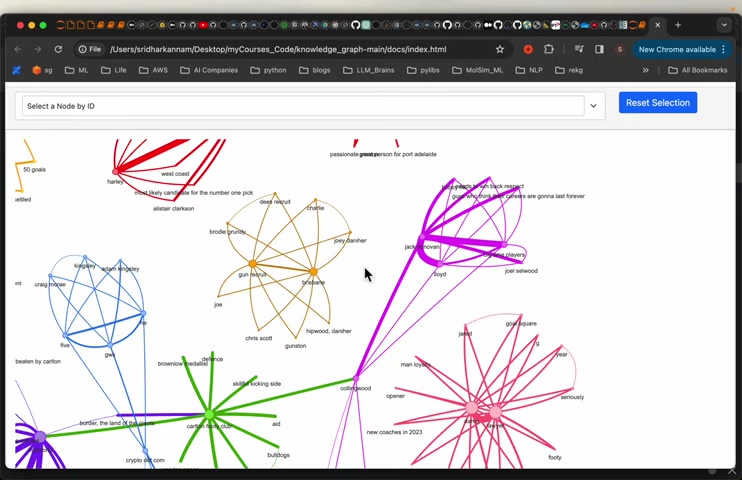
LLMs analyze the text, identify key entities and relationships, and generate a structured knowledge graph. Think of LLMs as intelligent engines that extract and refine these elements with amazing precision.
The typical flow of turning text to a knowledge graph is:
- Input source text
- The LLM scans the text, and extracts entities and relationships.
- Constructs the knowledge graph from those entities and relationships.
There are two primary approaches when constructing a knowledge graph:
- Data-Model First: In this approach, you define the structure and types of entities and relationships before processing any data. In the sports commentary example, we understand key terms like ‘players’, ‘teams’, and ‘coaches’ and the relationships between them.
- LLM-First (Open Ended Approach): In this method, you let the LLM determine the structure of the knowledge graph. The LLM first scans data and then determines what types of nodes and relationships it will use.
Creating Knowledge Graphs: A Data-Model-First Approach
Data Model Definition
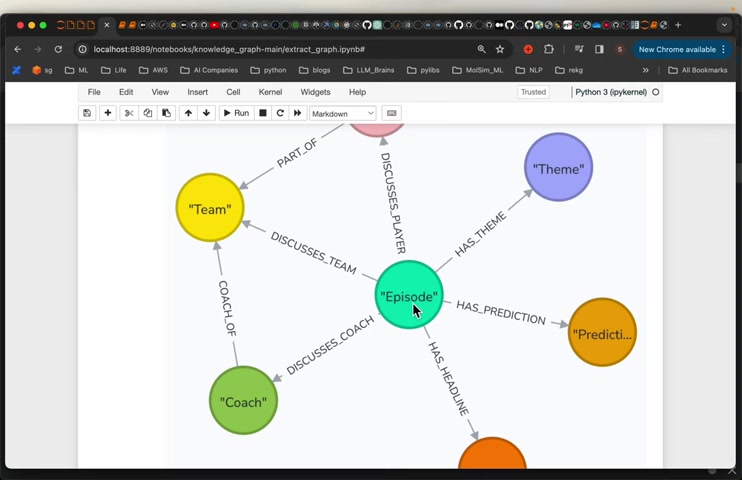
The 'Data Model first' strategy starts with knowing the data very well. Consider a sports commentary for instance, one likely knows most key parts. An Outline of what to include might consist of:
- Players
- Teams
- Coaches
- Themes
- Headlines
- Predictions
- Games
One would have some relationship between a team, its coaches, a player that is a part of the team. Then, one could connect those to games. Moreover, one could add predicted headlines based on the Game. One would also need the LLM to only use the edges and relationship predefined and nothing else. In other words, using a data model first is all about explicit relationships. However, how does the open-ended approach differ?
LLM first / Open Ended Approach
In the open-ended approach, the workflow fundamentally changes. One no longer defines in advance the relationships. Rather, one allows the LLM to scan a series of documents, define relationships, and build the knowledge graph in totality
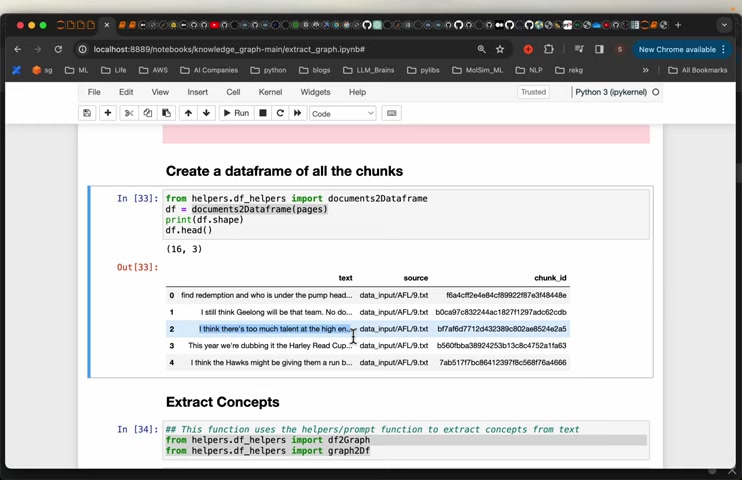
. This offers some benefits, such as:
- Finding things you were not explicitly looking for (unknown unknowns)
- Reduced bias given the lack of predefined relationships.
To utilize the open ended workflow, one needs to leverage the correct python libraries. Langchain is a core component for document loading, though it’s no longer strictly required. To work with data effectively, one may also leverage Pandas. Dataframes can be especially useful for the manipulation and aggregation of text.
Converting Text To Knowledge Graphs (Walkthrough)
Steps to Convert Text to Knowledge Graph
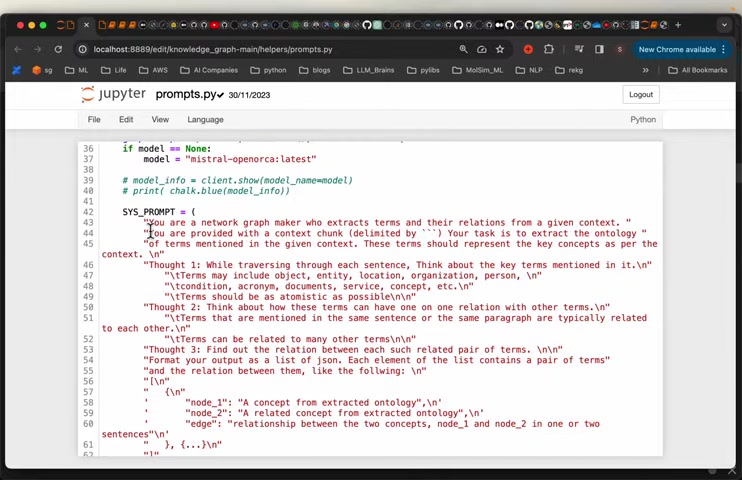
To convert text to a knowledge graph, follow these steps:
- Import libraries: Begin by importing necessary Python libraries, including
pandasandlangchain. - Loading Text Data One needs to load all the documents into a data structure (e.g. dataframes). Loading can handle PDFs, text files, or even audio files converted to text. The key is processing all documents the same way.
- Chunking of text. For long form text, one should process each document and chunk the text. For example, one can iterate through the text every 1500 tokens or so, with 150 tokens of overlap.
- Extract entities and relationships. One must extract the main concepts from each chunk of text. One can use an LLM via a service such as OLLAMA or others.
- Process Each chunk of text using an LLM. The user Prompt drives the output of the nodes and edges for one's knowledge graph.
- Format the data. One format the resulting data into JSON format.
- Merge all extracted knowledge One must transform this into a singular knowledge graph.
- Analyze and refine. Analyze, as needed, what relationships are Present and refine as needed. An LLM can also further classify the relationships.






Most people like


































Report
Please select a reason for reporting
- 13 Reasons to Switch from Snapchat to Text Messaging
- 7 Powerful Speech to Text Apps to Boost Productivity
- 10 Best Speech to Text Tools for Effortless Transcription
- 13 Free Tools to Easily Transcribe Audio to Text
- 15 Surprising Ways Google's Speech-to-Text Boosts Productivity
- 7 Best Free Online Audio to Text Transcription Tools
- 9 Tips to Transcribe Speech to Text Faster and Better
- 13 Best Speech to Text Software for Windows 10 in 2023
- 7 Tips for Choosing the Best Transcriber for Audio to Text
- 11 Reasons Why Dragon Speech-to-Text Apps are Game-Changers
- 6 Secrets to Enhance Your Speech to Text Transcription
- 6 Brilliant Ways to Boost Productivity with Talk-to-Text on Your MacBook
- 6 Ways Transcription Software Converts Audio to Text
- 8 Tips to Transcribe Speech to Text Like a Pro
- 6 Reasons IBM Watson Speech to Text is a Game-Changer
- 14 Powerful Ways Talk-to-Text Improves Your Workflow
- 12 Top Windows Speech-to-Text Software for Efficient Transcription
- 12 Game-Changing Benefits of Apple's Speech to Text Technology
- 9 Powerful Use Cases for AWS Speech to Text Technology
- 10 Easy Steps to Transcribe YouTube Videos to Text
- transcription audio en texte
- online audio transcription
- free audio file transcription
- free ai audio transcription
- audio transcription service
- audio transcription online free
- audio transcription free online
- audio to transcription software
- audio and transcript
- ai audio transcription free
- voice recording to text converter
- translate voice recording to text
- record voice to text
- audio recording to text converter
- voice recording and transcription
- chatgpt voice to text
- gmail voice to text
- speech to text reader
- speech to text ai free
- speech to talk
- Design Professional Flyers for Free on Your Phone
- Best Free Flyer Maker Apps for Android: Design Like a Pro
- How to Know If Your Business Is Ready for an AI Customer Service Agent
- Revolutionizing Storytelling: From Novels to Screenplays with AI
- Create Engaging Animated Explainer Videos with a Free AI Tool
- Stop Multi-Subscribing: Benchmark Top AI Visual Models in One Canvas
- Best Seedance 2.5 API Provider: Every Price on the Market, Checked at Source
- AI OnlyFans: How to Generate $30,000/Month (Legally)
- Transform Your Script into an Engaging Video with AI Video Maker!
- AI Marketing Automation: A Comprehensive Guide for Small Businesses
- Design Professional Flyers for Free on Your Phone
- Best Free Flyer Maker Apps for Android: Design Like a Pro
- Unleash Creativity: AI Coloring Pages with ColoringBook.ai
- Generate Stunning AI Photos with Google Gemini: A Guide
- Boost Your Etsy Sales with Stunning Digital Invitations!
- Revolutionize Your Etsy Listing with AI Text Generator
- Create Coloring Pages with AI: A Bing AI Tutorial
- Photo Lab App: Transform Your Photos with Stunning AI Effects
- Effortless Design: Rewriting Text with Microsoft Designer's AI
- Create & Sell Kids' Coloring Books with AI - KDP Guide

Copyright ©2026 toolify