































Table of Contents
- Key Points
- Understanding the Power of Document AI
- Simplified Operations with Document AI: A Step-by-Step Approach
- Document AI Pricing
- Benefits and Drawbacks
- Exploring Document AI's Key Features
- Key Use Cases for Document AI in Various Industries
- Frequently Asked Questions About Document AI
- Related Questions


Understanding the Power of Document AI
OCR, ICR, and NLP Technologies Overview:
It is important to understand what these three technologies do.
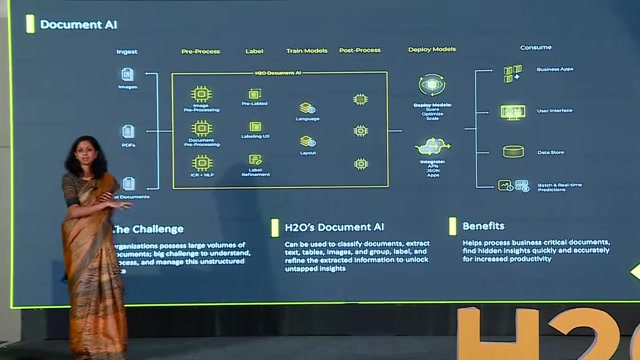
mentioned OCR, ICR, and NLP, so that will be defined in this section
- Optical Character Recognition (OCR): OCR is a technology that enables you to convert different types of documents, such as scanned paper documents, PDF files or images captured by a digital camera into editable and searchable data. In other words, OCR allows you to turn images of text into actual text you can use on a computer.
- Intelligent Character Recognition (ICR): ICR systems can interpret handwriting styles that are machine printed, but they work by using special software that reads and understands the fonts and various Handwriting strokes in a document or on an image file. Using ICR software programs can automate many types of data entry tasks, especially those with handwritten information.
- Natural Language Processing (NLP): Natural language processing (NLP) is an interdisciplinary subfield of linguistics, computer science, and artificial intelligence concerned with giving computers the ability to process human language.
The Challenge of Unstructured Data
Organizations possess large volumes of documents but have a hard time understanding, managing, and processing the unstructured data.

mentions that this is the challenge that Document AI tries to solve by mining data and creating insights for customers that brings more value.
Data comes in different forms like PDFs, and text documents. Without Document AI, businesses face significant hurdles in leveraging this information effectively. The most common challenges include:
- Manual Data Entry: Traditionally, extracting data from documents involves manual data entry, which is time-consuming, prone to errors, and costly.
- Limited Scalability: As data volumes grow, manual processes become increasingly difficult to scale, hindering the ability to handle larger workloads.
- Difficulty in Analysis: Unstructured data cannot be easily analyzed using conventional methods, making it challenging to identify trends, patterns, and insights.
- Compliance Risks: Ensuring data accuracy and compliance with regulatory requirements becomes more complex with manual data handling. Document AI addresses these challenges by automating the extraction and analysis of unstructured data, empowering organizations to optimize their operations and gain a competitive edge.
Simplified Operations with Document AI: A Step-by-Step Approach
Integrate APIs and json apps:
Use APIs to quickly integrate information, customize scale, and deploy modular scores.
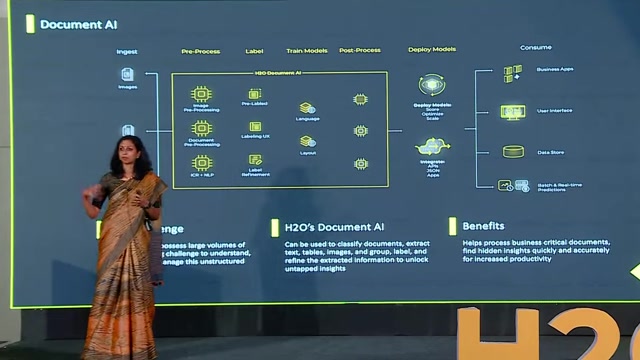
Business Applications Usage
Can be used for many applications, for example, user interfaces, batch and real-time predictions, and data stores.
Exploring Document AI's Key Features
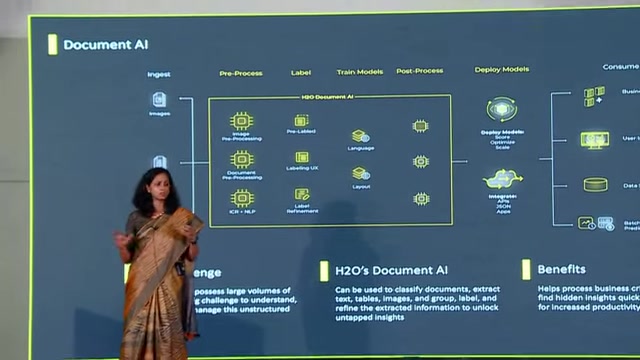
Pre-Processing
This includes labeling UX, image pre-processing, language models, and document pre-processing.
Pre-labeled Model:
This includes labeling UX, language models, and label refinements.
AI for Good: Abuse in Transaction Descriptions
This model creates transaction abuse detection and includes the transactions scored, relationships identified, repeat offenders, customer contacted, customers cautioned, relationships flagged over time, and customers contacted over time.
This can help detect transactions proactively and is something to be proud of to scale across.
Key Use Cases for Document AI in Various Industries
Customer Onboarding and Verification
Streamlining customer onboarding processes is a critical application of Document AI. By automating the extraction of data from documents such as account opening forms, identity documents, and utility bills, businesses can significantly reduce the time and effort required to onboard new customers.
- Automated data extraction of customer onboarding documents, which include account opening forms and identity documents.
-
Reduce new client onboarding.
Document AI also plays a key role in customer verification, ensuring compliance with regulatory requirements and preventing fraud.
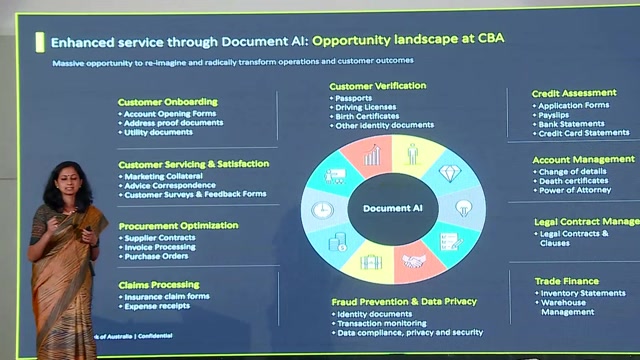
mentions the importance of Customer verification, and provides examples such as passports and driver licenses
Compliance and Regulatory Reporting
Document AI can automate data extraction from compliance documents and regulatory reports, ensuring accuracy and adherence to regulatory standards. The Commonwealth Bank has to comply with standards, and Dan touches up on that when he mentions being a regulated entity.
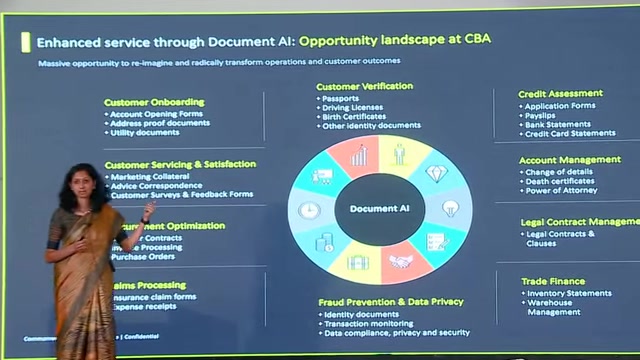
He mentioned death certificates and power of attorney.
Claims Processing in Insurance
In the insurance industry, Document AI can accelerate claims processing by automatically extracting data from claim forms, medical records, and expense receipts. This automation reduces manual effort, minimizes errors, and speeds up the claims settlement process, improving customer satisfaction.
Account Management
Dan mentions change of details, death certificates, and power of attorney, and these can all be managed with Document AI. This reduces a lot of paper and processing power.
Fraud Prevention and Data Privacy
Dan touches up on the ability of Document AI being able to prevent fraud and transaction monitoring. With data privacy and security, Document AI helps with data compliance, maintaining privacy and security.
Trade Finance
Inventory statements, warehouse management, can all be done with Document AI.





Most people like

































Report
Please select a reason for reporting
- 13 Reasons to Switch from Snapchat to Text Messaging
- 7 Powerful Speech to Text Apps to Boost Productivity
- 10 Best Speech to Text Tools for Effortless Transcription
- 13 Free Tools to Easily Transcribe Audio to Text
- 15 Surprising Ways Google's Speech-to-Text Boosts Productivity
- 7 Best Free Online Audio to Text Transcription Tools
- 9 Tips to Transcribe Speech to Text Faster and Better
- 13 Best Speech to Text Software for Windows 10 in 2023
- 7 Tips for Choosing the Best Transcriber for Audio to Text
- 11 Reasons Why Dragon Speech-to-Text Apps are Game-Changers
- 6 Secrets to Enhance Your Speech to Text Transcription
- 6 Brilliant Ways to Boost Productivity with Talk-to-Text on Your MacBook
- 6 Ways Transcription Software Converts Audio to Text
- 8 Tips to Transcribe Speech to Text Like a Pro
- 6 Reasons IBM Watson Speech to Text is a Game-Changer
- 14 Powerful Ways Talk-to-Text Improves Your Workflow
- 12 Top Windows Speech-to-Text Software for Efficient Transcription
- 12 Game-Changing Benefits of Apple's Speech to Text Technology
- 9 Powerful Use Cases for AWS Speech to Text Technology
- 10 Easy Steps to Transcribe YouTube Videos to Text
- transcription audio en texte
- online audio transcription
- free audio file transcription
- free ai audio transcription
- audio transcription service
- audio transcription online free
- audio transcription free online
- audio to transcription software
- audio and transcript
- ai audio transcription free
- voice recording to text converter
- translate voice recording to text
- record voice to text
- audio recording to text converter
- voice recording and transcription
- chatgpt voice to text
- gmail voice to text
- speech to text reader
- speech to text ai free
- speech to talk
- How to Use AI Tools to Find Internal Linking Opportunities Across a Business Website
- Discover Your Perfect Haircut with AI Hairstyle Apps
- Free Reputation Calculator Tools: How They're Adapting to Score AI Visibility, Not Just Rankings
- Design Professional Flyers for Free on Your Phone
- Best Free Flyer Maker Apps for Android: Design Like a Pro
- How to Know If Your Business Is Ready for an AI Customer Service Agent
- Revolutionizing Storytelling: From Novels to Screenplays with AI
- Create Engaging Animated Explainer Videos with a Free AI Tool
- Stop Multi-Subscribing: Benchmark Top AI Visual Models in One Canvas
- Best Seedance 2.5 API Provider: Every Price on the Market, Checked at Source
- Top AI Social Media Management Tools: Automate Your Content Strategy
- Free AI Text to Video Generator: Create Stunning Videos from Text
- Discover 17 ChatGPT Alternatives: A Comprehensive Comparison
- Character.AI vs. Janitor AI: Which AI Chat Platform Reigns Supreme?
- Top Virtual Assistant Companies in 2026: Reviews, Pricing, and Plans Compared
- Unveiling FaceCheck.ID: Revolutionizing Reverse Image Searches with AI
- 11 Best AI Dialers in 2026: Features, Pricing, Pros and Cons
- How I Direct Consistent AI Clips: A Hands-On Guide to Multi-Model Generation
- A Realistic Review of the Photo Generator Image Tool
- Playwright MCP Server: Automated Web Testing with Agent Mode

Copyright ©2026 toolify