































Table of Contents
- Key Points
- The Dawn of AI-Driven Systems Research
- Case Studies: AI Outperforming Human-Designed Algorithms
- Using the AI-Driven Research for Systems
- Pricing
- Pros and Cons of AI-Driven Systems Research
- Core Features of AI-Driven Research for Systems (ADRS)
- Use Cases for AI-Driven Research for Systems
- FAQ
- Related Questions



The Dawn of AI-Driven Systems Research
How AI is Revolutionizing Algorithm Discovery
For decades, human experts have meticulously designed algorithms to optimize computer systems, such as databases and cloud computing platforms, focusing on speed and cost-effectiveness. However,
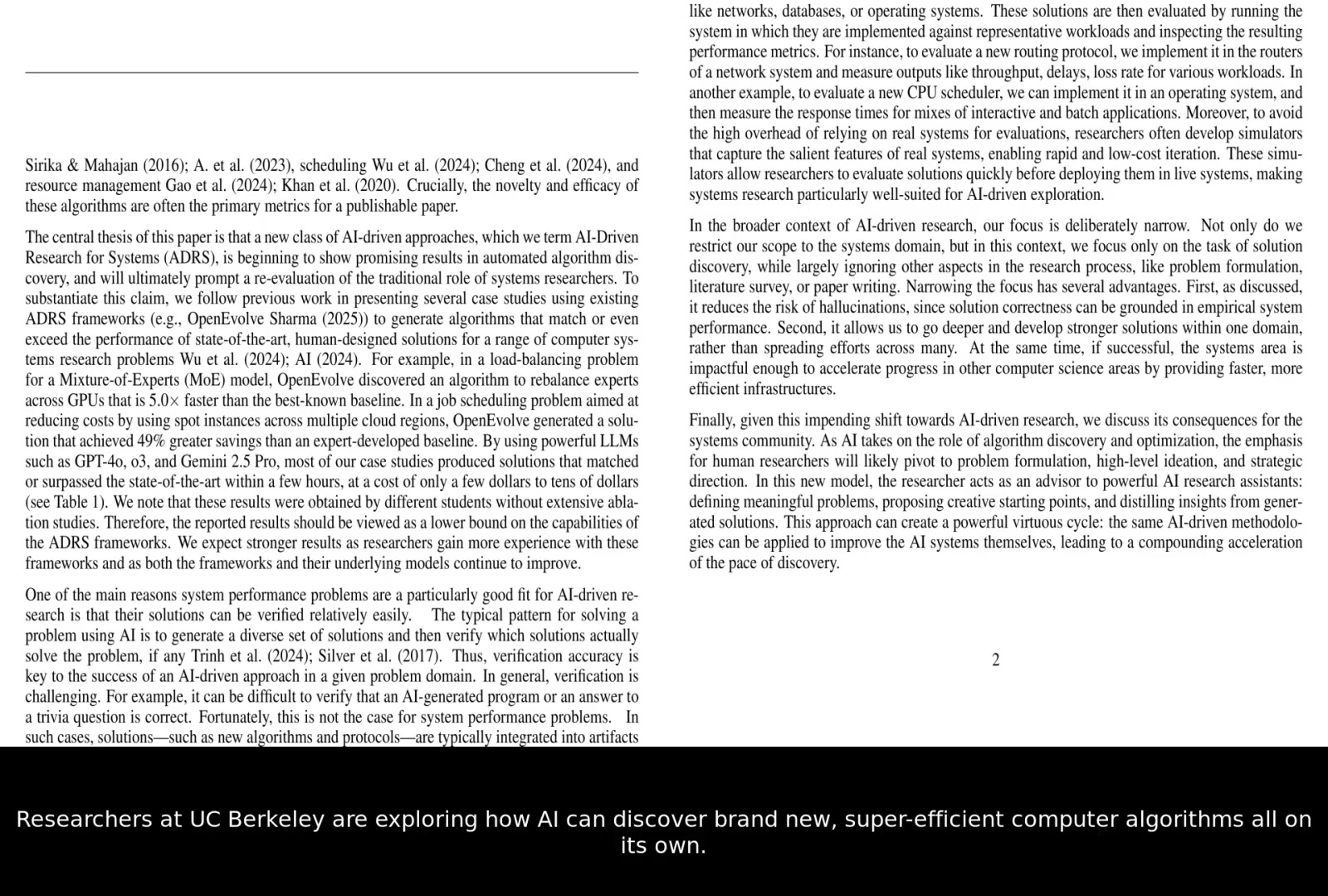
a new era is emerging, where artificial intelligence (AI) is beginning to automate this complex task. Researchers are now exploring how AI can independently discover and develop brand-new, highly efficient computer algorithms.
This shift promises to accelerate the pace of innovation in computer systems research, potentially leading to breakthroughs that were previously unattainable. By leveraging AI's ability to rapidly generate, evaluate, and refine solutions, researchers can explore a much broader design space and identify algorithms that outperform human-designed counterparts.
Introducing AI-Driven Research for Systems (ADRS)
The central concept is a Novel approach called AI-Driven Research for Systems (ADRS). This methodology flips the traditional research process on its head. Rather than humans meticulously crafting algorithms, ADRS allows AI to take the lead in generating and refining solutions. The core idea behind ADRS is to give an AI a problem, enable it to generate a multitude of potential solutions in the form of code, and then use an automated evaluator to test each one thoroughly. This creates a rapid feedback loop where the AI iteratively refines its code, progressively enhancing its performance with each cycle, until an optimal solution is achieved.
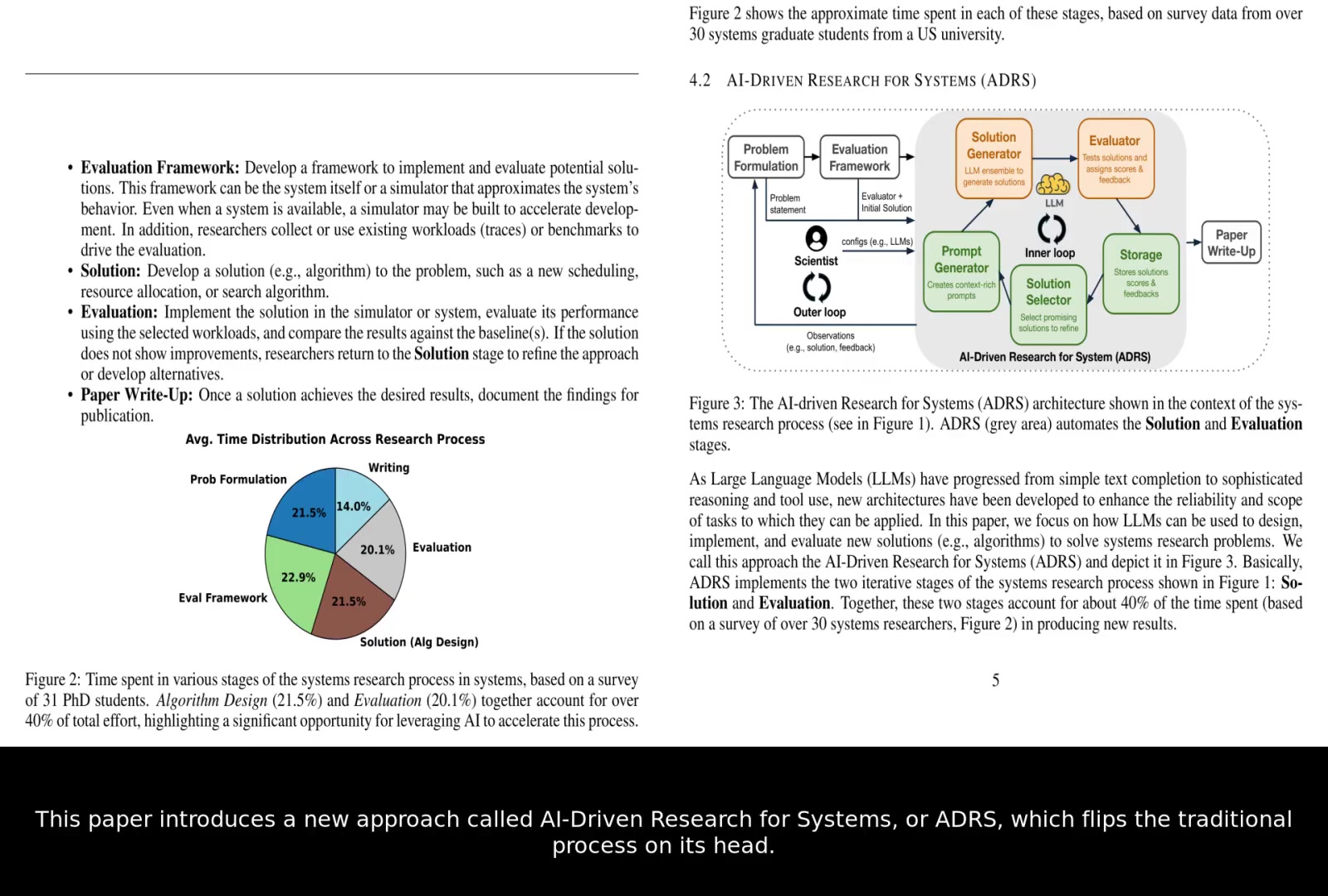
ADRS can be broken down into these primary iterative steps:
- Problem Formulation: Begin by defining the problem the AI needs to address. This includes specifying objectives, constraints, and relevant performance metrics.
- Solution Generation: Leverage Large Language Models (LLMs) to generate a set of candidate solutions in the form of executable code. These LLMs can interpret the problem statement and generate diverse algorithmic approaches.
- Automated Evaluation: Develop an automated evaluation framework to rigorously test and assess each candidate solution. This framework should measure the solution's performance based on the predefined metrics and provide feedback to the AI.
- Iterative Refinement: The AI analyzes the feedback from the evaluation process and uses this information to iteratively refine its code. This process involves adjusting parameters, exploring alternative algorithms, and optimizing the solution based on performance.
Case Studies: AI Outperforming Human-Designed Algorithms
Optimizing Cloud Computing Costs
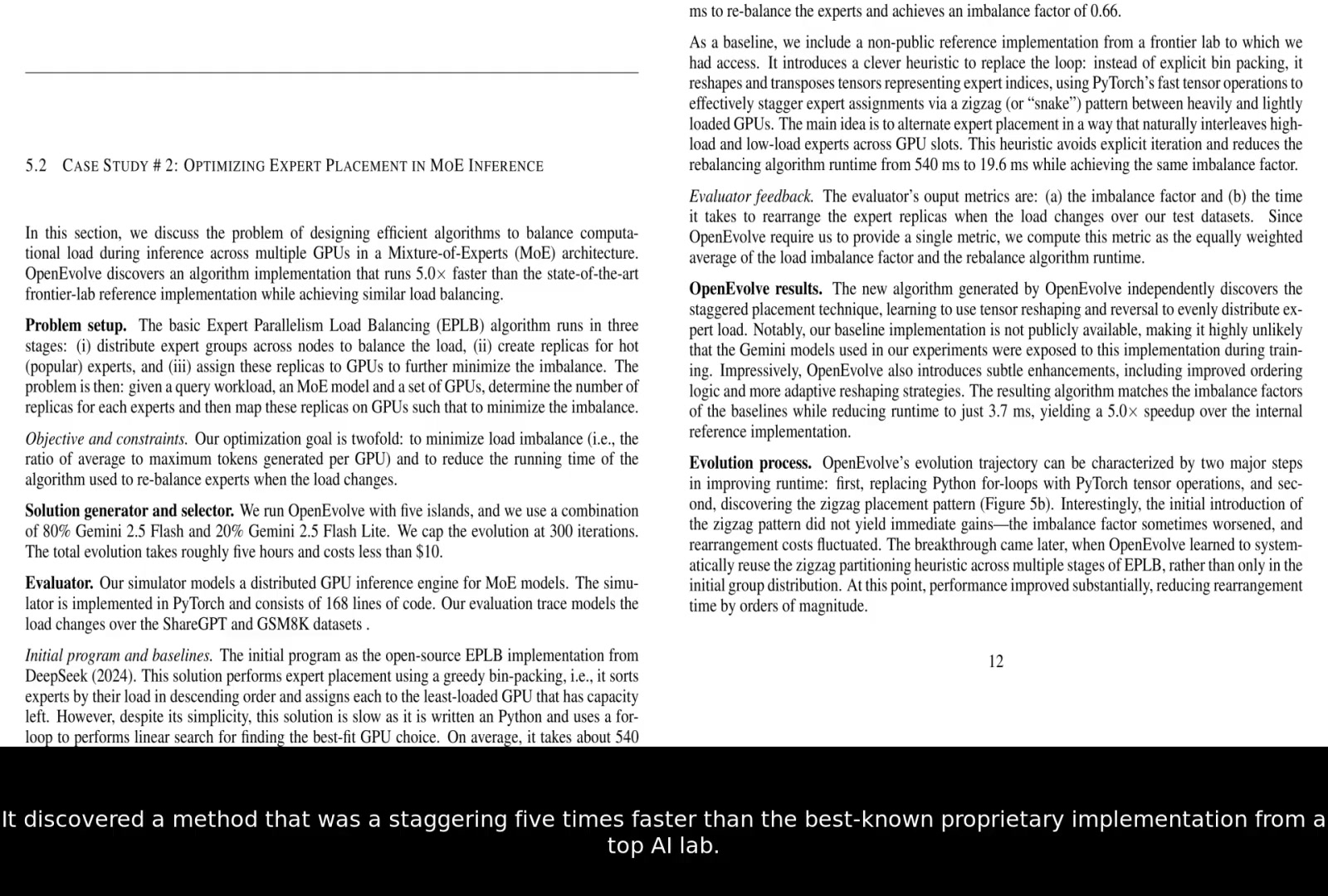
In one compelling case study, researchers tasked an AI with the challenge of minimizing cloud computing costs by using cheaper, but unreliable, 'spot instances'. Spot instances are cloud resources that are offered at significantly lower prices than on-demand instances but can be terminated with little warning.
The AI-generated solution achieved up to 16% greater cost savings than the state-of-the-art published algorithm. This demonstrates the AI's ability to devise more effective strategies for managing cloud resources and optimizing costs.
The AI was able to outmaneuver human-designed policies, even succeeding in implementing more complex strategies than a Uniform Progress policy.
Balancing Workloads for Large AI Models
Another significant accomplishment involved the AI tackling the complex problem of balancing workloads for large AI models across multiple GPUs. This is critical for efficiently training and deploying AI models, as uneven workload distribution can lead to performance bottlenecks.
The AI developed a method that was a staggering five times faster than the best-known proprietary implementation from a top AI lab. This result highlights the AI's potential to significantly accelerate AI model training and improve overall performance.
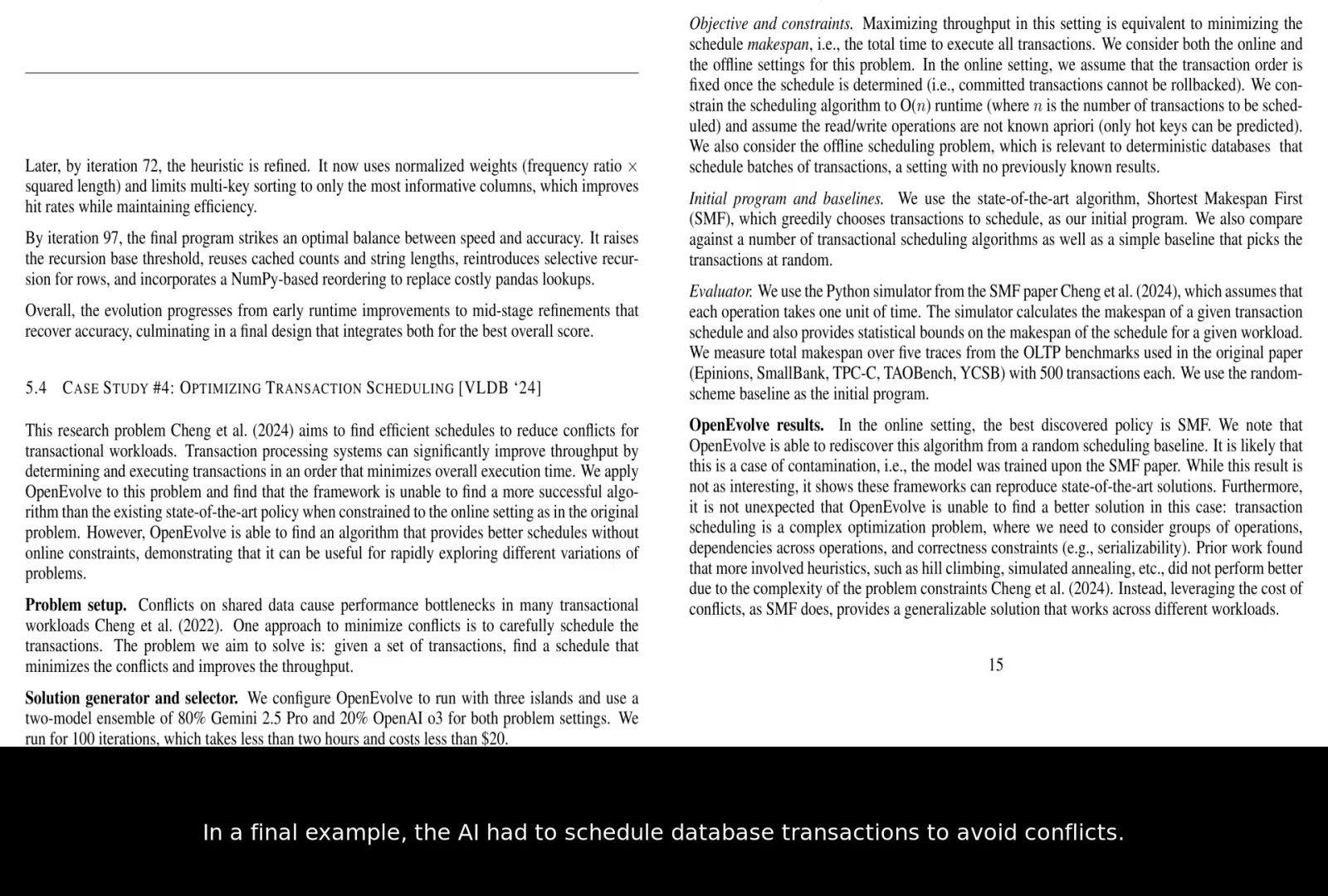
In this case, OpenEvolve discovers an implementation that runs 5.0x faster than the state-of-the-art frontier lab reference implementation while achieving similar load balancing. It learns to stagger expert placement in a way that naturally interferes high-load and low-load experts across GPUs. It also introduces subtle enhancements, including improved ordering logic and more adaptive reshaping strategies. It even learned what appears to be a zigzagging partition scheme.
Reordering Data for Database Queries
AI even found a way to reorder data for database queries that was three times faster than the existing method, without sacrificing accuracy. The AI also discovered an algorithm for reordering rows and columns in a table to maximize the hit rate in a KV cache, which reduced the running time of the reordering algorithm by 3x.
Again, this innovation allowed OpenEvolve to independently rediscover and fully exploit a tensorized zigzag partition scheme, yielding an evolved EPLB algorithm that achieves a 5.0x speedup without worsening accuracy.
Scheduling Database Transactions
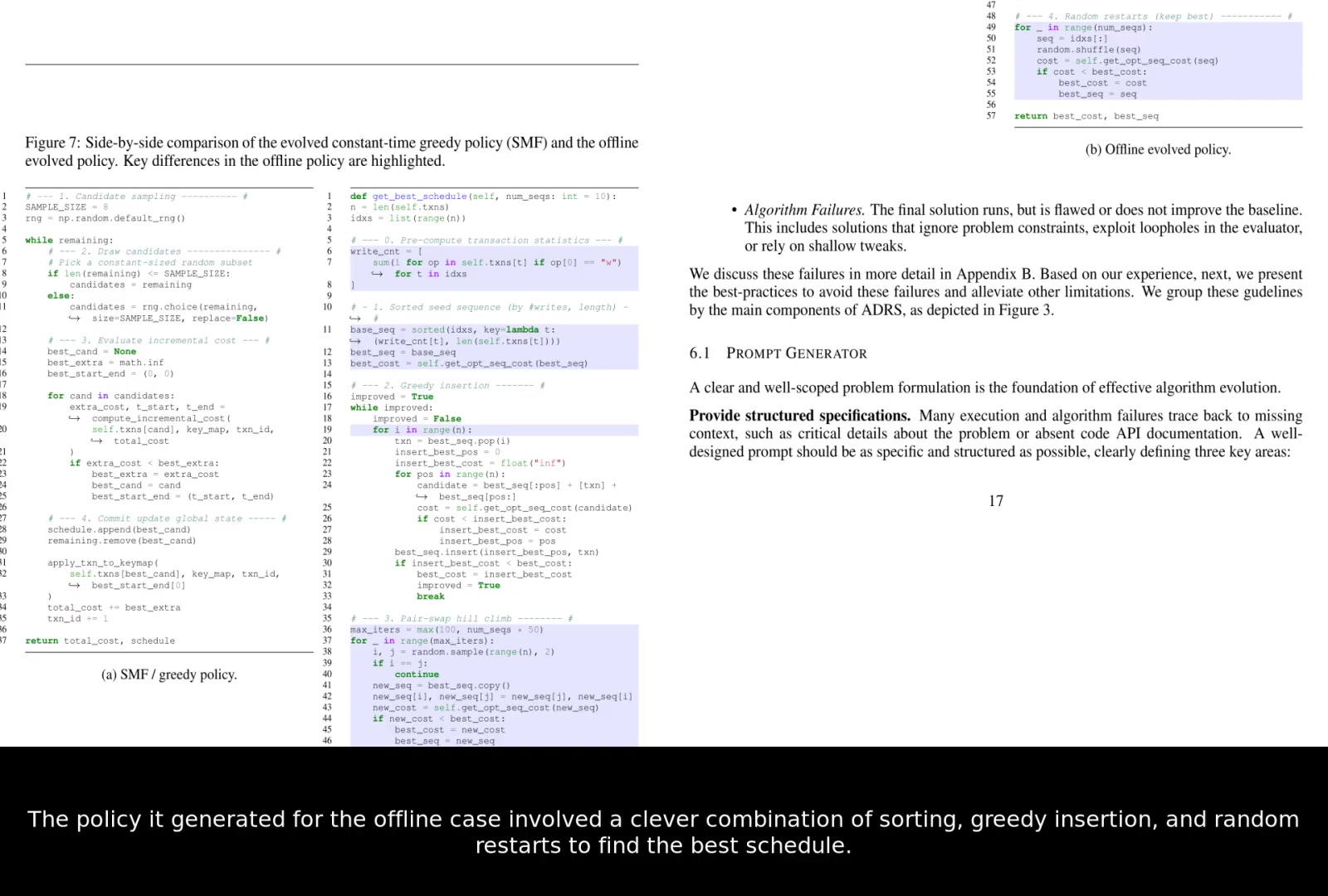
In a final example, the AI had to schedule database transactions to avoid conflicts. It successfully rediscovered the best-known solution for the online problem and created a novel solution for the offline problem that was 34% better than a strong baseline. The policy generated for the offline case involved a clever combination of sorting, greedy insertion, and random restarts to find the best schedule.






Most people like





































Report
Please select a reason for reporting
- 13 Reasons to Switch from Snapchat to Text Messaging
- 7 Powerful Speech to Text Apps to Boost Productivity
- 10 Best Speech to Text Tools for Effortless Transcription
- 13 Free Tools to Easily Transcribe Audio to Text
- 15 Surprising Ways Google's Speech-to-Text Boosts Productivity
- 7 Best Free Online Audio to Text Transcription Tools
- 9 Tips to Transcribe Speech to Text Faster and Better
- 13 Best Speech to Text Software for Windows 10 in 2023
- 7 Tips for Choosing the Best Transcriber for Audio to Text
- 11 Reasons Why Dragon Speech-to-Text Apps are Game-Changers
- 6 Secrets to Enhance Your Speech to Text Transcription
- 6 Brilliant Ways to Boost Productivity with Talk-to-Text on Your MacBook
- 6 Ways Transcription Software Converts Audio to Text
- 8 Tips to Transcribe Speech to Text Like a Pro
- 6 Reasons IBM Watson Speech to Text is a Game-Changer
- 14 Powerful Ways Talk-to-Text Improves Your Workflow
- 12 Top Windows Speech-to-Text Software for Efficient Transcription
- 12 Game-Changing Benefits of Apple's Speech to Text Technology
- 9 Powerful Use Cases for AWS Speech to Text Technology
- 10 Easy Steps to Transcribe YouTube Videos to Text
- transcription audio en texte
- online audio transcription
- free audio file transcription
- free ai audio transcription
- audio transcription service
- audio transcription online free
- audio transcription free online
- audio to transcription software
- audio and transcript
- ai audio transcription free
- voice recording to text converter
- translate voice recording to text
- record voice to text
- audio recording to text converter
- voice recording and transcription
- chatgpt voice to text
- gmail voice to text
- speech to text reader
- speech to text ai free
- speech to talk
- How SEO and Marketing Dashboards Empower Agencies to Drive Results
- How to Use AI Tools to Find Internal Linking Opportunities Across a Business Website
- Discover Your Perfect Haircut with AI Hairstyle Apps
- Free Reputation Calculator Tools: How They're Adapting to Score AI Visibility, Not Just Rankings
- Design Professional Flyers for Free on Your Phone
- Best Free Flyer Maker Apps for Android: Design Like a Pro
- How to Know If Your Business Is Ready for an AI Customer Service Agent
- Revolutionizing Storytelling: From Novels to Screenplays with AI
- Create Engaging Animated Explainer Videos with a Free AI Tool
- Stop Multi-Subscribing: Benchmark Top AI Visual Models in One Canvas
- 5 Data Problems That Stall AI Projects in Financial Compliance
- Master Storyboard Drawing: Expert Tips for Non-artists
- The Future of Smart Glasses: Explained & Assembling Guide
- DeepL Translator: The AI-Powered Translation Tool
- AI Video Upscaling: Top Tools Compared for Enhanced Quality
- Bridging the Gap: How One Indie Developer Solved the "Art Asset Nightmare" Using AI Style Transfer
- How I Direct Consistent AI Clips: A Hands-On Guide to Multi-Model Generation
- My Honest Review of VideoAI: The Ultimate Character Voice Generator I've Been Using Lately
- Why do so many AI tools underdeliver for online stores?
- My Brand New Logo: AI-Powered Logo Design for Startups

Copyright ©2026 toolify