

























Table of Contents
- Key Points
- Understanding Reinforcement Learning and its Challenges
- Future Directions and Research
- Causal Information Prioritization (CIP) Pros and Cons
- Decoding Causal Information Prioritization (CIP)
- Frequently Asked Questions about Causal Information Prioritization
- Related Questions


Understanding Reinforcement Learning and its Challenges
What is Reinforcement Learning?
Reinforcement learning is a type of machine learning where an agent learns to make decisions by interacting with an environment. The agent receives feedback in the form of rewards or penalties and uses this feedback to improve its decision-making process over time.
This learning paradigm is inspired by how humans and animals learn through experience. Imagine training a dog: you reward good behavior (like sitting) with a treat, and the dog gradually learns to associate the action with the reward.
In technical terms, a reinforcement learning problem is typically formalized as a Markov Decision Process (MDP). An MDP consists of states, actions, transition probabilities, and rewards. The agent starts in an initial state, takes an action based on its current policy, transitions to a new state according to the transition probabilities, and receives a reward. The goal of the agent is to learn a policy that maximizes the cumulative reward over time. This is an iterative process, that requires robots or AI agents to undergo lots of trail and errors.
Key components of reinforcement learning:
- Agent: The decision-maker that interacts with the environment.
- Environment: The world with which the agent interacts.
- State: A representation of the current situation of the environment.
- Action: A choice made by the agent that affects the environment.
- Reward: A scalar value that provides feedback to the agent about the quality of its action.
- Policy: A strategy that maps states to actions.
Reinforcement learning has found applications in various domains, including robotics, Game playing, finance, and Healthcare. For example, it can be used to train robots to perform complex tasks, develop AI agents that can play games at a Superhuman level, optimize trading strategies in financial markets, and personalize treatment plans for patients.
The Problem of Sample Inefficiency
Despite its potential, reinforcement learning faces several challenges, one of the most significant being sample inefficiency. This refers to the fact that reinforcement learning agents often require a massive amount of training data to learn effectively.

This is because traditional methods explore the environment without effectively prioritizing useful experiences, resulting in lots of wasteful trial and error. Imagine trying to learn how to ride a bike by randomly flailing your arms and legs – it would take a very long time to figure out the right combination of movements!
This reliance on extensive data limits the applicability of reinforcement learning in many real-world scenarios where data is scarce or expensive to obtain. For instance, training a robot to perform delicate surgical procedures requires a safe and controlled environment, but the number of real-world trials is inherently limited. Similarly, in drug discovery, the cost of running experiments to test new drug candidates can be prohibitive. The challenge of sample inefficiency hinders the widespread adoption of reinforcement learning.
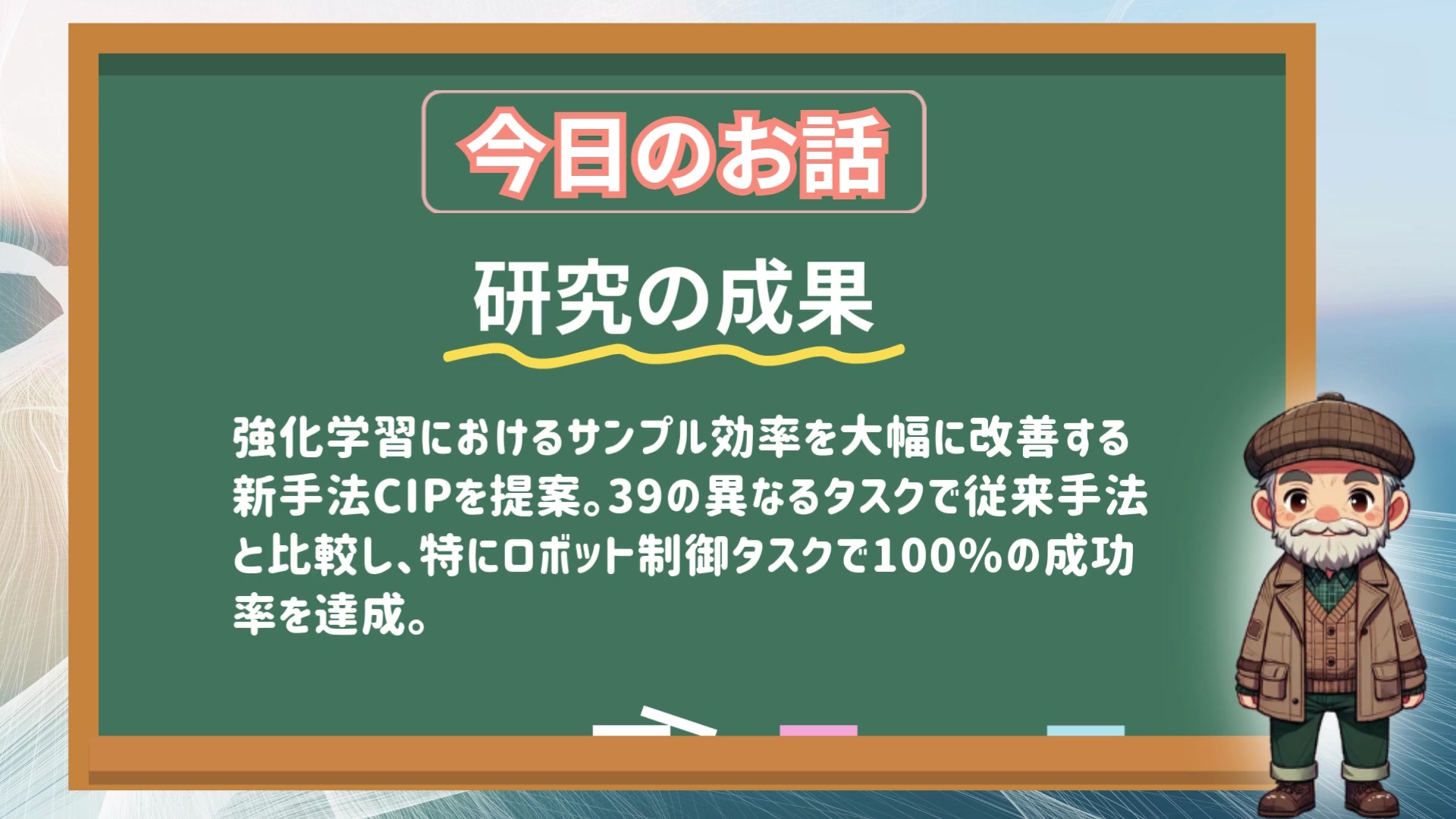
To address this problem, researchers have been exploring various techniques, including imitation learning, transfer learning, and hierarchical reinforcement learning. However, these methods often have their limitations and may not always be effective in improving sample efficiency. Causal Information Prioritization (CIP) presents a Novel approach by leveraging causal inference to guide the learning process and improve data efficiency.
Challenges with Ignoring Causal Relationships
Ignoring causal relationships in reinforcement learning can lead to several problems.

One key issue is that the agent might learn spurious correlations, leading to suboptimal policies. For example, if a robot is learning to grasp an object, it might mistakenly associate the color of the background with the success of the grasp, leading to incorrect actions when the background color changes.
Another problem is that traditional reinforcement learning methods often struggle to generalize to new environments. This is because they rely on memorizing specific state-action-reward relationships rather than learning the underlying causal mechanisms. As a result, the agent might perform well in the training environment but fail to adapt to changes in the environment's dynamics.
Further adding to the inefficencies of traditional RL methods is the fact that robots end up learning unnecessary information from each trial. In these circumstances the models get distracted with unimportant information such as the background or other states. As a result, much effort is wasted learning things that have little bearing on the task at HAND. To solve the sample efficiency and state understanding challenge, causal relationships must be introduced to the decision making progress.
Decoding Causal Information Prioritization (CIP)
The Core Idea Behind CIP
Causal Information Prioritization (CIP) operates under the principle that understanding the causal relationships between states, actions, and rewards is crucial for efficient reinforcement learning. Instead of blindly exploring the environment, CIP aims to identify and prioritize the information that is most Relevant for decision-making.

By focusing on the underlying causal mechanisms, CIP can learn more quickly and effectively, even with limited data.
Imagine teaching a child to bake a cake. Instead of letting them randomly mix ingredients, you would explain the role of each ingredient and how it affects the final product. This helps the child understand the causal relationships and learn more efficiently. CIP adopts a similar approach, allowing the agent to focus on the most important aspects of the learning problem.
The Technical Details: Structuring Causal Learning
CIP uses a structured causal model combined with a 'factored' MDP (Markov Decision Process). CIP models the causal relationships between states, actions, and rewards.

This allows the agent to reason about the consequences of its actions and identify the most relevant information for decision-making. This includes a state, reward and action space. However to build a model that actually functions, Causal matrixes must be created using DirectLiNGAM.
DirectLiNGAM: To extract the causal structure, direct Lingam is used to understand the causal relationship between the current state and reward. The system evaluates which of the inputs was most influential. For the agent, this allows the model to better understand its operating environment.
CIP leverages three innovative techniques to achieve this:
- Counterfactual Data Augmentation: Counterfactual reasoning helps agents imagine what would have happened if they had taken a different action. By generating counterfactual data, CIP can expand the training dataset and improve the agent's understanding of the environment. In the cake baking example, this would be like asking, "What would happen if I used baking soda instead of baking powder?"
- Causal Action Reweighting: CIP assigns different weights to actions based on their causal impact on the reward. Actions that have a strong positive impact are given higher weights, encouraging the agent to prioritize them. This is like telling the child that adding the right amount of sugar is more important than stirring the mixture.
- Causal Action Empowerment: CIP empowers the agent to take actions that have a high degree of control over the environment. This encourages exploration and helps the agent discover new and effective strategies. This is like letting the child experiment with different icing techniques to see which one produces the best result.
By integrating these three techniques, CIP enables reinforcement learning agents to learn more efficiently and effectively, even with limited data.





Most people like


































Report
Please select a reason for reporting
- 13 Reasons to Switch from Snapchat to Text Messaging
- 7 Powerful Speech to Text Apps to Boost Productivity
- 10 Best Speech to Text Tools for Effortless Transcription
- 13 Free Tools to Easily Transcribe Audio to Text
- 15 Surprising Ways Google's Speech-to-Text Boosts Productivity
- 7 Best Free Online Audio to Text Transcription Tools
- 9 Tips to Transcribe Speech to Text Faster and Better
- 13 Best Speech to Text Software for Windows 10 in 2023
- 7 Tips for Choosing the Best Transcriber for Audio to Text
- 11 Reasons Why Dragon Speech-to-Text Apps are Game-Changers
- 6 Secrets to Enhance Your Speech to Text Transcription
- 6 Brilliant Ways to Boost Productivity with Talk-to-Text on Your MacBook
- 6 Ways Transcription Software Converts Audio to Text
- 8 Tips to Transcribe Speech to Text Like a Pro
- 6 Reasons IBM Watson Speech to Text is a Game-Changer
- 14 Powerful Ways Talk-to-Text Improves Your Workflow
- 12 Top Windows Speech-to-Text Software for Efficient Transcription
- 12 Game-Changing Benefits of Apple's Speech to Text Technology
- 9 Powerful Use Cases for AWS Speech to Text Technology
- 10 Easy Steps to Transcribe YouTube Videos to Text
- transcription audio en texte
- online audio transcription
- free audio file transcription
- free ai audio transcription
- audio transcription service
- audio transcription online free
- audio transcription free online
- audio to transcription software
- audio and transcript
- ai audio transcription free
- voice recording to text converter
- translate voice recording to text
- record voice to text
- audio recording to text converter
- voice recording and transcription
- chatgpt voice to text
- gmail voice to text
- speech to text reader
- speech to text ai free
- speech to talk
- Meshy AI: How to Create 3D Models from Text and Images
- How SEO and Marketing Dashboards Empower Agencies to Drive Results
- How to Use AI Tools to Find Internal Linking Opportunities Across a Business Website
- Discover Your Perfect Haircut with AI Hairstyle Apps
- Free Reputation Calculator Tools: How They're Adapting to Score AI Visibility, Not Just Rankings
- Design Professional Flyers for Free on Your Phone
- Best Free Flyer Maker Apps for Android: Design Like a Pro
- How to Know If Your Business Is Ready for an AI Customer Service Agent
- Revolutionizing Storytelling: From Novels to Screenplays with AI
- Create Engaging Animated Explainer Videos with a Free AI Tool
- Automate Lead Generation: A Comprehensive Guide with AI Agents
- Revideo.io: The Future of Reverse Video Search Technology
- Revolutionizing Email Marketing Agency with AI
- Breaking the Character Drift Dilemma: A Practical Test of Smart Shot
- Meshy AI: How to Create 3D Models from Text and Images
- ASOMobile Helps Teams Benchmark App Store Screenshots Against Competitors
- How to Match LMS Software With Your Organization's Training Plan
- How to Convert BTC to HNT
- Unleashing the Power of AI: Cognizant's Roadmap for Transformation
- Frame to Video Review: A Practical Look at Turning Two Still Frames Into Motion

Copyright ©2026 toolify