































Table of Contents
- Key Points
- Understanding DeepLabv2: Semantic Image Segmentation
- Delving into the Technical Aspects of DeepLabv2
- Practical Uses of DeepLabv2
- Weighing the Scales: Pros and Cons of DeepLabv2
- Frequently Asked Questions about DeepLabv2
- Deep Dive: The Future of Semantic Image Segmentation and Beyond



Understanding DeepLabv2: Semantic Image Segmentation
What is Semantic Image Segmentation?
Semantic Image Segmentation is a computer vision task that involves classifying each pixel in an image to understand the scene at a granular level.
Unlike image classification, where an entire image is assigned a single label, semantic segmentation assigns a label to each pixel, grouping them into meaningful regions. This allows computers to understand the boundaries and relationships of objects within an image.
Semantic image segmentation differs from instance segmentation. Instance segmentation seeks to differentiate each instance of an object in an image as separate and unique objects even if they are the same class. In contrast, semantic segmentation only seeks to group objects of the same class together and does not need to treat objects of the same class differently.
Consider, for example, an image of a street scene. With semantic segmentation, the goal is to identify and label all pixels belonging to objects like roads, cars, pedestrians, buildings, and traffic signs. This detailed pixel-level understanding is critical for various applications, enabling more accurate and context-aware decision-making. The benefits of semantic image segmentation are significant and span many fields:
- Autonomous Driving: Allows self-driving cars to identify lanes, other vehicles, pedestrians, and traffic signals.
- Medical Imaging: Helps analyze medical scans, identifying tumors, lesions, and other anomalies at the pixel level.
- Robotics: Enables robots to perceive and interact with their environment, making them more versatile and efficient.
- Geospatial Analysis: Supports land cover mapping, urban planning, and environmental monitoring through satellite and aerial imagery analysis.
- Augmented Reality: Improves object recognition and environment understanding for more immersive AR experiences.
The DeepLab Family: A Series of Architectural Innovations
DeepLabv2 is part of a family of architectures that have evolved over time, each iteration building upon the strengths and addressing the weaknesses of its predecessors.
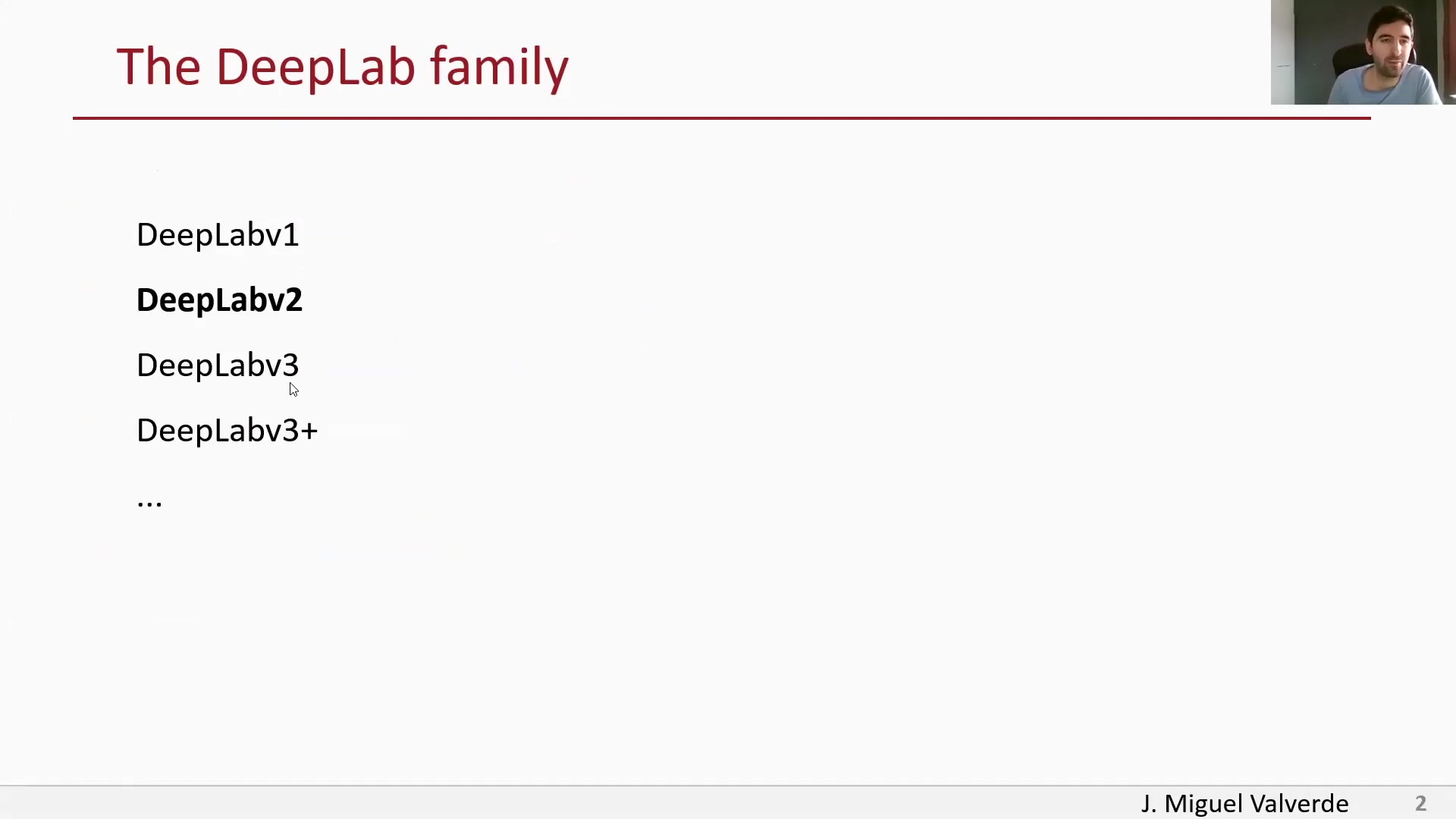
Understanding the evolution of the DeepLab family provides valuable context for appreciating the innovations introduced in DeepLabv2. The main DeepLab architectures are:
- DeepLabv1: The initial version introduced the concept of combining DCNNs with CRFs for improved segmentation accuracy.
- DeepLabv2: This version incorporates atrous convolution and ASPP (Atrous Spatial Pyramid Pooling) to capture multi-scale contextual information.
- DeepLabv3: DeepLabv3 refines the ASPP module to capture context at different scales and uses batch normalization more effectively.
- DeepLabv3+: The v3+ version improves upon DeepLabv3 by adding a decoder module, which refines segmentation boundaries by incorporating information from multiple scales.
DeepLabv2 is notable because it contains key components that can be used to understand other DeepLab architectures.
Delving into the Technical Aspects of DeepLabv2
Atrous Convolution: Preserving Resolution
At the heart of DeepLabv2 is atrous convolution, also known as dilated convolution.
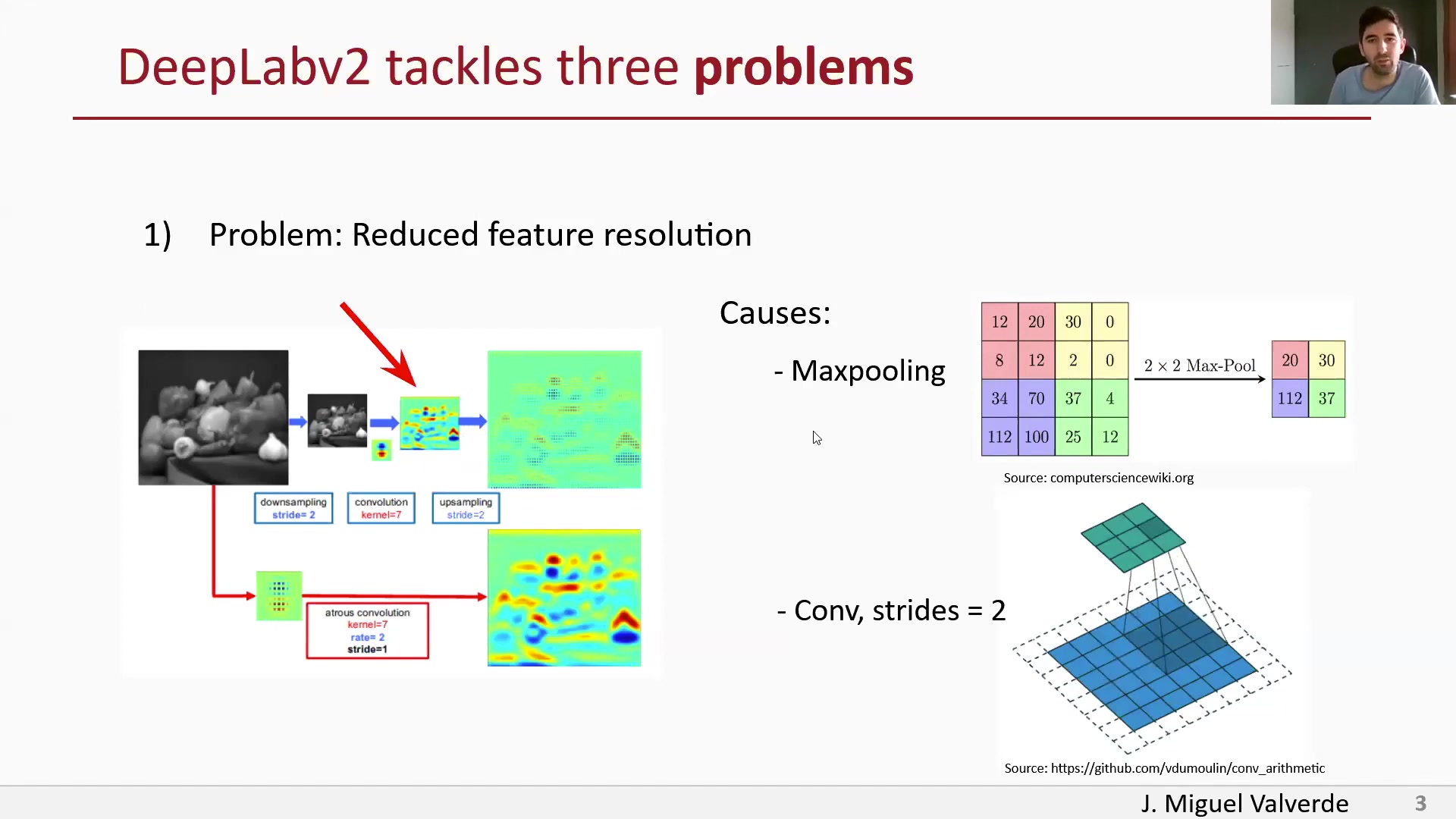
This technique addresses a common problem in semantic segmentation: the reduction of feature resolution due to downsampling operations. Downsampling is typically used in DCNNs to reduce computational load and increase the receptive field, but it also results in loss of fine-grained details. Atrous convolution allows for the expansion of the receptive field without the need for aggressive downsampling, thereby preserving important spatial information.
In standard convolution, the kernel elements are applied to adjacent pixels in the input feature map. Atrous convolution, however, introduces a 'dilation rate' that specifies the spacing between the kernel elements. The dilation rate can be thought of as the number of pixels to skip between each kernel tap. By increasing the dilation rate, the receptive field can be expanded without increasing the number of parameters or the computational cost.
Benefits of Atrous Convolution:
- Expanded Receptive Field: Captures larger contextual information.
- Preserved Resolution: Avoids aggressive downsampling, maintaining detailed spatial information.
- Efficient Computation: Expands the receptive field without adding significant computational overhead.
Here's a table contrasting standard convolution and atrous convolution:
| Feature | Standard Convolution | Atrous Convolution |
|---|---|---|
| Receptive Field | Limited | Expanded |
| Downsampling | Aggressive | Reduced |
| Computational Cost | Typically Lower | Efficient, controlled by rate |
| Parameter Count | Lower | Comparable |
Atrous Spatial Pyramid Pooling (ASPP): Capturing Multi-Scale Context
DeepLabv2 incorporates atrous spatial pyramid pooling (ASPP) to capture multi-scale contextual information. The atrous spatial pyramid pooling (ASPP) module is another cornerstone of DeepLabv2, designed to capture contextual information at different scales.
The module consists of several parallel atrous convolutional layers with different dilation rates, as well as a global average pooling layer.
By using multiple dilation rates, the ASPP module can capture objects and contextual features at various scales. Each branch of the ASPP module processes the input feature map with a different receptive field size, and the outputs are then concatenated and processed through a 1x1 convolution to reduce the feature dimension and produce the final output.
Components of ASPP Module:
- Multiple Atrous Convolutional Layers: Parallel layers with varying dilation rates.
- Global Average Pooling: Captures global context information.
- 1x1 Convolution: Reduces feature dimension and produces the output.
The ASPP module offers several advantages:
- Multi-Scale Context: Captures objects and features at different scales.
- Robust Segmentation: Improves the model's ability to handle objects of varying sizes.
- Enhanced Accuracy: Achieves state-of-the-art results on several benchmark datasets.
Fully Connected Conditional Random Fields (CRFs): Refining Segmentation Boundaries
To address the issue of reduced accuracy at segmentation boundaries, DeepLabv2 uses fully connected Conditional Random Fields (CRFs).
CRFs are probabilistic graphical models used to model the dependencies between the labels assigned to different pixels in an image. By considering these dependencies, CRFs can refine the segmentation boundaries and improve the overall quality of the segmentation map.
The CRF used in DeepLabv2 is fully connected, meaning that each pixel is connected to every other pixel in the image. This allows the model to capture long-range dependencies and improve the consistency of the segmentation. The energy function of the CRF consists of unary potentials (derived from the DCNN output) and pairwise potentials that encourage neighboring pixels to have similar labels.
By combining DCNNs with fully connected CRFs, DeepLabv2 can achieve more accurate and visually pleasing segmentation results.






Most people like
































Report
Please select a reason for reporting
- 13 Reasons to Switch from Snapchat to Text Messaging
- 7 Powerful Speech to Text Apps to Boost Productivity
- 10 Best Speech to Text Tools for Effortless Transcription
- 13 Free Tools to Easily Transcribe Audio to Text
- 15 Surprising Ways Google's Speech-to-Text Boosts Productivity
- 7 Best Free Online Audio to Text Transcription Tools
- 9 Tips to Transcribe Speech to Text Faster and Better
- 13 Best Speech to Text Software for Windows 10 in 2023
- 7 Tips for Choosing the Best Transcriber for Audio to Text
- 11 Reasons Why Dragon Speech-to-Text Apps are Game-Changers
- 6 Secrets to Enhance Your Speech to Text Transcription
- 6 Brilliant Ways to Boost Productivity with Talk-to-Text on Your MacBook
- 6 Ways Transcription Software Converts Audio to Text
- 8 Tips to Transcribe Speech to Text Like a Pro
- 6 Reasons IBM Watson Speech to Text is a Game-Changer
- 14 Powerful Ways Talk-to-Text Improves Your Workflow
- 12 Top Windows Speech-to-Text Software for Efficient Transcription
- 12 Game-Changing Benefits of Apple's Speech to Text Technology
- 9 Powerful Use Cases for AWS Speech to Text Technology
- 10 Easy Steps to Transcribe YouTube Videos to Text
- transcription audio en texte
- online audio transcription
- free audio file transcription
- free ai audio transcription
- audio transcription service
- audio transcription online free
- audio transcription free online
- audio to transcription software
- audio and transcript
- ai audio transcription free
- voice recording to text converter
- translate voice recording to text
- record voice to text
- audio recording to text converter
- voice recording and transcription
- chatgpt voice to text
- gmail voice to text
- speech to text reader
- speech to text ai free
- speech to talk
- Meshy AI: How to Create 3D Models from Text and Images
- How SEO and Marketing Dashboards Empower Agencies to Drive Results
- How to Use AI Tools to Find Internal Linking Opportunities Across a Business Website
- Discover Your Perfect Haircut with AI Hairstyle Apps
- Free Reputation Calculator Tools: How They're Adapting to Score AI Visibility, Not Just Rankings
- Design Professional Flyers for Free on Your Phone
- Best Free Flyer Maker Apps for Android: Design Like a Pro
- How to Know If Your Business Is Ready for an AI Customer Service Agent
- Revolutionizing Storytelling: From Novels to Screenplays with AI
- Create Engaging Animated Explainer Videos with a Free AI Tool
- Meshy AI: How to Create 3D Models from Text and Images
- ASOMobile Helps Teams Benchmark App Store Screenshots Against Competitors
- How to Match LMS Software With Your Organization's Training Plan
- Revolutionizing Email Marketing Agency with AI
- How to Convert BTC to HNT
- Unleashing the Power of AI: Cognizant's Roadmap for Transformation
- Frame to Video Review: A Practical Look at Turning Two Still Frames Into Motion
- NVIDIA NIM: Revolutionizing Supply Chain Data Analysis with AI
- Top AI Tools That Help Brands Stand Out Offline (Not Just Online)
- Top 5 Cold Email Software: Maximize Your Outreach in 2025

Copyright ©2026 toolify