































Table of Contents
- Key Points
- The Challenge of Complex Code
- Introducing AI-Inspired Code Reading Techniques
- Step-by-Step Code Reading Exercise
- Resources and Channels
- Frequently Asked Questions
- Related Questions


Introducing AI-Inspired Code Reading Techniques
Harnessing Visual Processing for Code Understanding
Drawing inspiration from artificial intelligence, we can leverage visual processing to enhance our code reading capabilities. AI excels at recognizing patterns and structures in data, and we can adapt these principles to efficiently understand complex code.
Visual processing allows you to:
- Free Up Working Memory: Offload some of the cognitive load by using visual cues instead of trying to memorize every line.
- Spot Code Patterns: Quickly identify repeating structures and design elements within the code.
- Understand Larger Structures: Grasp the overall organization and architecture of the code more easily.
The core of this method involves recognizing visual characteristics of code blocks, which can then be extracted and named, significantly reducing the burden of understanding long, complex methods. This technique shifts the focus from line-by-line reading to pattern recognition, thereby improving comprehension speed and reducing mental strain.
Identifying Code Paragraphs: The Core Concept
The cornerstone of AI-inspired code reading is identifying code paragraphs. A code paragraph is a cohesive section of code within a longer method, representing a logical unit that could be extracted into its own function or method. These paragraphs exhibit specific visual characteristics, allowing you to quickly identify and understand key code structures.
Characteristics of a Code Paragraph Include

:
- Starting with a one-line comment
- Comprising the entire block of an
if,for,try,switch, orwhilestatement - Having whitespace before and after
- Containing a cluster of statements using the same variable name or recurring WORD
By learning to recognize these visual cues, you can quickly partition complex code into manageable chunks, making the entire codebase more accessible and easier to comprehend.
Step-by-Step Code Reading Exercise
Train your brain to spot Code Paragraphs
This exercise is designed to train your brain to recognize code paragraphs effectively. The process involves identifying code sections that meet specific criteria, enabling quicker comprehension and refactoring.
Step-by-Step Code Paragraph Identification:
- Scan the Code: Quickly review the provided code samples without reading every line.
- Look for Visual Cues: Identify sections that have one or more of the following: one-line comments, complete blocks (
if,for,try,switch, orwhile), whitespace before and after, and recurring variable names or keywords. - Decide: Paragraph or No: Determine if the identified section qualifies as a code paragraph based on the presence of these visual cues.
- State Your Decision: Say aloud either 'Paragraph' or 'No' for each identified section.
- Check Your Answer: Check the provided answer to reinforce learning.
By practicing this exercise, you enhance your pattern-matching skills and train your brain to swiftly recognize meaningful code structures.
The Code Reading Game: paragraph or no
This will be a fast-paced code reading exercise, this part of the video trains you to spot code paragraphs or determine if a section of code is or isn't a code paragraph.
. You need to make an effort to get the answer right, because you want to practice making judgments and reinforce the correct ones, or incorrect ones for learning.
Resources and Channels
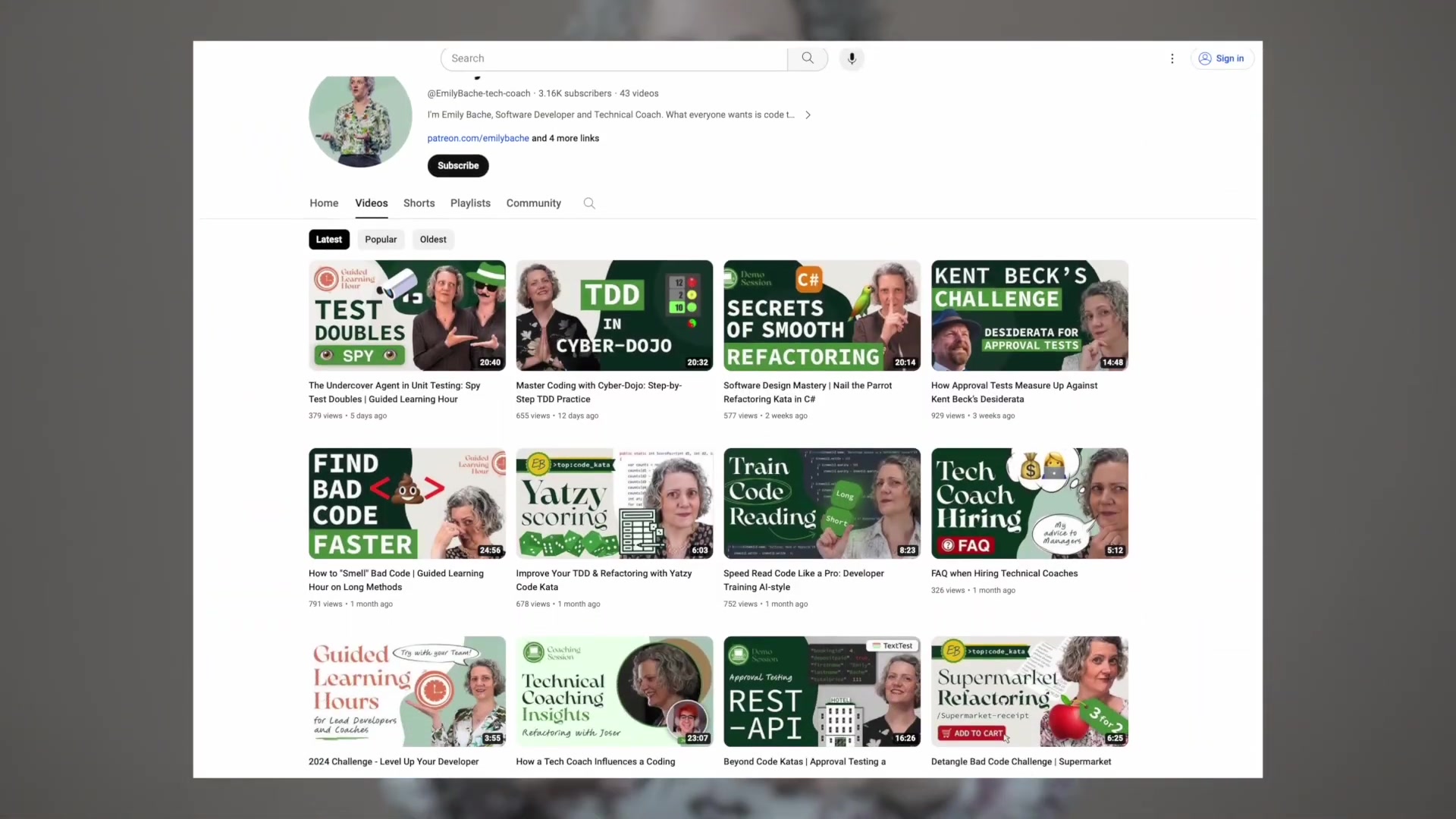
Emily Bache's Resources for Developers and Coaches
Emily Bache provides valuable resources for software developers and technical coaches through various platforms. These resources are designed to enhance code reading skills, promote effective refactoring, and support team training.
Emily Bache's Channel: Find content for technical coaches and team training.
Patreon Resources: Additional resources are available on her Patreon page.

By leveraging these resources, developers and coaches can significantly improve their skills and effectiveness in managing complex code environments.





Most people like


































Report
Please select a reason for reporting
- 13 Reasons to Switch from Snapchat to Text Messaging
- 7 Powerful Speech to Text Apps to Boost Productivity
- 10 Best Speech to Text Tools for Effortless Transcription
- 13 Free Tools to Easily Transcribe Audio to Text
- 15 Surprising Ways Google's Speech-to-Text Boosts Productivity
- 7 Best Free Online Audio to Text Transcription Tools
- 9 Tips to Transcribe Speech to Text Faster and Better
- 13 Best Speech to Text Software for Windows 10 in 2023
- 7 Tips for Choosing the Best Transcriber for Audio to Text
- 11 Reasons Why Dragon Speech-to-Text Apps are Game-Changers
- 6 Secrets to Enhance Your Speech to Text Transcription
- 6 Brilliant Ways to Boost Productivity with Talk-to-Text on Your MacBook
- 6 Ways Transcription Software Converts Audio to Text
- 8 Tips to Transcribe Speech to Text Like a Pro
- 6 Reasons IBM Watson Speech to Text is a Game-Changer
- 14 Powerful Ways Talk-to-Text Improves Your Workflow
- 12 Top Windows Speech-to-Text Software for Efficient Transcription
- 12 Game-Changing Benefits of Apple's Speech to Text Technology
- 9 Powerful Use Cases for AWS Speech to Text Technology
- 10 Easy Steps to Transcribe YouTube Videos to Text
- transcription audio en texte
- online audio transcription
- free audio file transcription
- free ai audio transcription
- audio transcription service
- audio transcription online free
- audio transcription free online
- audio to transcription software
- audio and transcript
- ai audio transcription free
- voice recording to text converter
- translate voice recording to text
- record voice to text
- audio recording to text converter
- voice recording and transcription
- chatgpt voice to text
- gmail voice to text
- speech to text reader
- speech to text ai free
- speech to talk
- How to Use AI Tools to Find Internal Linking Opportunities Across a Business Website
- Discover Your Perfect Haircut with AI Hairstyle Apps
- Free Reputation Calculator Tools: How They're Adapting to Score AI Visibility, Not Just Rankings
- Design Professional Flyers for Free on Your Phone
- Best Free Flyer Maker Apps for Android: Design Like a Pro
- How to Know If Your Business Is Ready for an AI Customer Service Agent
- Revolutionizing Storytelling: From Novels to Screenplays with AI
- Create Engaging Animated Explainer Videos with a Free AI Tool
- Stop Multi-Subscribing: Benchmark Top AI Visual Models in One Canvas
- Best Seedance 2.5 API Provider: Every Price on the Market, Checked at Source
- Top AI Social Media Management Tools: Automate Your Content Strategy
- Free AI Text to Video Generator: Create Stunning Videos from Text
- Discover 17 ChatGPT Alternatives: A Comprehensive Comparison
- Character.AI vs. Janitor AI: Which AI Chat Platform Reigns Supreme?
- Top Virtual Assistant Companies in 2026: Reviews, Pricing, and Plans Compared
- Unveiling FaceCheck.ID: Revolutionizing Reverse Image Searches with AI
- 11 Best AI Dialers in 2026: Features, Pricing, Pros and Cons
- How I Direct Consistent AI Clips: A Hands-On Guide to Multi-Model Generation
- A Realistic Review of the Photo Generator Image Tool
- Playwright MCP Server: Automated Web Testing with Agent Mode

Copyright ©2026 toolify