































Table of Contents
- Key Points
- Understanding C/A PRN Code Generation
- Illustrative Example: Generating a GPS Code
- Evaluating C/A PRN Codes: Advantages and Drawbacks
- Frequently Asked Questions About GPS C/A PRN Codes
- In-Depth Discussions on C/A PRN Codes


Understanding C/A PRN Code Generation
What is C/A PRN Code Generation?
C/A PRN code generation is a core process in GPS technology, enabling receivers to identify signals from individual satellites. C/A stands for Coarse Acquisition, and PRN stands for Pseudo Random Noise. The codes generated are crucial for distinguishing satellite signals, allowing GPS devices to determine their position accurately. These codes, transmitted by each satellite, contain information that receivers use to pinpoint the satellite's identity and, ultimately, the receiver's location. Understanding this code generation process is essential for anyone delving into the inner workings of GPS technology.
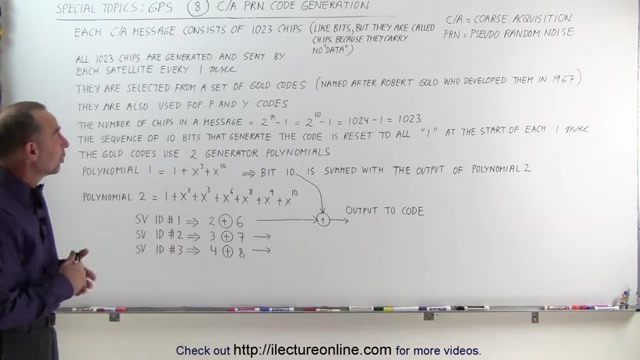
The C/A PRN codes are a specific type of signal that enables quick identification of GPS signals.
Let's dive deeper into understanding these codes. The key is that we're dealing with what are called Gold Codes, which are very important for distinguishing the different satellites from one another. Each satellite is sending out signals, and your receiver needs to know which signal comes from which satellite, and the GPS receiver does that through these unique Gold Codes that every satellite has. Every satellite transmits a unique sequence, ensuring that GPS receivers can differentiate them. The goal is to generate a noise-like signal, hence 'Pseudo Random Noise', but with deterministic properties that allow for easy acquisition and tracking.
Components of a C/A Message
A single C/A message is structured with specific components designed for efficient transmission and decoding. This structure ensures that receivers can quickly identify and process the information. Let's break down the components that make up a single C/A message:
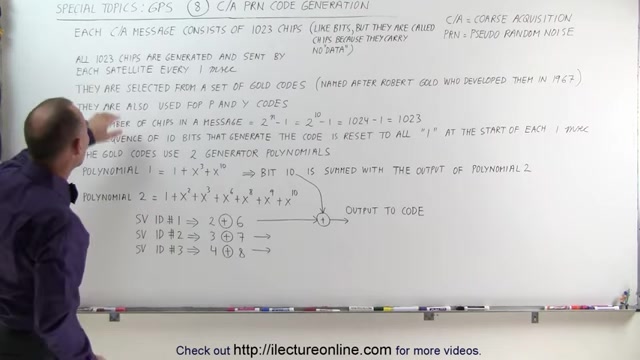
- Chips: Each C/A message consists of 1023 chips. These chips are similar to bits – representing zeros and ones – but are called chips because they do not carry significant data besides identifying the satellite. These chips are the fundamental units of the C/A code. Each satellite transmits these 1023 chips every millisecond, creating a continuous stream of unique identifiers. They’re like digital fingerprints, allowing receivers to distinguish between satellite signals.
- Gold Codes: The 1023 chips are generated based on a set of Gold codes, developed by Robert Gold in 1967.
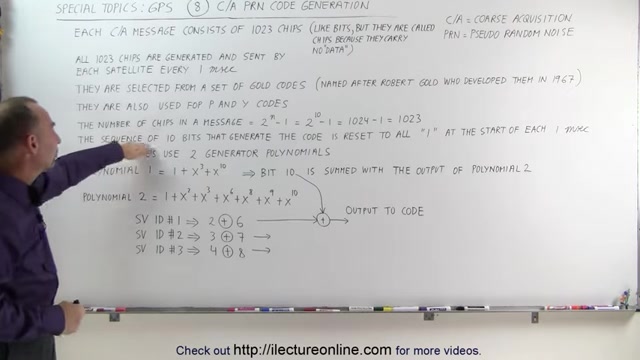
These codes are selected for their desirable correlation properties, which makes the signal acquisition easier and avoids cross-correlation issues. Robert Gold's work is fundamental to this process. They are also used in the creation of P and Y codes, expanding their influence within GPS technology.
- No Real Data: It's important to emphasize that chips themselves do not carry real data. The information transmitted by satellites (e.g., time, ephemeris data) is encoded through other messages that are superimposed on the C/A code message. These overlaid messages provide crucial data necessary for position calculations. Therefore, the primary role of the C/A code is to offer a means for satellite signal distinction and timing synchronization.
The Role of Gold Codes
Gold codes are selected from a set designed to have low cross-correlation, meaning that the codes are easily distinguishable from one another, even in noisy environments. This is crucial for a GPS receiver to pick out the signals from multiple satellites simultaneously. The choice of Gold codes enhances the efficiency and accuracy of the GPS system. It minimizes interference between satellite signals, which is crucial for precise positioning. The use of Gold codes allows for rapid signal acquisition and reliable tracking, even under challenging conditions.
These codes are not just random sequences; they are carefully constructed using mathematical properties to ensure that the GPS receiver can quickly and reliably distinguish between signals. That’s the beauty of the whole thing. It’s like everyone has a unique signature, a unique sound that can be distinguished among all the other satellites.
Robert Gold's innovation in 1967 laid the groundwork for how we utilize GPS today. The codes are pseudo-random, which makes them difficult to intercept or jam, adding a layer of security to GPS communications. They are also used for generating both P and Y codes, highlighting their versatility in GPS applications.
Mathematical Principles: Generator Polynomials
The Gold codes are generated using two generator polynomials. These polynomials dictate how the 1023 chips are produced in sequence. These aren't exponents; rather, they specify which bits are involved in the summation. The Gold codes use two generator polynomials for this.
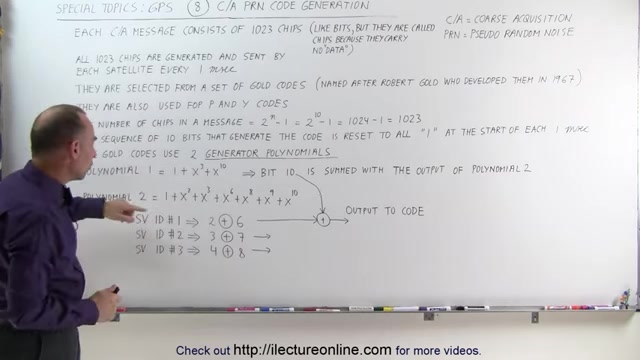
Here are the two generator polynomials:
- Polynomial 1: 1 + x^3 + x^10
- Polynomial 2: 1 + x^2 + x^3 + x^5 + x^6 + x^8 + x^9 + x^10
Bit 10 from Polynomial 1 is then summed with the output of Polynomial 2 to produce a part of the final Gold Code sequence. Polynomial 2 is more complex, involving multiple bits. This complexity is essential for creating the diversity needed to generate unique codes for every satellite.
Each satellite is assigned a unique combination of these polynomials. For instance, Space Vehicle ID #1 uses bits 2 and 6 from Polynomial 2. Space Vehicle ID #2 uses bits 3 and 7. Each satellite uses a unique combination to make sure that they can distinguish between them. This combination determines its unique C/A code. This approach, conceived by Robert Gold, remains a cornerstone of GPS technology.
By adding specific bits from polynomial two, with that 10th bit, this creates that unique code. This is performed 1023 times, after which everything is reset and repeated in the following millisecond.
Illustrative Example: Generating a GPS Code
GPS C/A Code Generation
To better understand how GPS codes are generated, let’s go through a simple example. Imagine we are generating the code for Satellite Vehicle (SV) ID #1.
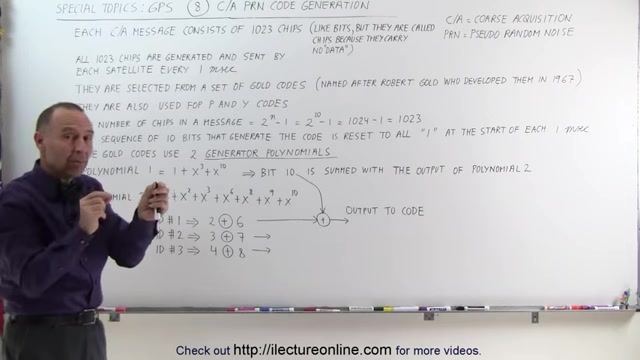
- Initialization: Start with a sequence of 10 bits, all set to ‘1’s. This is the beginning of each 1 millisecond cycle.
- Polynomial 2 Operation: Focus on Polynomial 2, which is: 1 + x^2 + x^3 + x^5 + x^6 + x^8 + x^9 + x^10. For SV ID #1, we are instructed to combine bits 2 and 6 from the 10-bit string of the second polynomial
- Polynomial 1, Bit 10 Operation: In addition to the polynomial 2 operation, we also focus on bit 10 from polynomial 1 to produce a part of the final Gold Code Sequence.
- Summation: Sum the values of bit 10 from the first polynomial with the combination of the specific two bits from the 10 bit string of the second polynomial.
- Iteration: Repeat this entire process 1023 times, generating one chip every iteration, each process of iteration is producing a single 'chip' (a single bit of code).
- Reset: At the end of the 1023 iterations, the entire 10-bit string is reset back to all ‘1’s, and the process begins again at the start of the next millisecond.
This iterative process, governed by the generator polynomials, creates a pseudo-random sequence of chips. Because the polynomials are different among satellites (and they are set up to give specific and desired cross-correlation properties), the receiver can find those codes and distinguish between the satellites. Each satellite thus gets its own Gold Code.










Most people like





























Report
Please select a reason for reporting
- 13 Reasons to Switch from Snapchat to Text Messaging
- 7 Powerful Speech to Text Apps to Boost Productivity
- 10 Best Speech to Text Tools for Effortless Transcription
- 13 Free Tools to Easily Transcribe Audio to Text
- 15 Surprising Ways Google's Speech-to-Text Boosts Productivity
- 7 Best Free Online Audio to Text Transcription Tools
- 9 Tips to Transcribe Speech to Text Faster and Better
- 13 Best Speech to Text Software for Windows 10 in 2023
- 7 Tips for Choosing the Best Transcriber for Audio to Text
- 11 Reasons Why Dragon Speech-to-Text Apps are Game-Changers
- 6 Secrets to Enhance Your Speech to Text Transcription
- 6 Brilliant Ways to Boost Productivity with Talk-to-Text on Your MacBook
- 6 Ways Transcription Software Converts Audio to Text
- 8 Tips to Transcribe Speech to Text Like a Pro
- 6 Reasons IBM Watson Speech to Text is a Game-Changer
- 14 Powerful Ways Talk-to-Text Improves Your Workflow
- 12 Top Windows Speech-to-Text Software for Efficient Transcription
- 12 Game-Changing Benefits of Apple's Speech to Text Technology
- 9 Powerful Use Cases for AWS Speech to Text Technology
- 10 Easy Steps to Transcribe YouTube Videos to Text
- transcription audio en texte
- online audio transcription
- free audio file transcription
- free ai audio transcription
- audio transcription service
- audio transcription online free
- audio transcription free online
- audio to transcription software
- audio and transcript
- ai audio transcription free
- voice recording to text converter
- translate voice recording to text
- record voice to text
- audio recording to text converter
- voice recording and transcription
- chatgpt voice to text
- gmail voice to text
- speech to text reader
- speech to text ai free
- speech to talk
- Revolutionizing Storytelling: From Novels to Screenplays with AI
- Create Engaging Animated Explainer Videos with a Free AI Tool
- Stop Multi-Subscribing: Benchmark Top AI Visual Models in One Canvas
- Best Seedance 2.5 API Provider: Every Price on the Market, Checked at Source
- AI OnlyFans: How to Generate $30,000/Month (Legally)
- Transform Your Script into an Engaging Video with AI Video Maker!
- AI Marketing Automation: A Comprehensive Guide for Small Businesses
- Midjourney Alternative for Anime Art Creators: Why PixAI May Be Better for Character Workflows
- 10 Things Most People Get Wrong About AI Image Search
- AI Girlfriend Apps: Top Choices Redefining Relationships 2025
- Top 4 AI Background Remover Tools for Flawless Image Editing
- Top 4 AI Lip-Sync Generators Tested: Features, Differences, and Real Results
- Top 4 Face Swap Generator Tools to Transform Your Visual Content
- Master Canva's Video Background Remover with 5 Essential Tips
- Mastering Microsoft Stream: Video Management Tips & Tricks
- AI Video Generation: Extend AI Videos for Free
- Master Loom: Create and Share Professional Videos with AI
- Create Captivating AI News Videos: Step-by-Step Guide
- Create Your Own AI News Channel with AI-Powered News Video Generator and AI Lip Sync
- Unleash the Power of Heygen AI: Create Unlimited Videos for Free!

Copyright ©2026 toolify