































Table of Contents
- Key Points
- Decoding the 'Array and Operations' Challenge
- Guide on How to Use to Solve the Problem
- Greedy Approach: Unveiling the Pros and Cons
- Frequently Asked Questions
- Related Questions


Decoding the 'Array and Operations' Challenge
Understanding the Problem Statement: Array Manipulation and Score Minimization
The 'Array and Operations' problem on Codeforces presents a scenario where you are given an array of 'n' integers and an integer 'k' such that 2k < n. The challenge lies in performing exactly 'k' operations on this array to minimize the final score. In each operation, you must choose two elements from the array, let's call them ai and aj, and remove them. Then, you add the floor of ai/aj to your score. After performing 'k' operations, you add all the remaining elements of the array to your score. The goal is to calculate the minimum possible score you can achieve through strategic array manipulation
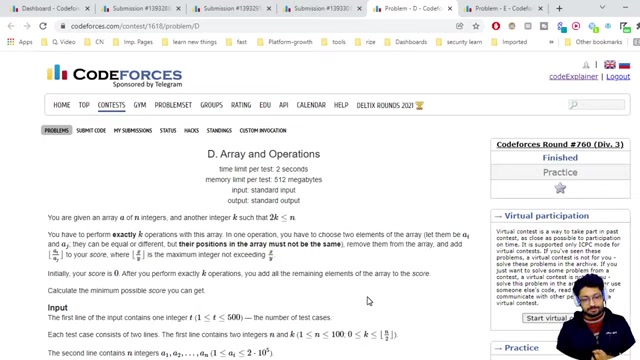
.
Key Problem Constraints:
- You must perform exactly 'k' operations.
- The positions of the chosen elements ai and aj must be different.
- 2k < n, implying that there will always be remaining elements after 'k' operations.
Breaking down the components:
- The Array: You start with an array 'A' of 'n' integers. Understanding the initial state of the array is crucial.
- The Integer k: This integer dictates how many pair-removal operations you need to perform. Given the constraint 2k < n, the number of operations will always be less than half the size of the array.
- The Operation:
- Choose two distinct elements ai and aj from the array.
- Calculate the floor of ai divided by aj (⌊ai/aj⌋).
- Add this result to your score.
- Remove ai and aj from the array.
- Final Score Calculation: After 'k' operations, you add the values of all remaining elements in the array to the score. This sum is then combined with the scores from each pair-removal operation to determine the total score.
The core challenge is to identify which elements to remove at each step, and in what order, to ensure the final total score is minimized. This requires careful consideration of the division results and their cumulative effect on the remaining array's sum. By strategically selecting pairs, you can manipulate both the score from divisions and the final array elements to achieve the lowest possible total score. Understanding these factors sets the stage for crafting an effective algorithm to tackle the 'Array and Operations' problem on Codeforces.
Strategic Approach: Greedy Algorithm for Score Minimization
To tackle the 'Array and Operations' problem, a greedy algorithm offers an effective method for minimizing the final score. This strategy involves making locally optimal decisions at each step to achieve a globally optimal solution.
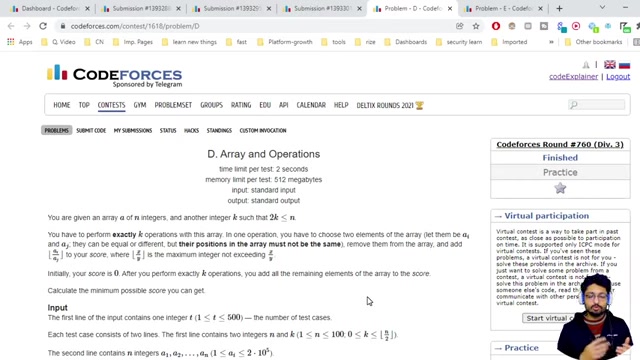
For the 'Array and Operations' problem, this means focusing on reducing the score from divisions as much as possible, while also managing the values of the remaining array elements. Let’s explore the details of how the greedy approach can be implemented:
1. Sorting the Array:
-
Initial Sort: The first step involves sorting the array 'A' in non-increasing (decreasing) order. This allows us to strategically select pairs where dividing the larger element by the smaller element results in a smaller or zero quotient. In C++, you can use
sort(a.rbegin(), a.rend()); -
Reasoning: By sorting in decreasing order, you ensure that when you divide ai by aj, where i < j, ai is greater than or equal to aj. This helps manage the score added from division since ⌊ai/aj⌋ will likely be smaller.
2. Pair Selection and Score Reduction:
-
Choosing Pairs: After sorting, select the first 'k' pairs for division operations in a specific order. This selection is crucial for minimizing the score added from each division.
-
Selection Strategy: A highly effective strategy is to perform the division operations using 2 elements as much as possible to get 1 or 0 score, This is because as it is clearly shown that (ai/aj) score adding into score
3. Handling Remaining Elements
-
Sum of Remaining Elements: After 'k' operations, the remaining elements in the array are added directly to the score. Since we want to minimize this score, we prioritize removing the larger numbers via division and keeping the smaller numbers in the remaining array.
-
Final Score Calculation: Add up the scores from the division operations and the sum of the remaining elements. Since each Ai/Aj score will have a small or zero score, all the remaining numbers will have a small score in end. It is better you select numbers that are smaller in size in end .
Justification for the Greedy Approach: The greedy approach aims to reduce the score from the division operations and ensure smaller numbers are left in the array. Sorting facilitates making informed, locally optimal choices at each step, contributing to a globally minimized final score.
Implementing this strategy carefully can lead to efficient and optimal solutions for the 'Array and Operations' problem. By strategically balancing the scores from divisions and the remaining elements, you can navigate through the test cases with greater confidence and precision, optimizing for competitive success on platforms like Codeforces.
Coding the Solution: Implementing the Greedy Algorithm in C++
Let's Translate the greedy strategy into a C++ solution. This implementation focuses on sorting the array, selecting pairs strategically, and accumulating the final score.
#include <iostream>
#include <vector>
#include <algorithm>

using namespace std;

int main() {
    int t;
    cin >> t;
    while (t--) {
        int n, k;
        cin >> n >> k;
        vector<int> a(n);
        for (int i = 0; i < n; ++i) {
            cin >> a[i];
        }

        sort(a.rbegin(), a.rend()); // Sort in decreasing order

        long long ans = 0;
        for (int i = 0; i < k; ++i) {
            ans += a[i + k] / a[i]; // Add floor of division
        }

        for (int i = 2 * k; i < n; ++i) {
            ans += a[i]; // Add remaining elements
        }

        cout << ans << endl;
    }
    return 0;
}
Code Explanation:
- Include Headers: The code starts with including necessary headers for input/output operations, vector manipulation, and sorting algorithms.
- Input Processing: For each test case:
- It reads the integers 'n' and 'k'.
- It inputs 'n' elements into the vector 'a'.
- Sorting: The code sorts the vector 'a' in decreasing order using
sort(a.rbegin(), a.rend());. The reverse iteratorsrbegin()andrend()are used to achieve sorting in descending order. - Pair Selection and Score Calculation:
- It initializes a variable
ansto store the final answer. - The code then iterates 'k' times to perform the 'k' operations.
- For each operation, it adds the floor of
a[i + k] / a[i]to the variableans, which accumulates the scores from each division operation.
- It initializes a variable
- Adding Remaining Elements: After performing 'k' operations, the remaining elements in the vector 'a' (from index
2 * kto the end) are added toans. - Output: Finally, it prints the computed
ans, which is the minimum possible score you can get after performing 'k' operations and adding the remaining elements.
This code is efficient and readable, and should provide the correct results for all test cases of this problem.





Most people like






































Report
Please select a reason for reporting
- 13 Reasons to Switch from Snapchat to Text Messaging
- 7 Powerful Speech to Text Apps to Boost Productivity
- 10 Best Speech to Text Tools for Effortless Transcription
- 13 Free Tools to Easily Transcribe Audio to Text
- 15 Surprising Ways Google's Speech-to-Text Boosts Productivity
- 7 Best Free Online Audio to Text Transcription Tools
- 9 Tips to Transcribe Speech to Text Faster and Better
- 13 Best Speech to Text Software for Windows 10 in 2023
- 7 Tips for Choosing the Best Transcriber for Audio to Text
- 11 Reasons Why Dragon Speech-to-Text Apps are Game-Changers
- 6 Secrets to Enhance Your Speech to Text Transcription
- 6 Brilliant Ways to Boost Productivity with Talk-to-Text on Your MacBook
- 6 Ways Transcription Software Converts Audio to Text
- 8 Tips to Transcribe Speech to Text Like a Pro
- 6 Reasons IBM Watson Speech to Text is a Game-Changer
- 14 Powerful Ways Talk-to-Text Improves Your Workflow
- 12 Top Windows Speech-to-Text Software for Efficient Transcription
- 12 Game-Changing Benefits of Apple's Speech to Text Technology
- 9 Powerful Use Cases for AWS Speech to Text Technology
- 10 Easy Steps to Transcribe YouTube Videos to Text
- transcription audio en texte
- online audio transcription
- free audio file transcription
- free ai audio transcription
- audio transcription service
- audio transcription online free
- audio transcription free online
- audio to transcription software
- audio and transcript
- ai audio transcription free
- voice recording to text converter
- translate voice recording to text
- record voice to text
- audio recording to text converter
- voice recording and transcription
- chatgpt voice to text
- gmail voice to text
- speech to text reader
- speech to text ai free
- speech to talk
- How SEO and Marketing Dashboards Empower Agencies to Drive Results
- How to Use AI Tools to Find Internal Linking Opportunities Across a Business Website
- Discover Your Perfect Haircut with AI Hairstyle Apps
- Free Reputation Calculator Tools: How They're Adapting to Score AI Visibility, Not Just Rankings
- Design Professional Flyers for Free on Your Phone
- Best Free Flyer Maker Apps for Android: Design Like a Pro
- How to Know If Your Business Is Ready for an AI Customer Service Agent
- Revolutionizing Storytelling: From Novels to Screenplays with AI
- Create Engaging Animated Explainer Videos with a Free AI Tool
- Stop Multi-Subscribing: Benchmark Top AI Visual Models in One Canvas
- AI & Elections: Defending Democracy Against Misinformation
- Navigating Political Discourse: AI, Deepfakes, and Reality Checks
- Detecting Political Bias in News Articles: A Powerful AI Algorithm
- AI Bias Unveiled: Political Leanings in ChatGPT & Beyond
- Revolutionize Learning: Discover Quizzes AI for Engaging Interactive Quizzes
- From AI-Generated to Audience-Ready: How Quillbot Humanize AI Is Changing the Content Editing Process
- Building an AI Writing Stack in 2026: LLMs, Detectors, and Humanizers
- 7 Top AI-Powered Database Assistant Platforms
- An Objective Look at Modern Web-Based Visual Modifications
- My Honest Experience with VideoAI: The Secret Weapon for Creators Who Need Character Voices

Copyright ©2026 toolify