































Table of Contents
- Key Points
- Understanding Script Bots (Simple Chatbots)
- Detailed Comparison: Script Bots vs. Smart Bots
- Cost Considerations: Script Bots vs. Smart Bots
- Pros and Cons of Script Bots
- Comparing Core Features: What Each Bot Type Offers
- Real-World Use Cases: Where Each Bot Type Excels
- Frequently Asked Questions (FAQ)
- Related Questions


Understanding Script Bots (Simple Chatbots)
What are Script Bots?
Script Bots, sometimes referred to as simple chatbots, function based on predefined text rules.
These bots do not employ artificial intelligence (AI) to learn or adapt to new information. Instead, they follow a set of scripted responses, making them suitable for handling straightforward, repetitive tasks. Script Bots are essentially rule-based systems, and their capabilities are limited to the scripts programmed into them. They are designed to provide specific answers to a limited range of questions or commands.
Key Characteristics of Script Bots:
- Predefined Rules: Script Bots operate using predetermined rules and scripts.
- No AI: They lack the ability to learn or adapt to new information using AI.
- Simple Tasks: Best suited for handling basic and repetitive tasks.
- Limited Functionality: Their capabilities are confined to the programmed scripts.
- Task-Specific: Designed for specific, well-defined tasks.
Think of a phone system that asks you to "Press 1 for English, Press 2 for Spanish." This is a classic example of a Script Bot in action. The system provides predefined options and directs you based on your input. It doesn't understand the intent behind your call, only the numerical choice you make.
Detailed Comparison: Script Bots vs. Smart Bots
Key Differences in a Table
To provide a clearer understanding of the differences between Script Bots and Smart Bots, consider the following comparison:
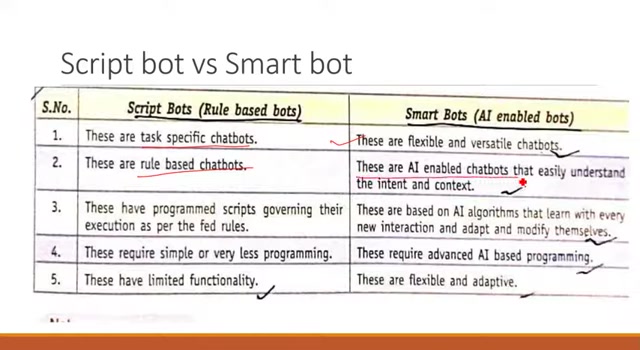
| Feature | Script Bots (Rule-Based) | Smart Bots (AI-Enabled) |
|---|---|---|
| Task Specificity | Task-specific chatbots | Flexible and versatile chatbots |
| Rule-Based | Rule-based chatbots | AI-enabled chatbots that easily understand intent and context |
| Programming | Programmed scripts governing execution as per fed rules | Based on AI algorithms that learn and adapt with new interactions |
| Programming Needs | Require simple or very less programming | Require advanced AI-based programming |
| Functionality | Limited functionality | Flexible and adaptive |
| Technology Used | Rule based, pre-defined text | Artificial intelligence (AI) and Natural Language Processing (NLP) |
| Complexity | Simple and straightforward | Complex and adaptive |
| Learning Ability | None. Cannot learn or adapt | Can learn and adapt based on user interactions |
| Use Cases | Simple Customer Service, basic information retrieval, FAQs | Advanced customer support, personalized recommendations, virtual assistants |
| Implementation Cost | Lower | Higher |
This table highlights the critical distinctions, emphasizing the advantages of Smart Bots in adaptability and intelligence, while acknowledging the simplicity and lower implementation cost of Script Bots.






Most people like

































Report
Please select a reason for reporting
- 13 Reasons to Switch from Snapchat to Text Messaging
- 7 Powerful Speech to Text Apps to Boost Productivity
- 10 Best Speech to Text Tools for Effortless Transcription
- 13 Free Tools to Easily Transcribe Audio to Text
- 15 Surprising Ways Google's Speech-to-Text Boosts Productivity
- 7 Best Free Online Audio to Text Transcription Tools
- 9 Tips to Transcribe Speech to Text Faster and Better
- 13 Best Speech to Text Software for Windows 10 in 2023
- 7 Tips for Choosing the Best Transcriber for Audio to Text
- 11 Reasons Why Dragon Speech-to-Text Apps are Game-Changers
- 6 Secrets to Enhance Your Speech to Text Transcription
- 6 Brilliant Ways to Boost Productivity with Talk-to-Text on Your MacBook
- 6 Ways Transcription Software Converts Audio to Text
- 8 Tips to Transcribe Speech to Text Like a Pro
- 6 Reasons IBM Watson Speech to Text is a Game-Changer
- 14 Powerful Ways Talk-to-Text Improves Your Workflow
- 12 Top Windows Speech-to-Text Software for Efficient Transcription
- 12 Game-Changing Benefits of Apple's Speech to Text Technology
- 9 Powerful Use Cases for AWS Speech to Text Technology
- 10 Easy Steps to Transcribe YouTube Videos to Text
- transcription audio en texte
- online audio transcription
- free audio file transcription
- free ai audio transcription
- audio transcription service
- audio transcription online free
- audio transcription free online
- audio to transcription software
- audio and transcript
- ai audio transcription free
- voice recording to text converter
- translate voice recording to text
- record voice to text
- audio recording to text converter
- voice recording and transcription
- chatgpt voice to text
- gmail voice to text
- speech to text reader
- speech to text ai free
- speech to talk
- How to Use AI Tools to Find Internal Linking Opportunities Across a Business Website
- Discover Your Perfect Haircut with AI Hairstyle Apps
- Free Reputation Calculator Tools: How They're Adapting to Score AI Visibility, Not Just Rankings
- Design Professional Flyers for Free on Your Phone
- Best Free Flyer Maker Apps for Android: Design Like a Pro
- How to Know If Your Business Is Ready for an AI Customer Service Agent
- Revolutionizing Storytelling: From Novels to Screenplays with AI
- Create Engaging Animated Explainer Videos with a Free AI Tool
- Stop Multi-Subscribing: Benchmark Top AI Visual Models in One Canvas
- Best Seedance 2.5 API Provider: Every Price on the Market, Checked at Source
- Top AI Social Media Management Tools: Automate Your Content Strategy
- Free AI Text to Video Generator: Create Stunning Videos from Text
- Discover 17 ChatGPT Alternatives: A Comprehensive Comparison
- Character.AI vs. Janitor AI: Which AI Chat Platform Reigns Supreme?
- Top Virtual Assistant Companies in 2026: Reviews, Pricing, and Plans Compared
- Unveiling FaceCheck.ID: Revolutionizing Reverse Image Searches with AI
- 11 Best AI Dialers in 2026: Features, Pricing, Pros and Cons
- How I Direct Consistent AI Clips: A Hands-On Guide to Multi-Model Generation
- A Realistic Review of the Photo Generator Image Tool
- Playwright MCP Server: Automated Web Testing with Agent Mode

Copyright ©2026 toolify