































Table of Contents
- Key Points
- Demystifying Pointers in C
- Additional Tips for Working with Pointers
- How to Use Pointers in C
- Advantages and Disadvantages of using pointer
- Frequently Asked Questions about C Pointers
- Related Questions



Demystifying Pointers in C
What is a Pointer?
In C programming, a pointer is a variable that stores the memory address of another variable. Unlike regular variables that hold data values, pointers hold locations in memory. This capability allows for direct manipulation of memory, which can lead to more efficient and flexible code. Understanding pointers is crucial for mastering C programming, as they are used extensively in various programming tasks.
Think of your computer's memory as a series of numbered boxes, each capable of holding a piece of information. A variable in your program occupies one or more of these boxes. The pointer, then, is like a label that tells you which box a particular variable is using. Instead of directly holding the data, it tells you where to find the data.
For example, let’s say we declare an integer variable:
int age = 21;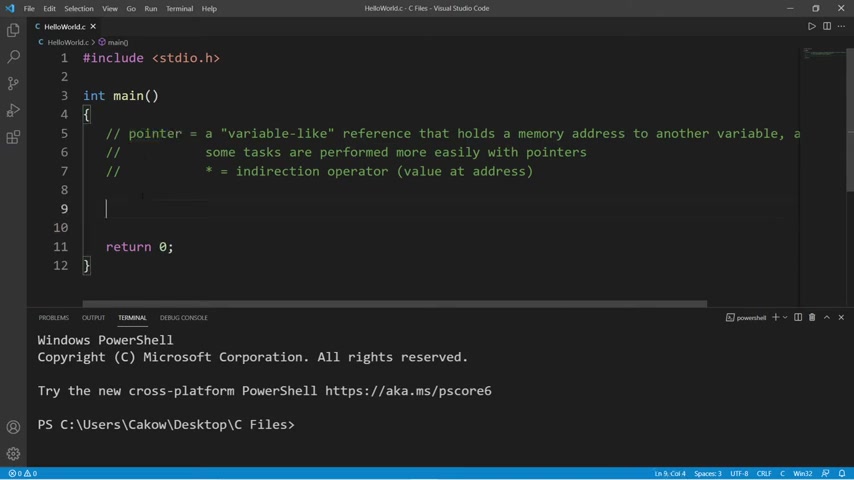
This statement allocates memory to store the integer value 21. The pointer, instead of storing the value 21, will store the memory location where 21 is stored. This fundamental difference makes pointers incredibly powerful and versatile.
The concept of pointers can be better understood with the analogy of a house address. Just as a house address tells you where a specific house is located, a pointer tells you where a specific variable is located in the computer's memory.
Pointers are declared using the asterisk * symbol. This symbol is often referred to as the 'indirection operator' or 'dereference operator' when used in certain contexts. When declaring a pointer, you must also specify the data type of the variable that the pointer will point to. For example:
int *pAge;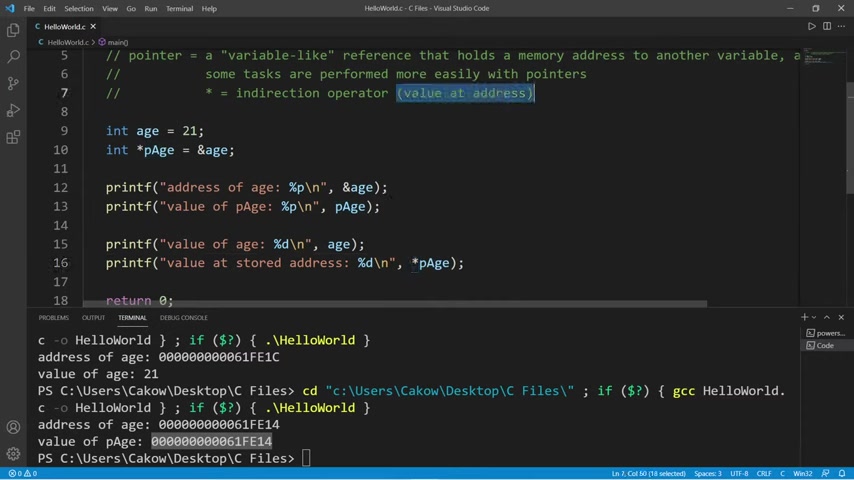
This declares a pointer named pAge that can point to an integer variable. It's important to note that this pointer, at this point, doesn't actually point to anything. It simply has the capacity to store the address of an integer variable.
Key Characteristics of Pointers:
- Memory Address Storage: Pointers are designed to hold memory addresses, not direct data values.
- Data Type Association: Each pointer is associated with a specific data type (e.g.,
int,char,float), indicating the type of variable it can point to. - Indirection: Pointers allow indirect access to the data they point to, using operators like
*(dereference operator) to retrieve or modify the value at the pointed address. - Dynamic Memory Allocation: Pointers are vital for dynamic memory allocation, allowing programs to request memory during runtime, enabling flexible data structures and efficient memory usage.
Pointers are essential for various programming techniques, such as:
- Dynamic Memory Allocation: Managing memory during runtime.
- Data Structures: Implementing linked lists, trees, and other complex structures.
- Function Arguments: Passing data to functions, allowing functions to modify the original data.
- Arrays and Strings: Efficiently manipulating arrays and strings.
By grasping the fundamentals of pointers, you can unlock a deeper understanding of C programming and write more powerful and efficient code.
Declaring and Initializing Pointers
To use a pointer effectively, you need to understand how to declare and initialize it. Declaring a pointer involves specifying its data type and name, while initializing it means assigning it a valid memory address.
Declaration:
As mentioned earlier, pointers are declared using the asterisk * symbol. The syntax for declaring a pointer is as follows:
data_type *pointer_name;Here,
data_typespecifies the data type of the variable that the pointer will point to.*indicates that you are declaring a pointer.pointer_nameis the name you choose for your pointer variable.
For example, to declare a pointer to an integer variable, you would use:
int *pAge;This declaration tells the compiler that pAge is a pointer that can store the address of an integer variable. Similarly, to declare a pointer to a character, you would use:
char *pChar;Initialization:
After declaring a pointer, you need to initialize it with a valid memory address. This is where the & operator comes in handy. The & operator, also known as the 'address-of operator,' returns the memory address of a variable. For example:
int age = 21;
int *pAge = &age;
In this code snippet,
ageis an integer variable with a value of 21.pAgeis a pointer variable that stores the memory address ofage.- The expression
&ageretrieves the memory address of theagevariable. - The assignment
int *pAge = &age;initializes thepAgepointer to point to theagevariable.
It's crucial to initialize pointers before using them. An uninitialized pointer contains a garbage value, which could lead to unpredictable behavior or program crashes if you attempt to access the memory location it points to.
Important Note:
It’s considered good practice to initialize a pointer to NULL if you don’t have a valid memory address to assign to it immediately. NULL is a special value that represents a null pointer, indicating that the pointer does not point to any valid memory location. This helps prevent accidental dereferencing of invalid memory addresses.
int *pAge = NULL; // Initialize pointer to NULLBy declaring and initializing pointers correctly, you can ensure that your program behaves predictably and avoids potential errors. Pointers are powerful tools, but they require careful handling to avoid common pitfalls like dangling pointers and memory leaks.
The Address-of Operator (&)
The address-of operator, represented by the ampersand symbol &, is a fundamental tool when working with pointers in C. This operator allows you to obtain the memory address of a variable, which is essential for assigning values to pointers.
Understanding the Address-of Operator:
-
Purpose: The primary purpose of the
&operator is to retrieve the memory address where a variable is stored. This address is a unique identifier that specifies the location of the variable in the computer's memory. -
Syntax: The
&operator is used as a prefix to a variable name. For example,&agereturns the memory address of the variableage. -
Usage: The address-of operator is commonly used to assign the memory address of a variable to a pointer. For example:
int age = 21;
int *pAge = &age;
In this snippet, the
pAgepointer is assigned the memory address of theagevariable, makingpAgepoint toage. -
Data Type Consistency: The data type of the pointer must match the data type of the variable whose address it stores. For example, you cannot assign the address of an integer variable to a character pointer.
Incorrect Example:
int age = 21;
char *pAge = &age; // This will cause a compiler warning or error
Correct Example:
int age = 21;
int *pAge = &age; // Correct usage
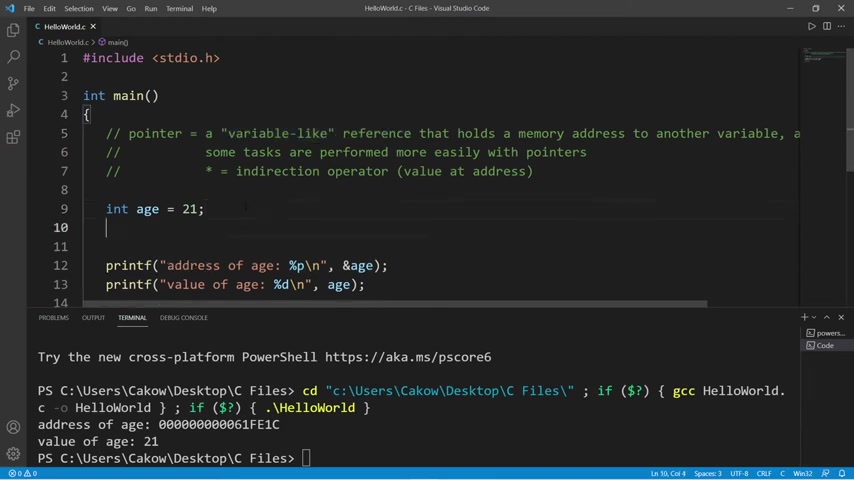
By understanding the address-of operator, you can effectively work with pointers and manipulate memory addresses in your C programs. Proper use of this operator ensures that pointers point to valid memory locations and that data types are consistent, reducing the risk of errors and unexpected behavior.
The Indirection Operator (*)
The indirection operator, denoted by the asterisk symbol *, is another essential tool when working with pointers in C. This operator allows you to access the value stored at the memory address held by a pointer, effectively allowing you to "dereference" the pointer.
Understanding the Indirection Operator:
- Purpose: The primary purpose of the
*operator is to access the value stored at the memory address held by a pointer. In simpler terms, it allows you to get the content of the memory location that the pointer is pointing to. - Syntax: The
*operator is used as a prefix to a pointer variable name. For example,*pAgereturns the value stored at the memory address held by thepAgepointer. -
Usage: The indirection operator is commonly used to retrieve or modify the value of the variable pointed to by a pointer. For example:
int age = 21;
int *pAge = &age;
printf("Value of age: %d
", *pAge); // Output: Value of age: 21
*pAge = 30; // Modifies the value of age to 30
printf("New value of age: %d
", age); // Output: New value of age: 30
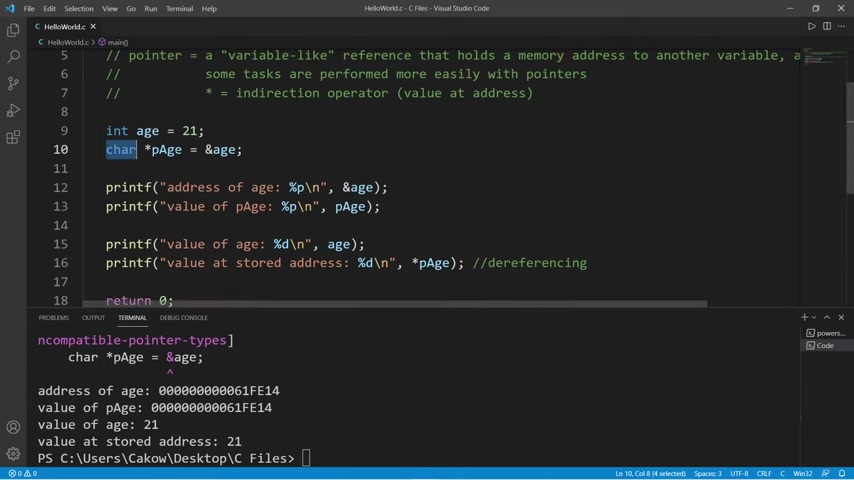
In this code snippet,
ageis an integer variable with an initial value of 21.pAgeis a pointer variable that stores the memory address ofage.*pAgeaccesses the value stored at the memory address held bypAge, which is the value ofage(i.e., 21).*pAge = 30;modifies the value at the memory location pointed to bypAge, effectively changing the value ofageto 30.
Important Notes:
- Uninitialized Pointers: Attempting to dereference an uninitialized pointer will lead to unpredictable behavior or program crashes. Always ensure that your pointers are properly initialized before using the indirection operator.
- Data Type Consistency: The data type of the value accessed through the indirection operator must match the data type of the pointer. Otherwise, you might encounter type-related errors or unexpected results.
The indirection operator is a key component when using pointers in C. It allows you to work with the actual data stored at a memory location indirectly, making pointers a powerful tool for memory manipulation and data access.
Advantages of Using Pointers
Pointers provide several significant advantages in C programming, making them a crucial tool for efficient and powerful code. Understanding these advantages will help you appreciate the importance of mastering pointers.
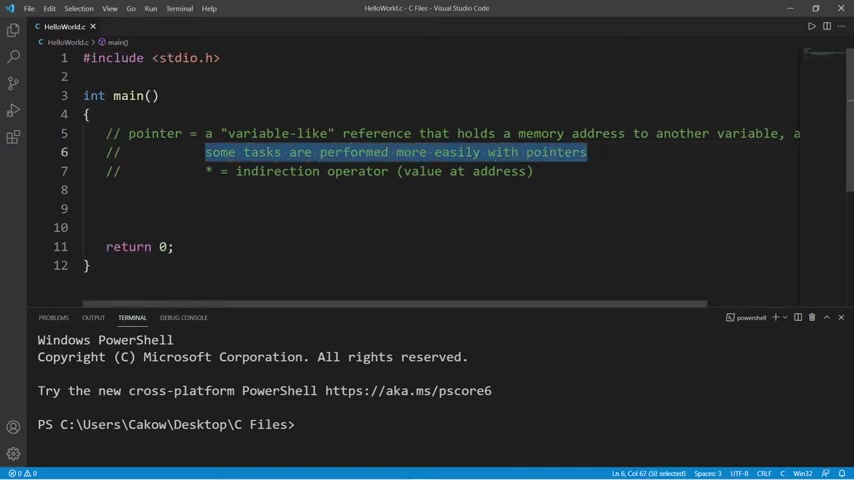
Here are some key benefits:
- Direct Memory Manipulation: Pointers allow you to directly manipulate memory locations. This is particularly useful when you need to optimize performance or work with hardware-specific features. By directly accessing and modifying memory, you can bypass the overhead of higher-level abstractions, leading to faster and more efficient code execution.
- Efficient Data Structures: Pointers are essential for creating dynamic data structures like linked lists, trees, and graphs. These structures can grow or shrink as needed during runtime, providing greater flexibility and efficiency compared to static arrays.
- Passing Arguments by Reference: By using pointers, you can pass arguments to functions by reference, allowing the function to modify the original variables directly. This is more efficient than passing by value, which involves creating a copy of the data.
- Dynamic Memory Allocation: Pointers are crucial for dynamic memory allocation, enabling programs to request memory during runtime. This is particularly useful when you need to allocate memory for data structures whose size is not known at compile time.
Advantages of Using Pointers Summarized:
| Advantage | Description |
|---|---|
| Direct Memory Manipulation | Allows for direct access and modification of memory locations, enabling performance optimization and hardware-level control. |
| Efficient Data Structures | Enables the creation of dynamic data structures, such as linked lists and trees, which can grow or shrink during runtime, providing flexibility in managing data. |
| Pass Arguments by Reference | Allows functions to modify the original variables directly, improving efficiency compared to passing by value, which involves creating copies of data. |
| Dynamic Memory Allocation | Enables programs to request memory during runtime, making it possible to manage data structures with sizes determined during execution rather than at compile time. |
| Less Time in Program Execution | Reduces execution time by allowing more efficient data manipulation and resource management. |
| Working on the Original Variable | Enables direct modifications to the original data, bypassing the need for creating and manipulating copies. |
| Searching and Sorting Data Easily | Simplifies the process of searching and sorting large datasets by allowing direct access to memory locations, enhancing the speed and efficiency of these operations. |
| Dynamic Memory Allocation | Allows the program to allocate memory at runtime as needed, adapting to varying data requirements. |
- Improved Performance: By reducing unnecessary copying of data and allowing for direct memory access, pointers can significantly improve the performance of your C programs.
While pointers offer numerous advantages, they also require careful handling to avoid potential pitfalls like memory leaks, dangling pointers, and segmentation faults. Mastering these complexities will enable you to harness the full power of pointers in your C programming endeavors.







Most people like
































Report
Please select a reason for reporting
- 13 Reasons to Switch from Snapchat to Text Messaging
- 7 Powerful Speech to Text Apps to Boost Productivity
- 10 Best Speech to Text Tools for Effortless Transcription
- 13 Free Tools to Easily Transcribe Audio to Text
- 15 Surprising Ways Google's Speech-to-Text Boosts Productivity
- 7 Best Free Online Audio to Text Transcription Tools
- 9 Tips to Transcribe Speech to Text Faster and Better
- 13 Best Speech to Text Software for Windows 10 in 2023
- 7 Tips for Choosing the Best Transcriber for Audio to Text
- 11 Reasons Why Dragon Speech-to-Text Apps are Game-Changers
- 6 Secrets to Enhance Your Speech to Text Transcription
- 6 Brilliant Ways to Boost Productivity with Talk-to-Text on Your MacBook
- 6 Ways Transcription Software Converts Audio to Text
- 8 Tips to Transcribe Speech to Text Like a Pro
- 6 Reasons IBM Watson Speech to Text is a Game-Changer
- 14 Powerful Ways Talk-to-Text Improves Your Workflow
- 12 Top Windows Speech-to-Text Software for Efficient Transcription
- 12 Game-Changing Benefits of Apple's Speech to Text Technology
- 9 Powerful Use Cases for AWS Speech to Text Technology
- 10 Easy Steps to Transcribe YouTube Videos to Text
- transcription audio en texte
- online audio transcription
- free audio file transcription
- free ai audio transcription
- audio transcription service
- audio transcription online free
- audio transcription free online
- audio to transcription software
- audio and transcript
- ai audio transcription free
- voice recording to text converter
- translate voice recording to text
- record voice to text
- audio recording to text converter
- voice recording and transcription
- chatgpt voice to text
- gmail voice to text
- speech to text reader
- speech to text ai free
- speech to talk
- Meshy AI: How to Create 3D Models from Text and Images
- How SEO and Marketing Dashboards Empower Agencies to Drive Results
- How to Use AI Tools to Find Internal Linking Opportunities Across a Business Website
- Discover Your Perfect Haircut with AI Hairstyle Apps
- Free Reputation Calculator Tools: How They're Adapting to Score AI Visibility, Not Just Rankings
- Design Professional Flyers for Free on Your Phone
- Best Free Flyer Maker Apps for Android: Design Like a Pro
- How to Know If Your Business Is Ready for an AI Customer Service Agent
- Revolutionizing Storytelling: From Novels to Screenplays with AI
- Create Engaging Animated Explainer Videos with a Free AI Tool
- Meshy AI: How to Create 3D Models from Text and Images
- ASOMobile Helps Teams Benchmark App Store Screenshots Against Competitors
- How to Match LMS Software With Your Organization's Training Plan
- Revolutionizing Email Marketing Agency with AI
- How to Convert BTC to HNT
- Unleashing the Power of AI: Cognizant's Roadmap for Transformation
- Frame to Video Review: A Practical Look at Turning Two Still Frames Into Motion
- NVIDIA NIM: Revolutionizing Supply Chain Data Analysis with AI
- Top AI Tools That Help Brands Stand Out Offline (Not Just Online)
- Top 5 Cold Email Software: Maximize Your Outreach in 2025

Copyright ©2026 toolify