































Table of Contents
- Key Points
- Redefining Software Quality Assurance with AI
- Real-World Application: Automating IoT Testing
- Expanding Automation Across Different Domains
- Contact for Pricing
- Pros and Cons of AI in Software Testing
- Core Features for Quality Assurance
- Key Software Quality Assurance Use Cases
- FAQ
- Related Questions


Redefining Software Quality Assurance with AI
The Challenge with Traditional Software Testing
Traditionally, building and maintaining test automation, especially for complex applications, has been a slow and manual process. This approach often strains engineering teams, increasing time-to-market and leaving more room for human error. Manual testing processes are inherently error-prone, resource-intensive, and struggle to keep pace with the speed of modern software development. This creates a bottleneck, hindering agility and potentially impacting product quality.
With traditional software testing, manual efforts often result in:
- Slow Test Creation: Each test case needs to be manually designed and implemented, consuming significant time.
- Error-Prone Processes: Manual interventions increase the risk of oversight and inconsistencies.
- High Maintenance Costs: Adapting tests to changes in the application requires time-consuming manual adjustments.
- Scalability Issues: Scaling testing efforts becomes challenging as the complexity and size of applications grow.
These limitations necessitate a more efficient and reliable approach to software quality assurance. This is where AI-powered automation steps in, offering a solution that addresses these critical pain points.
TechTez's Innovative Approach: AI-Powered Automation
TechTez addresses the challenges of traditional software testing with a smarter, faster, and context-aware automation approach. By combining VS Code’s GitHub Copilot extension with Claude Sonnet LLM (Large Language Model) through a GitHub Copilot Business setup, TechTez delivers intelligent AI-assisted script generation. This solution ensures that the generated code is fully aware of the code’s context and patterns, leading to more accurate and relevant test scripts.
This synergistic combination enables AI-Powered Development Automation, transforming code and documentation into intelligent workflows.
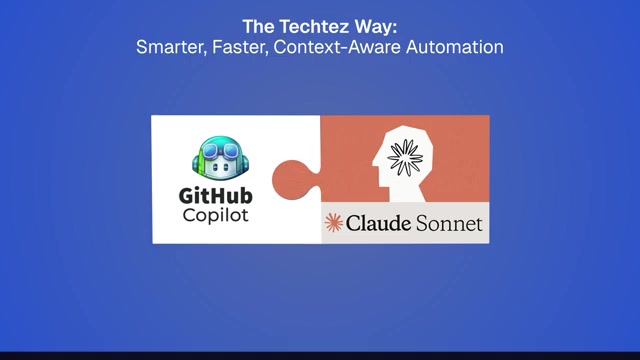
The model ingests information from various sources:
- Code Repository: AI analyzes the existing codebase to understand functions, classes, and data structures.
- Documentation: API references, testing guides, and best practices are utilized to provide context-aware assistance.
- Automated Workflows: The model supports auto-testing, code reviews, deployment, monitoring, and automatic documentation generation.
The AI-driven automation transforms the software development lifecycle, boosting productivity, improving code quality, and accelerating time to market.
Real-World Application: Automating IoT Testing
Generating Robot Framework Scripts for IoT
TechTez uses AI to automate the generation of Robot Framework scripts for testing IoT applications. A solid base context is established, including detailed variables, API structures, and workflows for key IoT features such as GPS management and XDK device handling.
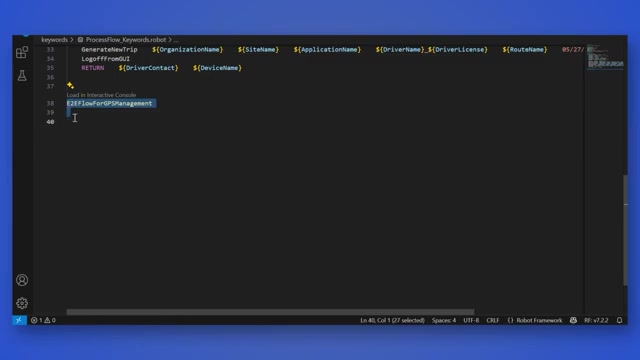
This comprehensive context allows the AI to generate more effective and accurate test scripts.
TheThe process involves several key steps:
- Context Preparation: The AI is fed with comprehensive information about the codebase, API structures, and IoT-specific workflows.
- Keyword Generation: The AI generates Robot Framework keywords that encapsulate specific functionalities, like GPS management.
- Test Case Integration: The generated keywords are integrated into test cases, creating an end-to-end flow for testing IoT applications.
For example, the AI can generate a keyword for an end-to-end flow for GPS management in Robot Framework, which handles user login, device and driver creation, vehicle and route setup, and trip generation—all parameterized for easy reuse. This dramatically reduces the time and effort required to create robust test suites for IoT applications.
Step-by-Step AI Assisted Script Generation
Let’s dive into the step-by-step process of how AI assists in script generation:
-
Context Preparation: We begin by feeding the LLM and Copilot with a comprehensive understanding of our environment, including imports, setups, device definitions and expected flows.
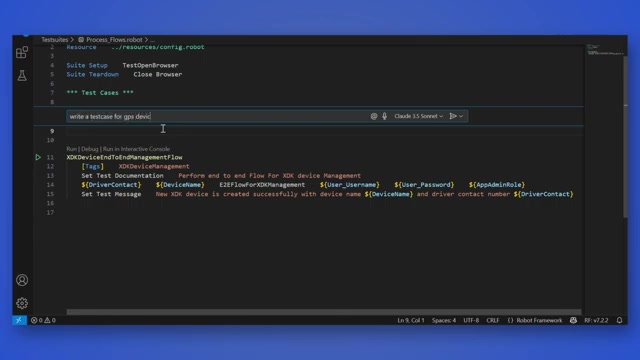
-
Keyword Generation: Using this established context, we instruct Copilot to generate the necessary keywords. For instance, we request a robust end-to-end flow for GPS management.
-
AI Code Generation: Copilot swiftly generates the code, covering aspects like user login, device/driver creation, vehicle setup, and trip generation, all while ensuring parametrization for effortless reusability.
-
Test Case Integration: The next step involves crafting the corresponding test case, specifically tailored for GPS device end-to-end management, seamlessly integrating and validating devices, and meticulously documenting driver details for comprehensive audits.
This process ensures that test cases are generated swiftly, accurately and with a high degree of relevance to the application’s context.
Advantages of AI-Powered Test Automation
The advantages of using AI in test automation are multifold:
-
Contextual Understanding: The AI comprehends your framework via imports and code structure, which allows for pinpoint accuracy. This enhances code generation.

-
Productivity Boost: AI generates entire functions or flows, cutting down the time spent typing or debugging boilerplate. This accelerates testing.
-
Relevant Code Generation: AI learns your application's style and patterns to produce consistent, production-grade scripts. This reduces maintenance needs.
-
Context-Aware Suggestions: AI proposes what's most relevant based on your variables, functions, or comments. This results in relevant tests.
-
Code Quality and Consistency: AI aligns with your existing code style, minimizing syntax or logic errors. This increases code confidence.
These advantages lead to up to 70% faster script creation and a 50%+ higher test coverage, significantly boosting release confidence and reducing maintenance, thus creating an efficient and reliable system. Here is a summary of the benefits in table format:
| Feature | Benefit |
|---|---|
| Contextual Understanding | Pinpoint Accuracy |
| Productivity Boost | Accelerated Testing |
| Relevant Code Generation | Reduced Maintenance |
| Context-Aware Suggestions | Relevant Tests |
| Code Quality & Consistency | Increased Code Confidence |
| Script Creation Speed | Up to 70% Faster |
| Test Coverage | 50%+ Higher |
| Overall System | Efficient and Reliable |








Most people like
































Report
Please select a reason for reporting
- 13 Reasons to Switch from Snapchat to Text Messaging
- 7 Powerful Speech to Text Apps to Boost Productivity
- 10 Best Speech to Text Tools for Effortless Transcription
- 13 Free Tools to Easily Transcribe Audio to Text
- 15 Surprising Ways Google's Speech-to-Text Boosts Productivity
- 7 Best Free Online Audio to Text Transcription Tools
- 9 Tips to Transcribe Speech to Text Faster and Better
- 13 Best Speech to Text Software for Windows 10 in 2023
- 7 Tips for Choosing the Best Transcriber for Audio to Text
- 11 Reasons Why Dragon Speech-to-Text Apps are Game-Changers
- 6 Secrets to Enhance Your Speech to Text Transcription
- 6 Brilliant Ways to Boost Productivity with Talk-to-Text on Your MacBook
- 6 Ways Transcription Software Converts Audio to Text
- 8 Tips to Transcribe Speech to Text Like a Pro
- 6 Reasons IBM Watson Speech to Text is a Game-Changer
- 14 Powerful Ways Talk-to-Text Improves Your Workflow
- 12 Top Windows Speech-to-Text Software for Efficient Transcription
- 12 Game-Changing Benefits of Apple's Speech to Text Technology
- 9 Powerful Use Cases for AWS Speech to Text Technology
- 10 Easy Steps to Transcribe YouTube Videos to Text
- transcription audio en texte
- online audio transcription
- free audio file transcription
- free ai audio transcription
- audio transcription service
- audio transcription online free
- audio transcription free online
- audio to transcription software
- audio and transcript
- ai audio transcription free
- voice recording to text converter
- translate voice recording to text
- record voice to text
- audio recording to text converter
- voice recording and transcription
- chatgpt voice to text
- gmail voice to text
- speech to text reader
- speech to text ai free
- speech to talk
- How to Use AI Tools to Find Internal Linking Opportunities Across a Business Website
- Discover Your Perfect Haircut with AI Hairstyle Apps
- Free Reputation Calculator Tools: How They're Adapting to Score AI Visibility, Not Just Rankings
- Design Professional Flyers for Free on Your Phone
- Best Free Flyer Maker Apps for Android: Design Like a Pro
- How to Know If Your Business Is Ready for an AI Customer Service Agent
- Revolutionizing Storytelling: From Novels to Screenplays with AI
- Create Engaging Animated Explainer Videos with a Free AI Tool
- Stop Multi-Subscribing: Benchmark Top AI Visual Models in One Canvas
- Best Seedance 2.5 API Provider: Every Price on the Market, Checked at Source
- Top AI Social Media Management Tools: Automate Your Content Strategy
- Free AI Text to Video Generator: Create Stunning Videos from Text
- Discover 17 ChatGPT Alternatives: A Comprehensive Comparison
- Character.AI vs. Janitor AI: Which AI Chat Platform Reigns Supreme?
- Top Virtual Assistant Companies in 2026: Reviews, Pricing, and Plans Compared
- Unveiling FaceCheck.ID: Revolutionizing Reverse Image Searches with AI
- 11 Best AI Dialers in 2026: Features, Pricing, Pros and Cons
- How I Direct Consistent AI Clips: A Hands-On Guide to Multi-Model Generation
- A Realistic Review of the Photo Generator Image Tool
- Playwright MCP Server: Automated Web Testing with Agent Mode

Copyright ©2026 toolify