































Table of Contents
- Key Points
- Automating Task Management with AI
- Integrating OpenAI's Model with Google Apps Script
- Fine-Tuning for Enhanced Accuracy
- Understanding OpenAI's Pricing
- Benefits and Drawbacks of AI-Powered Task Categorization
- Key Features of the AI Task Categorization System
- Real-World Use Cases
- FAQ
- Related Questions



Automating Task Management with AI
The Power of AI in Google Sheets
In today's fast-paced environment, efficient Task Management is crucial. Integrating AI into Google Sheets offers a seamless way to automate categorization, saving time and reducing manual effort.
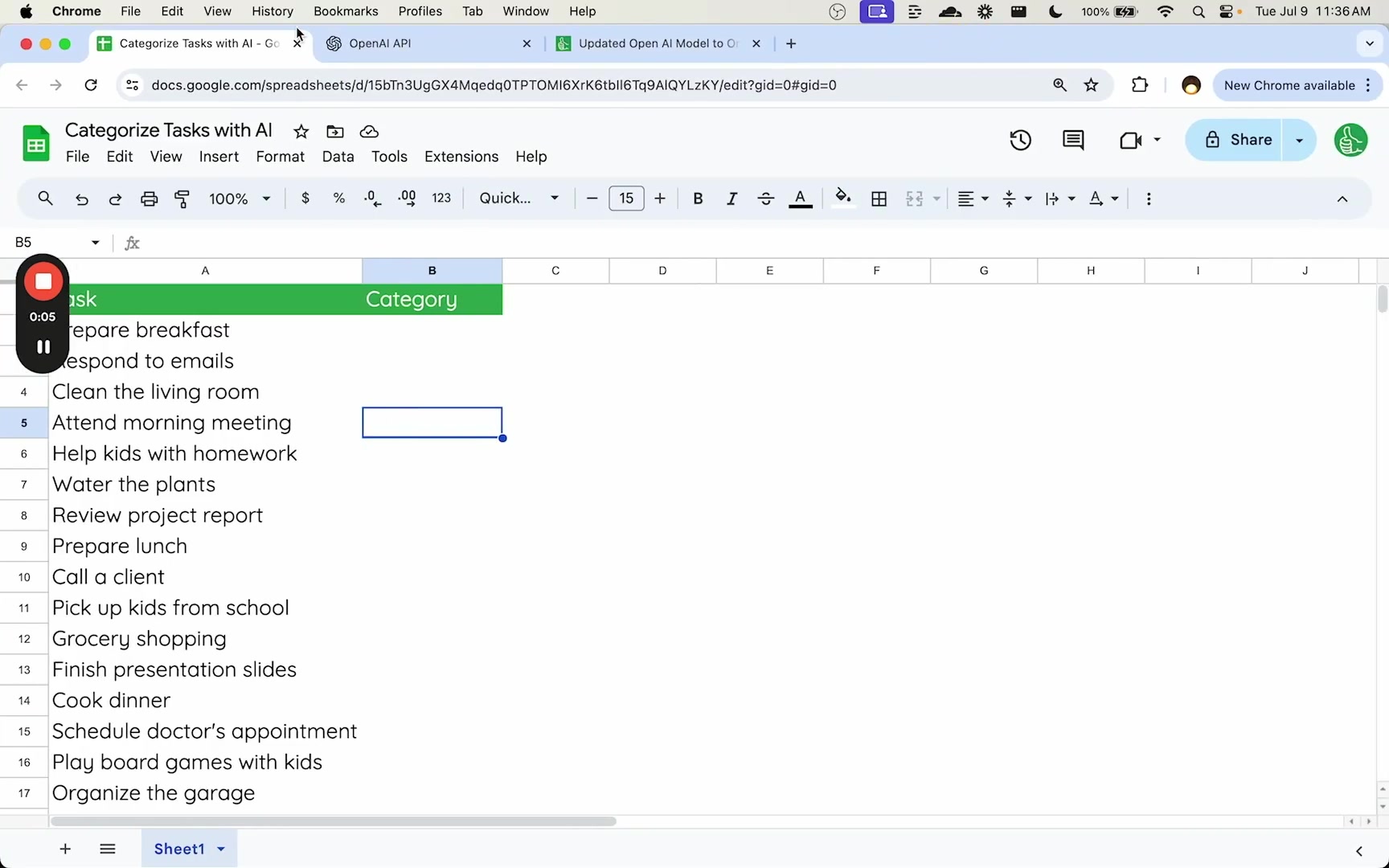
By using AI, you can transform your task lists into organized, manageable schedules that enhance productivity and reduce stress. This method leverages OpenAI's models to understand and classify your tasks based on context and keywords, providing a smarter way to balance your work and personal life. Implementing AI for task categorization in Google Sheets can lead to better time management, improved focus, and a more balanced lifestyle. The use of AI Tools ensures that tasks are correctly sorted, allowing for precise Scheduling and reducing the mental load of manually organizing each activity. This enhanced efficiency empowers you to concentrate on the completion of tasks rather than the administrative effort of managing them. It’s about creating a streamlined, intelligent workflow that adapts to your needs and makes task management a breeze.
Why Categorize Tasks with AI?
Manual task categorization can be time-consuming and prone to human error. Automating this process with AI offers several advantages:
- Efficiency: AI categorizes tasks in seconds, freeing up your time for more important activities.
- Accuracy: AI reduces the risk of miscategorization, ensuring your tasks are properly sorted.
- Balance: Understanding the distribution of your tasks between 'Work' and 'Home' helps you achieve a better work-life balance.
- Insights: AI-driven categorization can reveal Patterns and trends in your tasks, providing insights for improved scheduling and prioritization.
Categorizing tasks with AI allows for a dynamic overview of your responsibilities, aiding in the strategic planning of your day. This level of automated insight facilitates more informed decision-making regarding time allocation, leading to a more harmonious balance between professional and personal engagements. The integration of AI transforms a traditionally tedious task into a powerful tool for self-management and efficiency, promoting a more productive and balanced approach to daily life. Embracing this technology is not just about automating a task; it's about enhancing your overall lifestyle by enabling smarter, more efficient time utilization.
Setting Up Your Google Sheet
First, create a new Google Sheet and set up two columns: 'Task' and 'Category'.
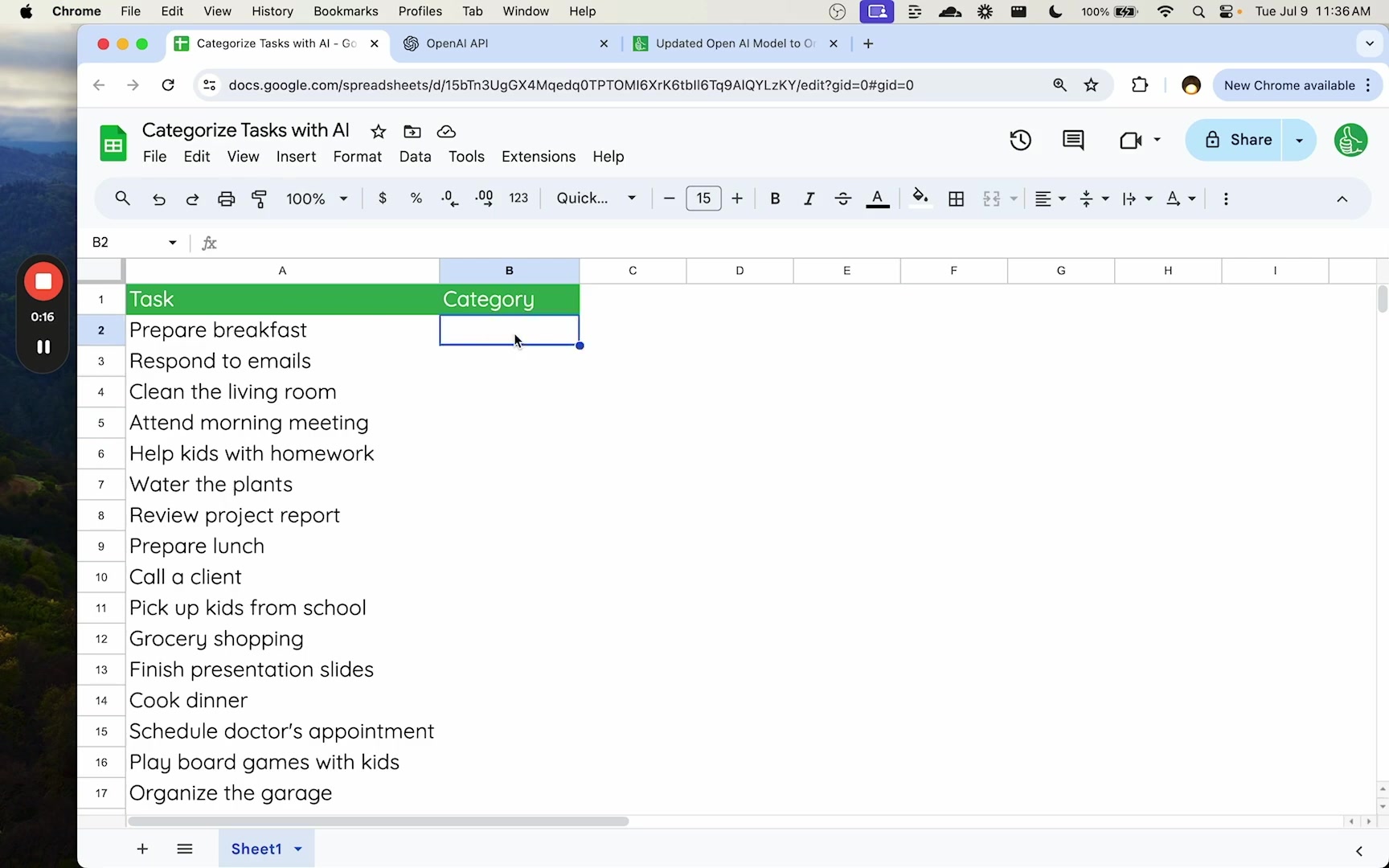
In the 'Task' column, list all your tasks. The 'Category' column will be populated by the AI with either 'Work' or 'Home.'
Here is how your sheet should look:
| Task | Category |
|---|---|
| Prepare breakfast | |
| Respond to emails | |
| Clean the living room | |
| Attend morning meeting | |
| Help kids with Homework | |
| Water the plants | |
| Review project report | |
| Prepare lunch | |
| Call a client | |
| Pick up kids from school | |
| Grocery shopping | |
| Finish presentation slides | |
| Cook dinner | |
| Schedule doctor's appointment | |
| Play board games with kids | |
| Organize the garage | |
| Draft a budget proposal | |
| Read a bedtime story | |
| Plan the next day's tasks | |
| Exercise for 30 minutes |
This simple setup provides the foundation for AI integration and task automation. Ensuring clear and consistent labeling helps the AI classify tasks more effectively, ultimately improving the accuracy and efficiency of your task management process. By meticulously structuring your sheet, you optimize the AI’s ability to provide actionable insights and support a more balanced and productive daily routine.
Integrating OpenAI's Model with Google Apps Script
Accessing the Script Editor
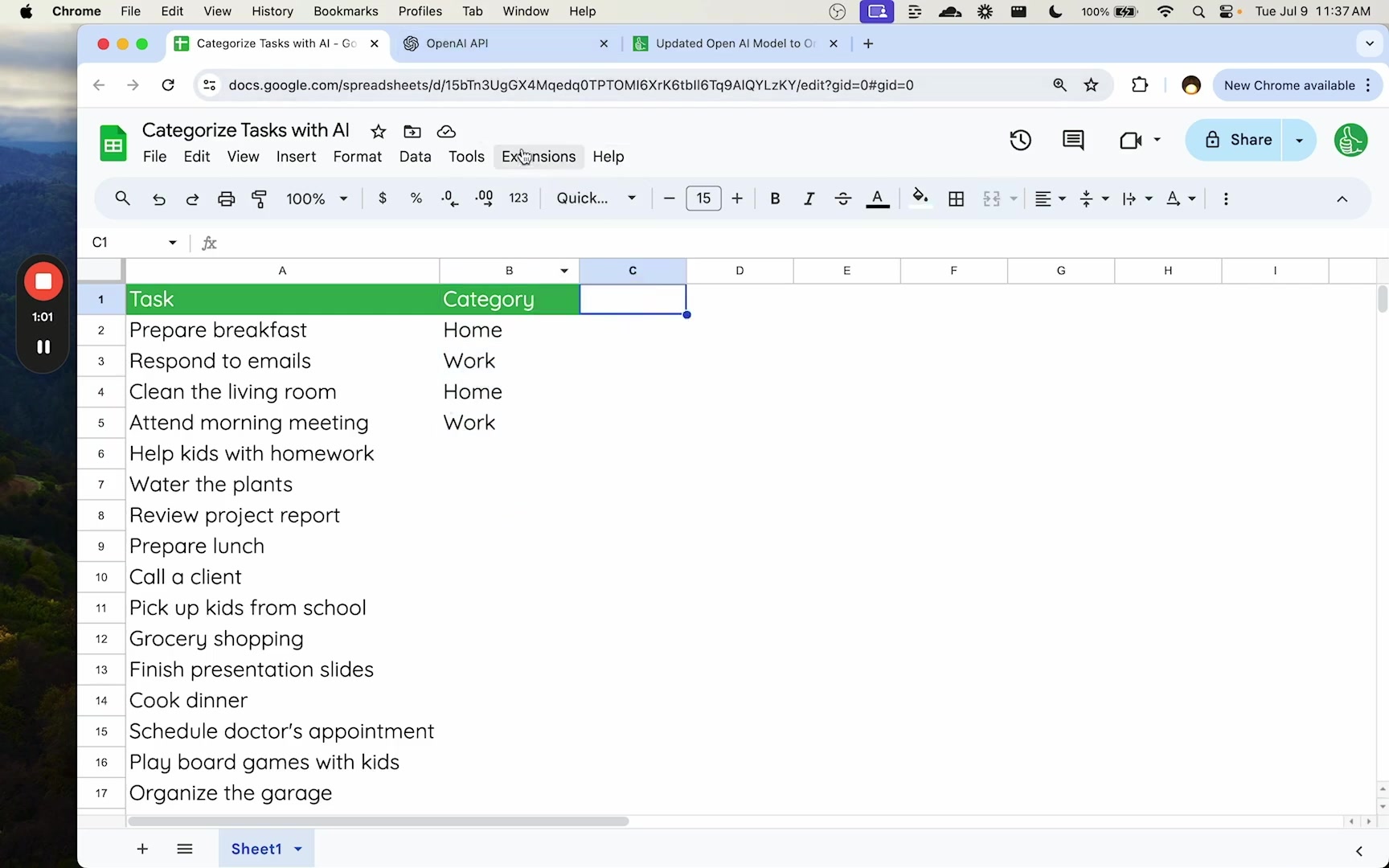
To integrate AI into your Google Sheet, you'll use Google Apps Script. This powerful tool allows you to write custom functions that interact with Google Sheets and external APIs. To open the script editor, go to 'Extensions' > 'Apps Script'. This action opens a new tab where you can write and manage your code.
The Google Apps Script editor provides a coding environment tailored to Google Workspace, facilitating the creation of scripts that can automate tasks, connect to external services, and customize your Google Sheets experience. Familiarizing yourself with this editor is essential for unlocking the full potential of AI-powered task management within Google Sheets. The script editor also features debugging tools and version control, ensuring that your code runs smoothly and can be easily managed over time. By utilizing Apps Script, you can transform your Google Sheets into dynamic and intelligent tools that adapt to your specific needs, enhancing productivity and streamlining your workflow.
Writing the AI Categorization Script
Now, it's time to write the script that will communicate with OpenAI's model and categorize your tasks. Copy and paste the following code into your Apps Script editor:
function AI(task) {
 var apiKey = 'YOUR_OPENAI_API_KEY'; // Replace with your actual API key
 var model = 'gpt-3.5-turbo'; // Or any other suitable model

 var prompt = `Give back only the category of the task given. Only give back either Work or Home. No other categories. For example: Task: Prepare breakfast Category:Home Task:Respond to emails Category:Work Task:Clean the living room Category:Home Task:Attend morning meeting Category:Work Task: ` + task + ` Category:`;

 var data = {
 'model': model,
 'messages': [
 { 'role': 'system', 'content': 'You are a task categorization assistant.' },
 { 'role': 'user', 'content': prompt }
 ]
 };

 var options = {
 'method': 'post',
 'contentType': 'application/json',
 'headers': {
 'Authorization': 'Bearer ' + apiKey
 },
 'payload': JSON.stringify(data)
 };

 var response = UrlFetchApp.fetch('https://api.openai.com/v1/chat/completions', options);
 var json = JSON.parse(response.getContentText());

 return json.choices[0].message.content;
}
Remember to replace 'YOUR_OPENAI_API_KEY' with your actual OpenAI API Key.
This script defines a function AI(task) that sends a task to OpenAI, receives a category ('Work' or 'Home'), and returns it. The Prompt is carefully crafted to instruct the AI to provide only the category, improving accuracy. Make sure to enable the OpenAI API in your Google Cloud project and set up billing to avoid any interruptions. This script is designed to be efficient and reliable, ensuring that your task categorization process is both fast and accurate. Proper error handling and API key management are essential for the security and stability of your AI-powered Google Sheet. This setup provides a streamlined solution for automating task categorization, saving time and enhancing productivity. This script interacts with OpenAI, using its natural language processing capabilities to analyze task descriptions and assign them to the correct category.
Integrating the Script into Google Sheets
To use the AI function in your Google Sheet, enter the following formula in the first cell of your 'Category' column (e.g., B2):
=AI(A2)This formula calls the AI function with the task from cell A2 as input. Drag the fill handle (the small square at the bottom-right of the cell) down to apply the formula to all your tasks. Google Sheets will now use the AI to categorize each task automatically. The results should appear in the 'Category' column, providing a quick and organized overview of your tasks. This integration allows for dynamic updates, meaning that any changes in the 'Task' column will automatically trigger a new categorization by the AI. This seamless process ensures that your task list remains current and properly organized at all times, enhancing efficiency and reducing manual effort. The formula can be easily adjusted to accommodate different sheet layouts or column arrangements, providing flexibility and customization to suit your specific needs. By integrating the script in this way, you empower your Google Sheets to function as an intelligent task management tool, capable of adapting to your evolving workload.






Most people like




































Report
Please select a reason for reporting
- 13 Reasons to Switch from Snapchat to Text Messaging
- 7 Powerful Speech to Text Apps to Boost Productivity
- 10 Best Speech to Text Tools for Effortless Transcription
- 13 Free Tools to Easily Transcribe Audio to Text
- 15 Surprising Ways Google's Speech-to-Text Boosts Productivity
- 7 Best Free Online Audio to Text Transcription Tools
- 9 Tips to Transcribe Speech to Text Faster and Better
- 13 Best Speech to Text Software for Windows 10 in 2023
- 7 Tips for Choosing the Best Transcriber for Audio to Text
- 11 Reasons Why Dragon Speech-to-Text Apps are Game-Changers
- 6 Secrets to Enhance Your Speech to Text Transcription
- 6 Brilliant Ways to Boost Productivity with Talk-to-Text on Your MacBook
- 6 Ways Transcription Software Converts Audio to Text
- 8 Tips to Transcribe Speech to Text Like a Pro
- 6 Reasons IBM Watson Speech to Text is a Game-Changer
- 14 Powerful Ways Talk-to-Text Improves Your Workflow
- 12 Top Windows Speech-to-Text Software for Efficient Transcription
- 12 Game-Changing Benefits of Apple's Speech to Text Technology
- 9 Powerful Use Cases for AWS Speech to Text Technology
- 10 Easy Steps to Transcribe YouTube Videos to Text
- transcription audio en texte
- online audio transcription
- free audio file transcription
- free ai audio transcription
- audio transcription service
- audio transcription online free
- audio transcription free online
- audio to transcription software
- audio and transcript
- ai audio transcription free
- voice recording to text converter
- translate voice recording to text
- record voice to text
- audio recording to text converter
- voice recording and transcription
- chatgpt voice to text
- gmail voice to text
- speech to text reader
- speech to text ai free
- speech to talk
- How SEO and Marketing Dashboards Empower Agencies to Drive Results
- How to Use AI Tools to Find Internal Linking Opportunities Across a Business Website
- Discover Your Perfect Haircut with AI Hairstyle Apps
- Free Reputation Calculator Tools: How They're Adapting to Score AI Visibility, Not Just Rankings
- Design Professional Flyers for Free on Your Phone
- Best Free Flyer Maker Apps for Android: Design Like a Pro
- How to Know If Your Business Is Ready for an AI Customer Service Agent
- Revolutionizing Storytelling: From Novels to Screenplays with AI
- Create Engaging Animated Explainer Videos with a Free AI Tool
- Stop Multi-Subscribing: Benchmark Top AI Visual Models in One Canvas
- AI & Elections: Defending Democracy Against Misinformation
- Navigating Political Discourse: AI, Deepfakes, and Reality Checks
- Detecting Political Bias in News Articles: A Powerful AI Algorithm
- AI Bias Unveiled: Political Leanings in ChatGPT & Beyond
- Revolutionize Learning: Discover Quizzes AI for Engaging Interactive Quizzes
- From AI-Generated to Audience-Ready: How Quillbot Humanize AI Is Changing the Content Editing Process
- Building an AI Writing Stack in 2026: LLMs, Detectors, and Humanizers
- 7 Top AI-Powered Database Assistant Platforms
- An Objective Look at Modern Web-Based Visual Modifications
- My Honest Experience with VideoAI: The Secret Weapon for Creators Who Need Character Voices

Copyright ©2026 toolify