































Table of Contents
- Key Points
- Understanding Edge Detection
- The Edge Detection Algorithm Landscape: Sobel, Laplacian, and Canny
- Step-by-Step Implementation with Code
- Pricing Models
- Pros and Cons (Sobel, Laplacian, and Canny Edge Detection)
- Core Features of Edge Detection Techniques
- Practical Applications of Edge Detection
- Frequently Asked Questions
- Related Questions


Understanding Edge Detection
What is Edge Detection?
Edge detection is a critical process in computer vision that identifies boundaries within an image where significant changes in pixel intensity occur. These boundaries, or edges, often correspond to the outlines of objects or features in the scene. By detecting edges, we can extract valuable information about the image content, including shape, size, and location of objects.
This information serves as a cornerstone for many computer vision applications, such as object recognition, Image Segmentation, and feature extraction. The core goal of edge detection is to reduce the amount of data to be processed, filtering out information that may be regarded as less relevant, while preserving the important structural properties of an image. Edges typically occur at object boundaries, surfaces with distinct textures, and areas with significant variations in color or brightness. Effective edge detection algorithms balance sensitivity (detecting as many true edges as possible) with specificity (avoiding the detection of false edges or noise). The choice of algorithm often depends on the image characteristics and the intended application. Sophisticated methods may involve multiple stages of filtering and thresholding to refine the results. The ability to accurately detect and represent edges is a fundamental requirement for tasks like scene understanding, image retrieval, and automated inspection systems.
The Edge Detection Algorithm Landscape: Sobel, Laplacian, and Canny
Delving into the Details: How do these Edge Detectors Work?
Now that we've understood the fundamental concept of edge detection, let’s dive into the workings of three key algorithms, each with its unique strengths.
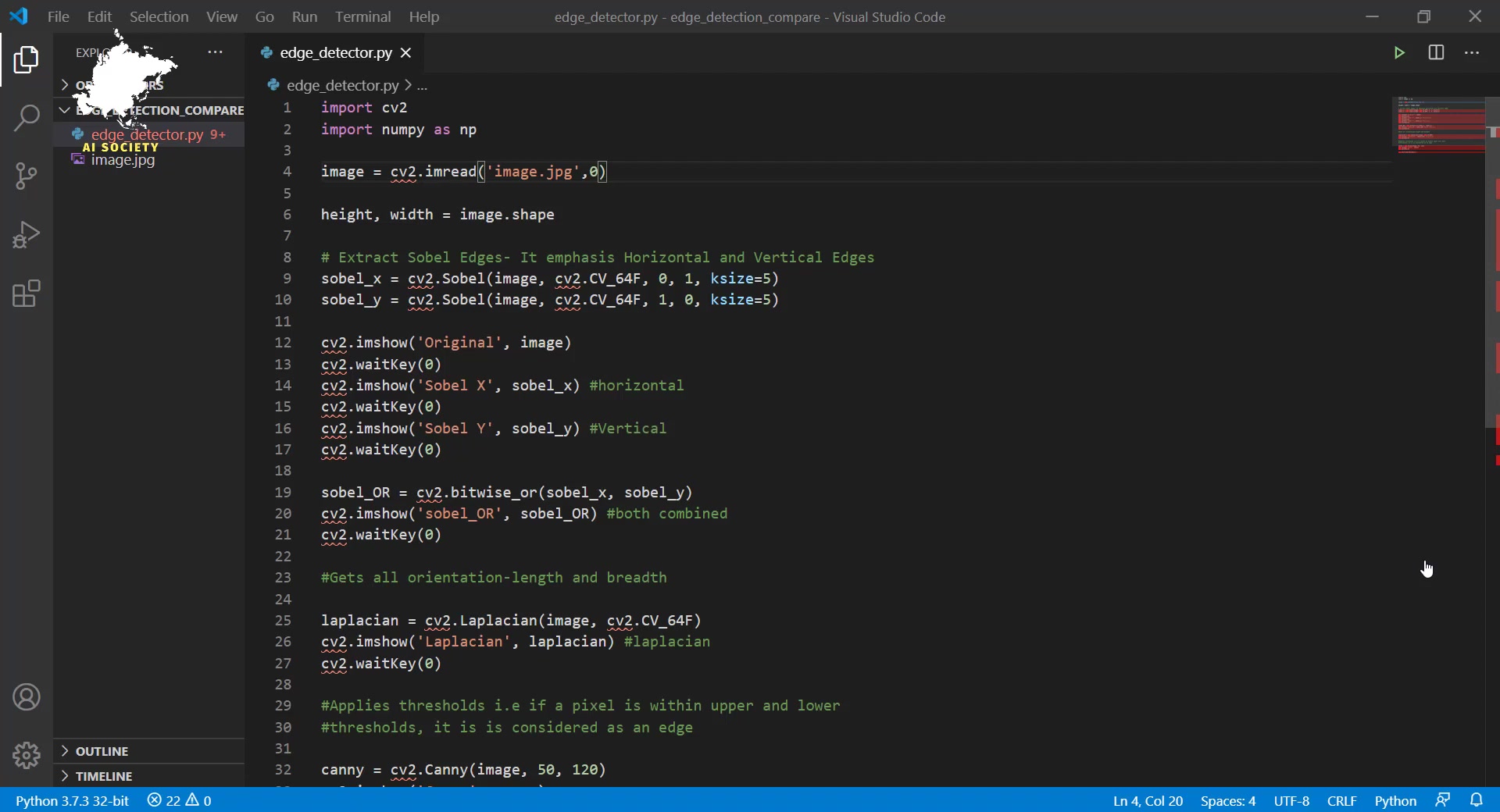
The comparison of these edge detection techniques will be below:
-
Sobel Operator: The Sobel operator is primarily used to find edges by approximating the derivative of the image intensity function. It is most effective at emphasizing edges that have high spatial frequency in the horizontal and vertical directions. This operator uses two 3x3 kernels which are convolved with the original image to calculate approximations of the derivatives – one for horizontal changes and one for vertical.
This approach is robust for detecting edges in grayscale images, especially when lighting is uniform. However, it is more sensitive to noise than some other edge detection methods, which may result in false positives. Furthermore, the Sobel operator works best when edge orientation is close to horizontal or vertical, making it less effective for detecting diagonal edges. This algorithm uses the following parameters:
cv2.CV_64F(data type for storing the result)dx(order of the derivative in the x direction, typically 1 or 0)dy(order of the derivative in the y direction, typically 1 or 0)ksize(size of the Sobel kernel).
-
Laplacian Operator: The Laplacian operator is an isotropic operator that measures the second spatial derivative of an image. This isotropic property means it responds equally to edges regardless of their direction. The Laplacian is very sensitive to noise, because it calculates second derivatives, which tend to amplify noise. Therefore, images are often preprocessed using a smoothing filter (like Gaussian blur) before applying the Laplacian.
This edge detection process is orientation-independent, the Laplacian is excellent at detecting edges without bias toward horizontal or vertical directions. This is useful when the orientation of edges is arbitrary or when you need to capture every significant change regardless of direction. The code implementation would be:
cv2.CV_64F(data type for storing the result)- The default kernel size is often used for general-purpose edge detection, but it can be changed based on the desired level of detail.
-
Canny Edge Detector: The Canny edge detector is widely regarded as one of the most effective and influential edge detection algorithms. Its main goal is to identify a wide range of edges in images while minimizing noise and false positives. The Canny edge detector begins with noise reduction through a Gaussian filter, followed by the computation of image gradient magnitudes and directions. After finding edge gradients, it applies non-maximum suppression to thin out the edge lines. Thresholding is then used to determine whether edge pixels are likely to be true edges; this involves a dual threshold to identify potential edges and to classify edges effectively.
This algorithm's effectiveness comes from its multi-stage process that optimizes edge detection while minimizing false positives and accurately capturing true edges. Because of these characteristics, the Canny edge detector is very useful for a wide variety of image processing and computer vision tasks. Parameters the Canny Edge Detector used:
image(the input image)threshold1(lower threshold for hysteresis thresholding)threshold2(upper threshold for hysteresis thresholding).
The differences in the edge detection methods described in the table below:
| Feature | Sobel Operator | Laplacian Operator | Canny Edge Detector |
|---|---|---|---|
| Edge Emphasis | Horizontal and vertical edges | All orientations | All orientations |
| Orientation Bias | Strong bias to horizontal and vertical | No bias; isotropic | No inherent bias |
| Complexity | Lower | Medium | Higher |
| Parameters | Derivative orders, kernel size | Kernel size | Thresholds, aperture size |
| Noise Sensitivity | Moderate | High (very sensitive without preprocessing) | Low to moderate (includes noise reduction preprocessing) |
| Best Use Cases | Emphasizing horizontal/vertical edges, simple edge detection tasks | Detecting fine details, orientation-independent edge detection | Applications requiring accurate edge maps with minimum false positives, object detection, image segmentation, feature extraction |
Script Overview
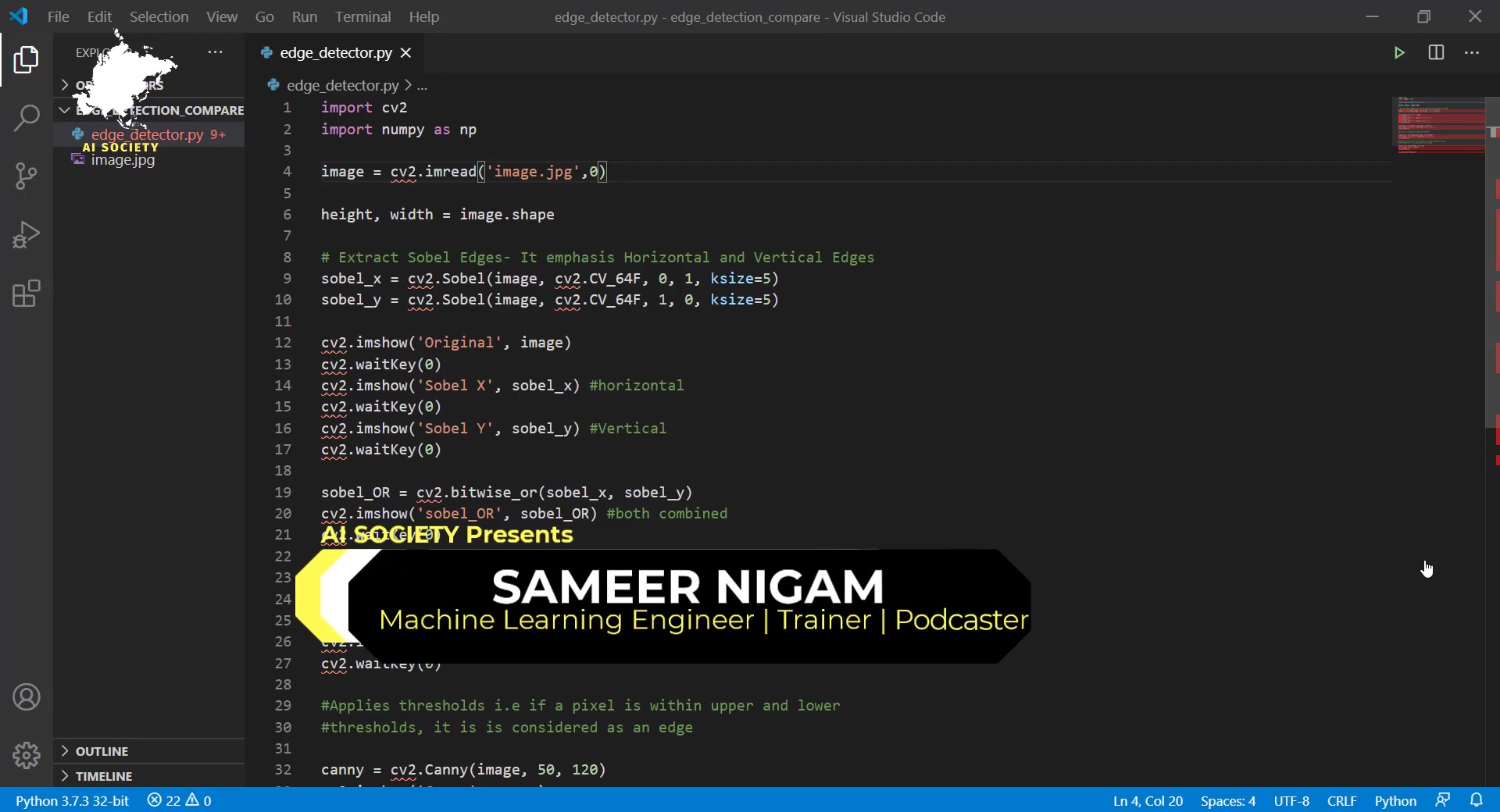
The Python script demonstrates a comparative approach to edge detection using OpenCV. It starts by importing necessary libraries: OpenCV (cv2) for image processing tasks and NumPy (np) for numerical operations.
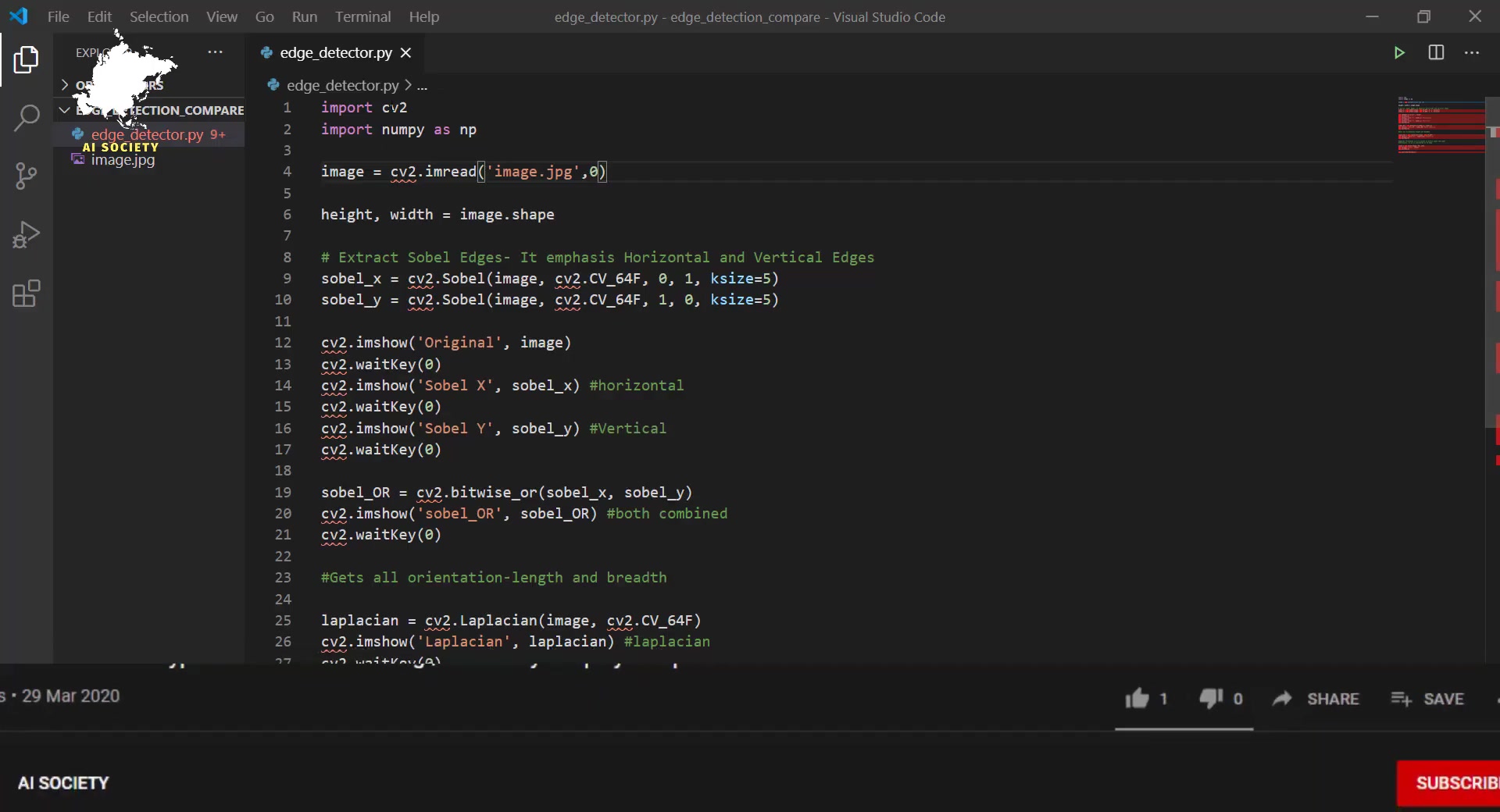
The script then defines three primary edge detection techniques to be tested on the image: Sobel, Laplacian, and Canny. Each of these techniques is implemented using built-in OpenCV functions with different parameters to extract edge information from the same input image. To showcase the outputs, OpenCV's imshow function is utilized to display the original image alongside the processed results from each algorithm. waitKey(0) is then used to hold the display until a key is pressed. The goal is to visually compare and analyze the effectiveness of each algorithm in detecting edges under identical conditions, offering a practical understanding of their strengths and weaknesses. Also the code is set to automatically destroy windows.The script imports the cv2 module for OpenCV functions and numpy for array manipulations. An image is read and the height and width is determined:
import cv2
import numpy as np

image = cv2.imread('image.jpg', 0)
height, width = image.shape





Most people like

































Report
Please select a reason for reporting
- 13 Reasons to Switch from Snapchat to Text Messaging
- 7 Powerful Speech to Text Apps to Boost Productivity
- 10 Best Speech to Text Tools for Effortless Transcription
- 13 Free Tools to Easily Transcribe Audio to Text
- 15 Surprising Ways Google's Speech-to-Text Boosts Productivity
- 7 Best Free Online Audio to Text Transcription Tools
- 9 Tips to Transcribe Speech to Text Faster and Better
- 13 Best Speech to Text Software for Windows 10 in 2023
- 7 Tips for Choosing the Best Transcriber for Audio to Text
- 11 Reasons Why Dragon Speech-to-Text Apps are Game-Changers
- 6 Secrets to Enhance Your Speech to Text Transcription
- 6 Brilliant Ways to Boost Productivity with Talk-to-Text on Your MacBook
- 6 Ways Transcription Software Converts Audio to Text
- 8 Tips to Transcribe Speech to Text Like a Pro
- 6 Reasons IBM Watson Speech to Text is a Game-Changer
- 14 Powerful Ways Talk-to-Text Improves Your Workflow
- 12 Top Windows Speech-to-Text Software for Efficient Transcription
- 12 Game-Changing Benefits of Apple's Speech to Text Technology
- 9 Powerful Use Cases for AWS Speech to Text Technology
- 10 Easy Steps to Transcribe YouTube Videos to Text
- transcription audio en texte
- online audio transcription
- free audio file transcription
- free ai audio transcription
- audio transcription service
- audio transcription online free
- audio transcription free online
- audio to transcription software
- audio and transcript
- ai audio transcription free
- voice recording to text converter
- translate voice recording to text
- record voice to text
- audio recording to text converter
- voice recording and transcription
- chatgpt voice to text
- gmail voice to text
- speech to text reader
- speech to text ai free
- speech to talk
- How to Use AI Tools to Find Internal Linking Opportunities Across a Business Website
- Discover Your Perfect Haircut with AI Hairstyle Apps
- Free Reputation Calculator Tools: How They're Adapting to Score AI Visibility, Not Just Rankings
- Design Professional Flyers for Free on Your Phone
- Best Free Flyer Maker Apps for Android: Design Like a Pro
- How to Know If Your Business Is Ready for an AI Customer Service Agent
- Revolutionizing Storytelling: From Novels to Screenplays with AI
- Create Engaging Animated Explainer Videos with a Free AI Tool
- Stop Multi-Subscribing: Benchmark Top AI Visual Models in One Canvas
- Best Seedance 2.5 API Provider: Every Price on the Market, Checked at Source
- Top AI Social Media Management Tools: Automate Your Content Strategy
- Free AI Text to Video Generator: Create Stunning Videos from Text
- Discover 17 ChatGPT Alternatives: A Comprehensive Comparison
- Character.AI vs. Janitor AI: Which AI Chat Platform Reigns Supreme?
- Top Virtual Assistant Companies in 2026: Reviews, Pricing, and Plans Compared
- Unveiling FaceCheck.ID: Revolutionizing Reverse Image Searches with AI
- 11 Best AI Dialers in 2026: Features, Pricing, Pros and Cons
- How I Direct Consistent AI Clips: A Hands-On Guide to Multi-Model Generation
- A Realistic Review of the Photo Generator Image Tool
- Playwright MCP Server: Automated Web Testing with Agent Mode

Copyright ©2026 toolify