































Table of Contents


The 3-Step Method to Spelling Improvement
Step 1: Find Your Spelling Mistakes
The initial step to improving your spelling is to actively identify the words you frequently misspell. This awareness is crucial for targeted improvement.

To do this effectively, you must scrutinize your writing, whether it's academic Papers, professional emails, or personal notes.
If you are a student, consider reviewing your past assignments or notes, paying special attention to any words your teachers marked as incorrect. If you're a working professional, examine emails, reports, and other documents you've written. It's recommended that at least once a week, you set aside time to go through your writing, focusing solely on identifying potential spelling errors.
However, finding these errors isn’t always easy. If you are unsure of the spelling, there are two helpful routes you can take:
- Ask Someone Else: Enlist the help of a friend, colleague, or tutor who has strong spelling skills. Have them read through your work and highlight any errors they find, providing you with the correct spellings.
- Use Microsoft Word: Copy and paste your writing into Microsoft Word or another WORD-processing program with built-in Spell check. The software will automatically underline any misspelled words, making them easy to identify.
By taking these steps, you can uncover your most common spelling mistakes, setting the stage for focused learning and improvement. Let's look at an example of misspelled words.
| Incorrect Spelling | Correct Spelling |
|---|---|
| alot | a lot |
| definately | definitely |
| recieved | received |
| rythm | rhythm |
| shedule | schedule |
Step 2: Record the Correct Spellings
After identifying the words you misspell, the next step is to create a system for Recording their correct spellings. This will help you internalize the correct forms and avoid making the same mistakes again.
You can use a physical notebook, a digital document, or any other method that works best for you. The key is to organize the information in a way that's easy to access and review.
Here's how to effectively Record the correct spellings:
- Write the correct spelling: Clearly write the word down in your chosen notebook or file.
- Include phonetic transcription: Next to the correct spelling, add the phonetic Transcription of the word.
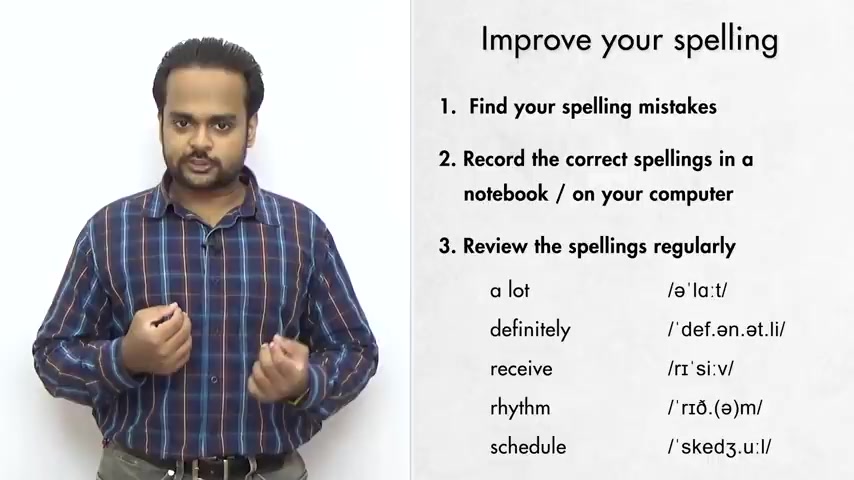
This helps you associate the spelling with the proper pronunciation, further reinforcing your memory. You can find the phonetic transcription in most dictionaries.
| Correct Spelling | Phonetic Transcription |
|---|---|
| a lot | /ə ˈlɒt/ |
| definitely | /ˈdef.ɪn.ət.li/ |
| receive | /rɪˈsiːv/ |
| rhythm | /ˈrɪð.əm/ |
| schedule | /ˈskedʒ.uːl/ |
By recording both the spelling and the pronunciation, you create a multi-sensory learning experience that helps you remember the word more effectively.
Step 3: Review the Spellings Regularly
The final, and perhaps most crucial, step is to regularly review the correct spellings you've recorded. Consistent review helps to solidify your knowledge and prevent you from reverting to old, incorrect habits.
Make it a habit to review your list of words regularly. Consider setting aside a specific day of the week, perhaps Saturday or Sunday, as your "spelling improvement day." This dedicated time will help you stay on track and make consistent progress.
Here’s how to make your review Sessions effective:
- Cover up the correct spellings: When reviewing, cover up the side of your notebook or document that contains the correct spellings. This forces you to rely on your memory.
- Look at the pronunciation: Look at the pronunciation of the word first.
- Try to spell the word: Attempt to spell the word correctly from memory.
- Check your answer: Reveal the correct spelling and compare it to your attempt. If you made a mistake, take note and try again later.
By consistently testing yourself and reinforcing the correct spellings, you'll gradually reduce your errors and improve your overall spelling skills. This 3-step method, when practiced consistently, will lead to significant improvements in your spelling accuracy.





Most people like


































Report
Please select a reason for reporting
- 13 Reasons to Switch from Snapchat to Text Messaging
- 7 Powerful Speech to Text Apps to Boost Productivity
- 10 Best Speech to Text Tools for Effortless Transcription
- 13 Free Tools to Easily Transcribe Audio to Text
- 15 Surprising Ways Google's Speech-to-Text Boosts Productivity
- 7 Best Free Online Audio to Text Transcription Tools
- 9 Tips to Transcribe Speech to Text Faster and Better
- 13 Best Speech to Text Software for Windows 10 in 2023
- 7 Tips for Choosing the Best Transcriber for Audio to Text
- 11 Reasons Why Dragon Speech-to-Text Apps are Game-Changers
- 6 Secrets to Enhance Your Speech to Text Transcription
- 6 Brilliant Ways to Boost Productivity with Talk-to-Text on Your MacBook
- 6 Ways Transcription Software Converts Audio to Text
- 8 Tips to Transcribe Speech to Text Like a Pro
- 6 Reasons IBM Watson Speech to Text is a Game-Changer
- 14 Powerful Ways Talk-to-Text Improves Your Workflow
- 12 Top Windows Speech-to-Text Software for Efficient Transcription
- 12 Game-Changing Benefits of Apple's Speech to Text Technology
- 9 Powerful Use Cases for AWS Speech to Text Technology
- 10 Easy Steps to Transcribe YouTube Videos to Text
- transcription audio en texte
- online audio transcription
- free audio file transcription
- free ai audio transcription
- audio transcription service
- audio transcription online free
- audio transcription free online
- audio to transcription software
- audio and transcript
- ai audio transcription free
- voice recording to text converter
- translate voice recording to text
- record voice to text
- audio recording to text converter
- voice recording and transcription
- chatgpt voice to text
- gmail voice to text
- speech to text reader
- speech to text ai free
- speech to talk
- How to Use AI Tools to Find Internal Linking Opportunities Across a Business Website
- Discover Your Perfect Haircut with AI Hairstyle Apps
- Free Reputation Calculator Tools: How They're Adapting to Score AI Visibility, Not Just Rankings
- Design Professional Flyers for Free on Your Phone
- Best Free Flyer Maker Apps for Android: Design Like a Pro
- How to Know If Your Business Is Ready for an AI Customer Service Agent
- Revolutionizing Storytelling: From Novels to Screenplays with AI
- Create Engaging Animated Explainer Videos with a Free AI Tool
- Stop Multi-Subscribing: Benchmark Top AI Visual Models in One Canvas
- Best Seedance 2.5 API Provider: Every Price on the Market, Checked at Source
- Top AI Social Media Management Tools: Automate Your Content Strategy
- Free AI Text to Video Generator: Create Stunning Videos from Text
- Discover 17 ChatGPT Alternatives: A Comprehensive Comparison
- Character.AI vs. Janitor AI: Which AI Chat Platform Reigns Supreme?
- Top Virtual Assistant Companies in 2026: Reviews, Pricing, and Plans Compared
- Unveiling FaceCheck.ID: Revolutionizing Reverse Image Searches with AI
- 11 Best AI Dialers in 2026: Features, Pricing, Pros and Cons
- How I Direct Consistent AI Clips: A Hands-On Guide to Multi-Model Generation
- A Realistic Review of the Photo Generator Image Tool
- Playwright MCP Server: Automated Web Testing with Agent Mode

Copyright ©2026 toolify