































Table of Contents
- Key Points
- Demystifying Instance Segmentation
- Applications of Instance Segmentation in Soccer Analytics
- Steps to Training the Instance Segmentation Model
- Pricing
- Advantages and Disadvantages of using a Polygon Mask
- Use Cases for Model Generation
- FAQ
- Deep Dive Into How To Train An Instance Segmentation Model


Demystifying Instance Segmentation
What is Instance Segmentation?
Instance segmentation, at its core, is a computer vision technique that allows machines to identify and delineate individual objects within an image or video.
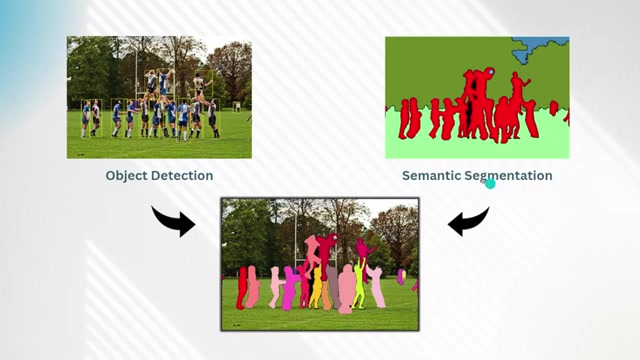
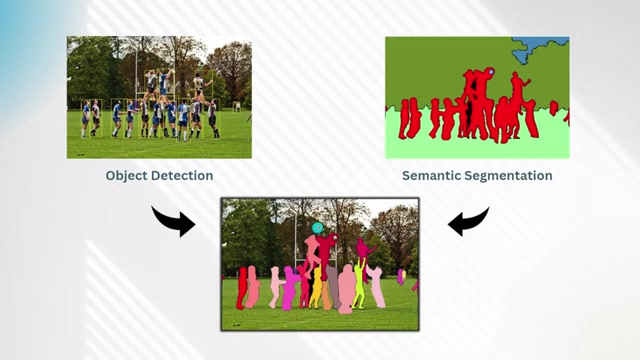
Unlike object detection, which only provides bounding boxes around objects, instance segmentation goes a step further by outlining the exact pixel boundaries of each object. And unlike semantic segmentation, it distinctively separates each instance of the same class. For example, if you were to process an image of a soccer field, instance segmentation would not only identify each player but also differentiate between them, even if they're part of the same team.
Instance segmentation leverages machine learning models to understand the patterns, textures, and shapes that define different objects. In machine learning, object instance segmentation entails a computer's ability to discern and separate individual items within a single image, even when these items share a common categorization. This advanced approach facilitates a nuanced comprehension of visual data, enabling computers to not only recognize the presence of objects but also to meticulously delineate the boundaries of each distinct entity, thereby enhancing precision in image interpretation and analysis. This is achieved through the use of advanced AI models that can discern subtle differences between objects, and provide distinct, pixel-perfect segmentation.
Instance Segmentation vs. Object Detection and Semantic Segmentation
To fully appreciate instance segmentation, it's helpful to compare it with other related computer vision tasks:
- Object Detection:
This task identifies objects within an image and places bounding boxes around them. While it's useful for locating objects, it doesn't provide information about their precise shape or boundaries. Object detection is quicker and easier to compute as segmentation is much more detailed and complex.
- Semantic Segmentation: This technique classifies each pixel in an image, assigning it to a particular object class. However, it doesn't differentiate between individual instances of the same class. For example, all players would be labeled as 'player' without distinguishing between them. In the context of Computer vision, semantic segmentation serves as a method to categorize parts of images into meaningful classes. The goal is to divide an image into areas that correspond to different semantic categories, like 'sky', 'road', 'car', and 'pedestrian'. This task contrasts with object detection, which focuses on identifying and locating individual objects within an image using bounding boxes, and instance segmentation, which distinguishes between different instances of the same object class. Semantic segmentation instead assigns a class label to each pixel in the image, allowing for a fine-grained understanding of the scene.
Applications of Instance Segmentation in Soccer Analytics
Revolutionizing Player Tracking
By precisely identifying and delineating each player, instance segmentation allows for accurate and detailed player tracking.
This goes beyond simply knowing a player's location to understanding their movement patterns, speed, and interactions with other players. It is important to account for any player on the field or the performance of an offside player, which instance segmentation can account for. These metrics are invaluable for coaches and analysts looking to gain a competitive edge.
By deploying instance segmentation in Sports like soccer, analysts can get far more than just basic information. It equips analysts with abilities that dramatically improve their ability to analyze players and gameplays to get the competitive edge to have better insights and strategies.
Here's the Competitive Advantages of Instance Segmentation in Player Tracking:
- Detailed Performance Metrics: Go beyond basic location data. Track individual player speed, acceleration, and movement patterns with high precision.
- Advanced Movement Analysis: Use directional vectors and skeleton tracking data to analyze the intricacies of player movements, identifying strengths and weaknesses.
- Interaction Mapping: Analyze player interactions to build insights into team dynamics, passing efficiencies, and more.
Performance Analysis
Instance segmentation opens doors to a deeper understanding of player and team performance.
This can help provide information on the following metrics:
-
Time spent in specific zones of the field
-
Distances covered during different phases of the Game, as discussed in instance segmentation
-
Number of successful passes, tackles, and other key actions.
-
Automated Offside Detection. By precisely locating every player on the field, instance segmentation can be used to automate offside detection, potentially reducing errors.
Steps to Training the Instance Segmentation Model
A Three-Step Training Process
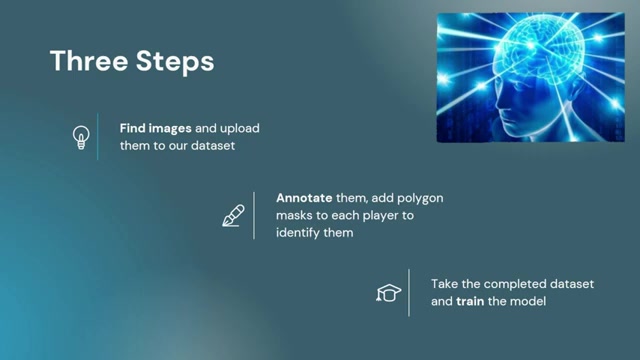
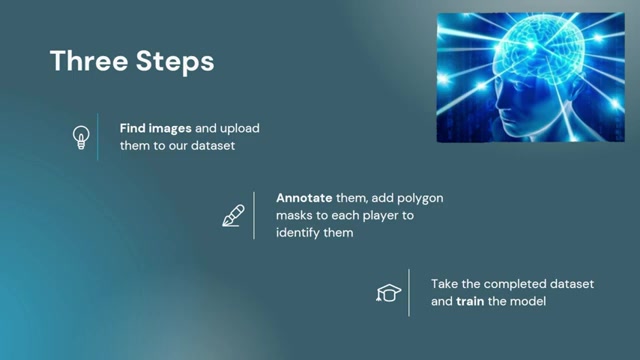
To train an instance segmentation model effectively, there are three clear, well-defined steps that one must follow to achieve the desired results.
Step 1: Data Collection.
Find images and upload them to a dataset. It is a must to have all the needed files to train a computer vision model. This means that there should be an adequate number of photos of soccer matches and all annotations for them. Annotations should accurately represent each element, and must be clearly labeled.
Step 2: Image annotation. Once you have all the needed image samples uploaded, you must then annotate the images and label the objects within them. This is when a polygon mask for object detection should be used. Every player on the field should be clearly labeled to be correctly trained.
Step 3: Training the model. With all images uploaded and properly labeled, you can train the model to learn how to replicate the steps. The instance segmentation model should then be able to output a similar result as the training examples.
Pricing
V7 Darwin Pricing Structure
V7 Darwin is built primarily for team use, so it may not be a good fit for individual users.
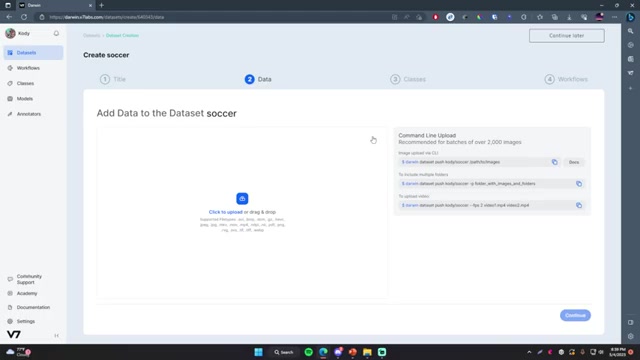
The platform gives an entire platform for building a data set, annotating that data set, and training models.
The pricing for V7 Darwin is complex. But there are some core values to take into account.
- The model and Logic is paid. V7's platform can be used for data collection, image annotation, or even both. But what V7 is really good at is their model and the logic behind it.
- Team pricing. This is built for companies who are working with machine learning models.
If you are in need of a computer vision software toolkit for a big team, then this software is a good fit.
Use Cases for Model Generation
Potential Uses for a Soccer Instance Segmentation Model
Here are some use cases of this model that you can put into use.
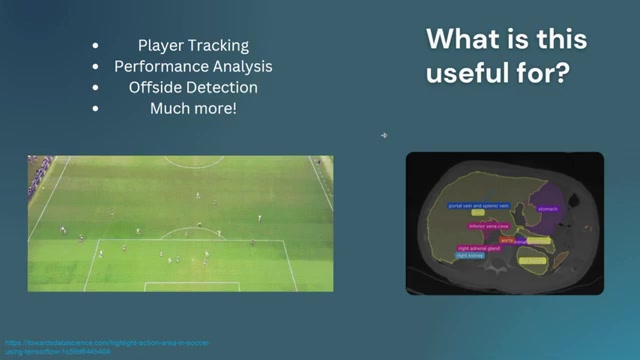
This list is simply a few examples relevant to what is being looked at.
- Tracking players on a field.
- Doing Performance analysis using multiple metrics.
- Help detect any offsides.









Most people like




























Report
Please select a reason for reporting
- 13 Reasons to Switch from Snapchat to Text Messaging
- 7 Powerful Speech to Text Apps to Boost Productivity
- 10 Best Speech to Text Tools for Effortless Transcription
- 13 Free Tools to Easily Transcribe Audio to Text
- 15 Surprising Ways Google's Speech-to-Text Boosts Productivity
- 7 Best Free Online Audio to Text Transcription Tools
- 9 Tips to Transcribe Speech to Text Faster and Better
- 13 Best Speech to Text Software for Windows 10 in 2023
- 7 Tips for Choosing the Best Transcriber for Audio to Text
- 11 Reasons Why Dragon Speech-to-Text Apps are Game-Changers
- 6 Secrets to Enhance Your Speech to Text Transcription
- 6 Brilliant Ways to Boost Productivity with Talk-to-Text on Your MacBook
- 6 Ways Transcription Software Converts Audio to Text
- 8 Tips to Transcribe Speech to Text Like a Pro
- 6 Reasons IBM Watson Speech to Text is a Game-Changer
- 14 Powerful Ways Talk-to-Text Improves Your Workflow
- 12 Top Windows Speech-to-Text Software for Efficient Transcription
- 12 Game-Changing Benefits of Apple's Speech to Text Technology
- 9 Powerful Use Cases for AWS Speech to Text Technology
- 10 Easy Steps to Transcribe YouTube Videos to Text
- transcription audio en texte
- online audio transcription
- free audio file transcription
- free ai audio transcription
- audio transcription service
- audio transcription online free
- audio transcription free online
- audio to transcription software
- audio and transcript
- ai audio transcription free
- voice recording to text converter
- translate voice recording to text
- record voice to text
- audio recording to text converter
- voice recording and transcription
- chatgpt voice to text
- gmail voice to text
- speech to text reader
- speech to text ai free
- speech to talk
- Create Engaging Animated Explainer Videos with a Free AI Tool
- Stop Multi-Subscribing: Benchmark Top AI Visual Models in One Canvas
- Best Seedance 2.5 API Provider: Every Price on the Market, Checked at Source
- AI OnlyFans: How to Generate $30,000/Month (Legally)
- Transform Your Script into an Engaging Video with AI Video Maker!
- AI Marketing Automation: A Comprehensive Guide for Small Businesses
- Midjourney Alternative for Anime Art Creators: Why PixAI May Be Better for Character Workflows
- 10 Things Most People Get Wrong About AI Image Search
- AI Girlfriend Apps: Top Choices Redefining Relationships 2025
- How to Reduce Quoting Errors in Salesforce with AI-Assisted Quote Creation
- Revideo.io: The Future of Reverse Video Search Technology
- Mastering Cold Calling: The Buffoon Technique for Client Acquisition
- Top AI Image Generators: Photo-Realistic Results in 2025
- Top 5 AI Image Generators: Create Stunning Visuals Easily
- Mastering Camera Angle Control: Top 4 AI Image & Video Generators for Cinematic Precision
- Top 4 AI Tools to Generate Flawless Digital Personas in 2026
- Why AI Language Tutors Underperform in Low-Resource Languages (And How to Work Around It)
- Top 5 AI Detector Tools: Ensuring Originality in Your Content
- How to Tell If an AI Study Tool Is Actually Helping You Learn (6 Checks for 2026)
- From Auto-Cuts to Generative Clips: Top 4 AI Video Editor Platforms Tested

Copyright ©2026 toolify