























Top Trending Open Source GitHub Projects: AI and Reverse Engineering

Updated on May 17,2025








Table of Contents
- Key Points
- AI and GitHub: Exploring Trending Open Source Projects
- How to Use these Trending Open Source Tools?
- Key Features of the Trending Open Source Projects
- Frequently Asked Questions
- Related Questions


AI and GitHub: Exploring Trending Open Source Projects
Evo 2: Genome Modeling and Design Across All Domains of Life
Evo 2

is a cutting-edge DNA language model designed for long context modeling and design, distinguishing itself with the capability to model DNA sequences at single-nucleotide resolution across an extensive context length of up to 1 million base pairs.This is achieved through the StripedHyena 2 architecture. The model was pre-trained using Savanna and trained autoregressively on OpenGenome2, a dataset of 8.8 trillion tokens from all domains of life.
One of the things that makes Evo 2 particularly unique is its capacity for long-context modeling, enabling it to capture dependencies and relationships within very long DNA sequences. This is crucial for understanding complex genomic structures and functions.
Evo 2 also allows users to score the likelihoods across a DNA sequence. Evo 2 embeddings can be saved for downstream usage. Evo 2 distinguishes itself through its broad applicability across all domains of life. This is owing to its training on the comprehensive OpenGenome 2 dataset.
This pre-training data includes raw fastas and sam files with preprocessing and data augmentation. The model supports various functionalities, including forward sequence scoring, generating embeddings for downstream tasks, and DNA sequence generation based on prompts.
It should be noted that Evo 2 is based on StripedHyena 2 which requires python >=3.11. Evo 2 uses Transformer Engine FP8 for some layers which requires an H100 (or other GPU with compute capability >=8.9). However, the developers are actively investigating ways to avoid this requirement.
Scira: The Minimalistic AI-Powered Search Engine
Scira
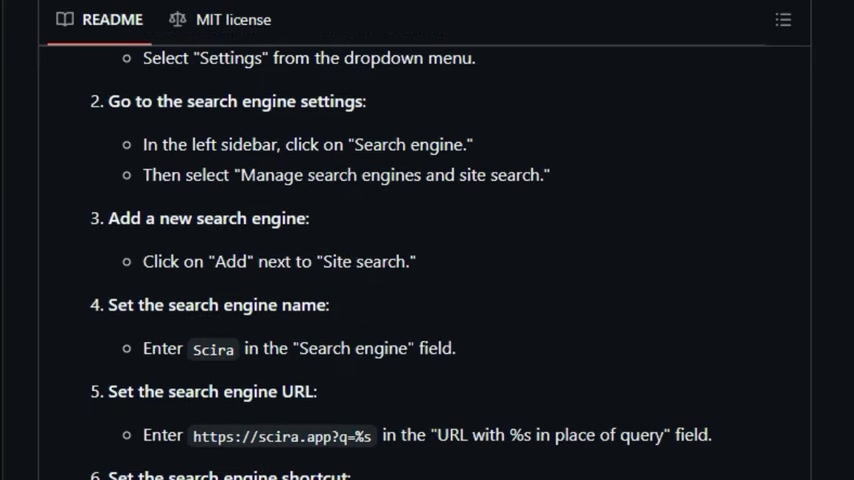
is a Search Engine standing out with its minimalistic design and powerful AI capabilities. It is designed to help you find information on the internet efficiently. What makes Scira unique is its use of AI to provide answers to your questions, powered by the Vercel AI SDK. This allows for AI model integration and streaming, enhancing the search experience.
One of Scira’s key features is its web search capability, utilizing Tavily AI for search grounding. This ensures that the information you receive is Relevant and accurate. It also offers URL-specific search, allowing you to extract information from a particular webpage.
Scira provides features like weather updates and the ability to run code snippets in multiple languages and maps using various APIs. The search engine can search YouTube videos and provides timestamps and transcripts. It can also conduct academic searches and search for posts on X.com, all powered by Exa.AI.
OpenEval: Evaluating LLM Applications
OpenEval
is a tool designed to help you evaluate your large language model applications, much like tests in traditional software development. This package provides a starting point for writing evals, which can be customized to fit specific application needs. OpenEval suggests exploring the agent evals Package if your focus is on evaluating LLM agents.
The reason to use this over other options is the LLM-as-Judge functionality, where another LLM is used to evaluate the outputs of your primary LLM application. The create_LLM_as_judge function takes a Prompt and a model as input and returns an evaluator function that formats inputs, parses the judge LLM’s outputs into a score, while also tracing and logging results via LangSmith.
OpenEval includes prebuilt prompts for common evaluation criteria such as correctness, conciseness, and hallucination. The correctness prompt scores the accuracy of an LLM's output. OpenEval supports customization of prompts, models, and output scores.
Roo Code: The AI-Powered Autonomous Coding Agent
Roo Code
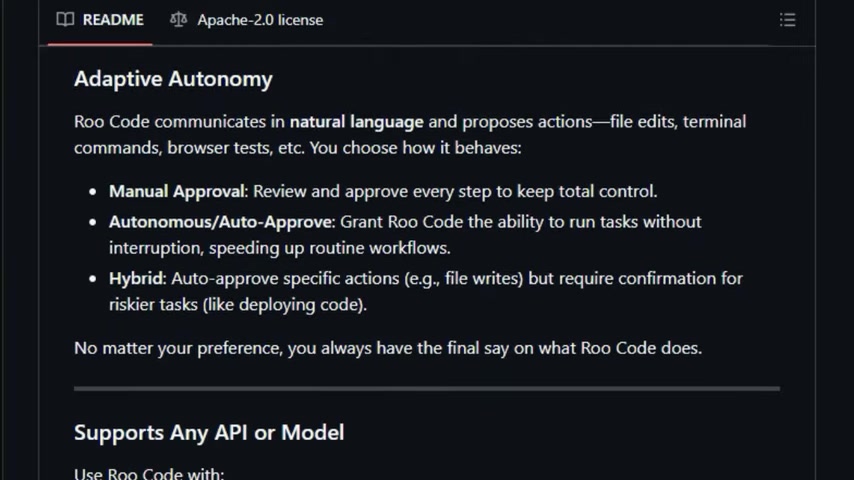
, formerly Roo Cline, is an AI-powered autonomous coding agent designed to live right inside your editor, aiming to make software development more efficient. What makes Roo Code unique is its ability to act as a flexible coding partner capable of communicating in natural language, reading and writing files, running terminal commands, automating browser actions, and integrating with various APIs. It adapts to different roles through customizable modes, functioning as a system architect, qa engineer, or product manager.
Roo Code stands out with its adaptive autonomy, offering manual approval, fully autonomous operation, or a hybrid approach. This allows you to maintain control while automating routine tasks. It supports various APIs and models, including OpenAI-compatible options, and allowing different models per mode.
Roo Code can create and edit files, respond to errors, track changes, run terminal commands, and automate browser Sessions for testing and debugging. It can be extended with new tools using the Model Context Protocol (MCP).
VLM-R1: Solving Visual Understanding with Reinforced VLMs
VLM-R1
is a large vision language model that distinguishes itself through its stability and generalizability, achieved via reinforced learning techniques. What makes VLM-R1 unique is its R1-style architecture.
Specifically, the VLM-R1 leverages both R1 and SFT methods when training Qwen2.5-VL for referring expression comprehension (REC). The results indicate that while the SFT model performs slightly worse than the R1 model on in-domain test data, its performance significantly deteriorates as the number of steps increases on out-of-domain test data. In contrast, the R1 model demonstrates consistent improvement. This highlights VLM-R1’s ability to maintain and improve performance in diverse and unseen scenarios.
BIG-AGI: The AI Suite for Professionals
Big-AGI
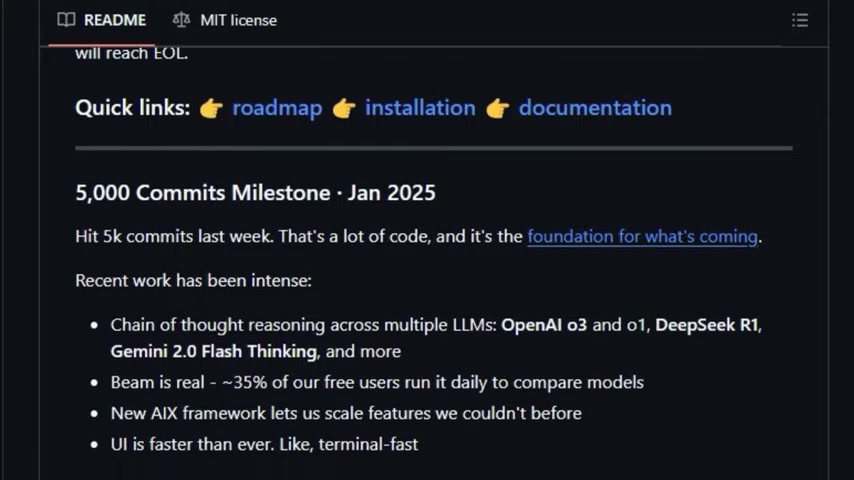
is an AI suite designed for professionals, offering a Blend of functionality, aesthetics, simplicity, and speed. What makes Big-AGI stand out is its ability to provide advanced AI/AGI functions through state-of-the-art models, all within a polished user experience.
Big-AGI is powered by the latest models from 15 vendors and open-source servers. It supports a wide array of AI functionalities, including AI personas, multimodal chats, text-to-image, voice, response streaming, code highlighting, and execution, and PDF importing.
One of the key features of Big-AGI is Beam, a multimodal AI Chat that helps users find better answers faster, making it ideal for brainstorming, decision-making, and creative tasks. Chat has cost estimation so that you are able to keep an eye on your use.
The platform also incorporates an AIX framework that allows for scaling features, and the user interface is designed for speed. Big-AGI supports several Large Language Models (LLMs), including xAI’s Grok, Anthropic’s Claude, Meta’s Llama, deepseek and OpenAI.
Ghidra: Software Reverse Engineering Framework
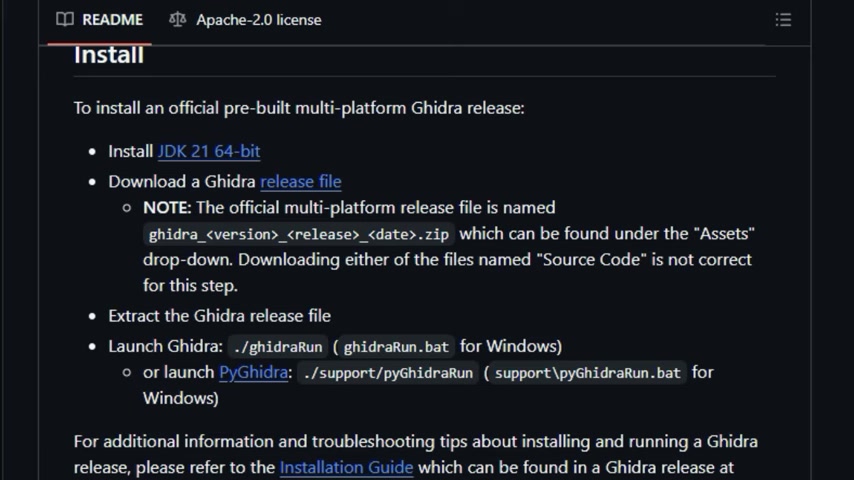
Ghidra is a software reverse engineering (SRE) framework developed by the National Security Agency’s Research Directorate, designed to provide a comprehensive suite of tools for analyzing compiled code across Windows, macOS, and Linux. What truly distinguishes Ghidra is its combination of high-end software analysis tools within a single, versatile framework.
It brings together capabilities like disassembly, assembly, decompilation, graphing, and scripting, making it a go-to platform for anyone diving deep into software. Ghidra's flexibility extends to its operational modes, as it can be run interactively for hands-on analysis or in automated modes for streamlined workflows.
Ghidra supports a wide variety of processor instruction sets and executable formats. Also it supports the development of custom scripts and extensions using Java or Python.
PapersGPT for Zotero: Your AI-Powered Research Assistant
PapersGPT for Zotero is a groundbreaking plugin transforming how you interact with research Papers by enabling you to chat directly with your PDFs within Zotero. What truly sets PapersGPT apart is its deep integration with Zotero, combined with its extensive support for a wide array of state-of-the-art large language models (LLMs), encompassing both commercial and open-source options.
With PapersGPT, you can leverage the power of various LLMs such as DeepSeek, GPT, ChatGPT, Claude, Gemini to enhance your research. It allows you to summarize papers, pinpoint key concepts, and generate insights for literature reviews.
Just Chat: The Ultimate Tool for Effortless AI Agent Deployment
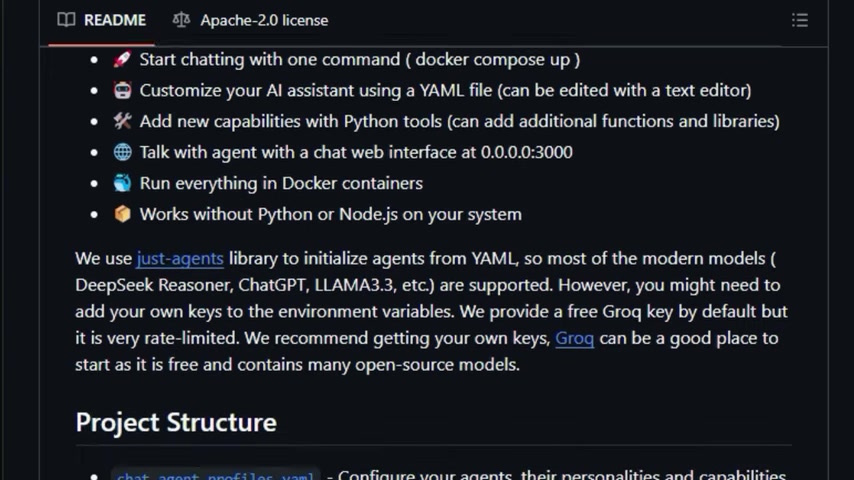
Just Chat is designed to drastically simplify the creation and deployment of language model (LLM) agents. What sets Just Chat apart is its focus on ease of use and rapid deployment, allowing users to get their AI assistant up and running with just a few commands.
This is achieved through containerization with Docker or Podman, eliminating the need for complex installations or dependency management. Just Chat also allows you to customize your agent’s personality and capabilities via a YAML configuration file. The command launches a chat interface which you can immediately begin interacting with your AI agent.
Cherry Studio: Your Desktop Hub for Multiple LLM Providers
Cherry Studio is a desktop client designed to support multiple large language model (LLM) providers available on Windows, Mac, and Linux. Cherry Studio makes it unique is its ability to integrate various LLM cloud services and local models into one application.
Cherry Studio offers a range of features, including over 300 preconfigured AI assistants, and the ability to create custom assistants. It supports multimodal simultaneous conversations, allowing users to compare responses from different models. It offers voice calls. The application will be quick pop-up features, comparison of multimodal answers, SSO login support, networking support for all models, plugin functionality, browser extensions and mobile clients.








Most people like































Report
Please select a reason for reporting
- 13 Reasons to Switch from Snapchat to Text Messaging
- 7 Powerful Speech to Text Apps to Boost Productivity
- 10 Best Speech to Text Tools for Effortless Transcription
- 13 Free Tools to Easily Transcribe Audio to Text
- 15 Surprising Ways Google's Speech-to-Text Boosts Productivity
- 7 Best Free Online Audio to Text Transcription Tools
- 9 Tips to Transcribe Speech to Text Faster and Better
- 13 Best Speech to Text Software for Windows 10 in 2023
- 7 Tips for Choosing the Best Transcriber for Audio to Text
- 11 Reasons Why Dragon Speech-to-Text Apps are Game-Changers
- 6 Secrets to Enhance Your Speech to Text Transcription
- 6 Brilliant Ways to Boost Productivity with Talk-to-Text on Your MacBook
- 6 Ways Transcription Software Converts Audio to Text
- 8 Tips to Transcribe Speech to Text Like a Pro
- 6 Reasons IBM Watson Speech to Text is a Game-Changer
- 14 Powerful Ways Talk-to-Text Improves Your Workflow
- 12 Top Windows Speech-to-Text Software for Efficient Transcription
- 12 Game-Changing Benefits of Apple's Speech to Text Technology
- 9 Powerful Use Cases for AWS Speech to Text Technology
- 10 Easy Steps to Transcribe YouTube Videos to Text
- transcription audio en texte
- online audio transcription
- free audio file transcription
- free ai audio transcription
- audio transcription service
- audio transcription online free
- audio transcription free online
- audio to transcription software
- audio and transcript
- ai audio transcription free
- voice recording to text converter
- translate voice recording to text
- record voice to text
- audio recording to text converter
- voice recording and transcription
- chatgpt voice to text
- gmail voice to text
- speech to text reader
- speech to text ai free
- speech to talk
- Create Engaging Animated Explainer Videos with a Free AI Tool
- Stop Multi-Subscribing: Benchmark Top AI Visual Models in One Canvas
- Best Seedance 2.5 API Provider: Every Price on the Market, Checked at Source
- AI OnlyFans: How to Generate $30,000/Month (Legally)
- Transform Your Script into an Engaging Video with AI Video Maker!
- AI Marketing Automation: A Comprehensive Guide for Small Businesses
- Midjourney Alternative for Anime Art Creators: Why PixAI May Be Better for Character Workflows
- 10 Things Most People Get Wrong About AI Image Search
- AI Girlfriend Apps: Top Choices Redefining Relationships 2025
- How to Reduce Quoting Errors in Salesforce with AI-Assisted Quote Creation
- AI Resume Builders: EnhanceCV, ResumeNerd AI, & Teal Compared
- ResumeAI: Crafting ATS-Optimized Resumes with AI
- AI in Resume Writing: A New Era for Job Seekers
- AI Resume Tools: Streamline Your Job Search and Land Your Dream Role
- AI Resume Optimization: The Right Way to Land Interviews
- Crafting a Killer Resume with AI: A Step-by-Step Guide
- Crafting a Winning Resume: AI Tools and Expert Tips
- AI Job Search: Level Up Your Career with AI Automation
- Empower Your Career Journey: Dynamic Resumes with AI
- AI Resume Builder: Create Professional Resumes Effortlessly

Copyright ©2026 toolify