



Total runs:
213.5K
Run Growth:
125.2K
Growth Rate:
58.61%








MOSS‑TTS Family is an open‑source speech and sound generation model family from MOSI.AI and the OpenMOSS team . It is designed for high‑fidelity , high‑expressiveness , and complex real‑world scenarios , covering stable long‑form speech, multi‑speaker dialogue, voice/character design, environmental sound effects, and real‑time streaming TTS.
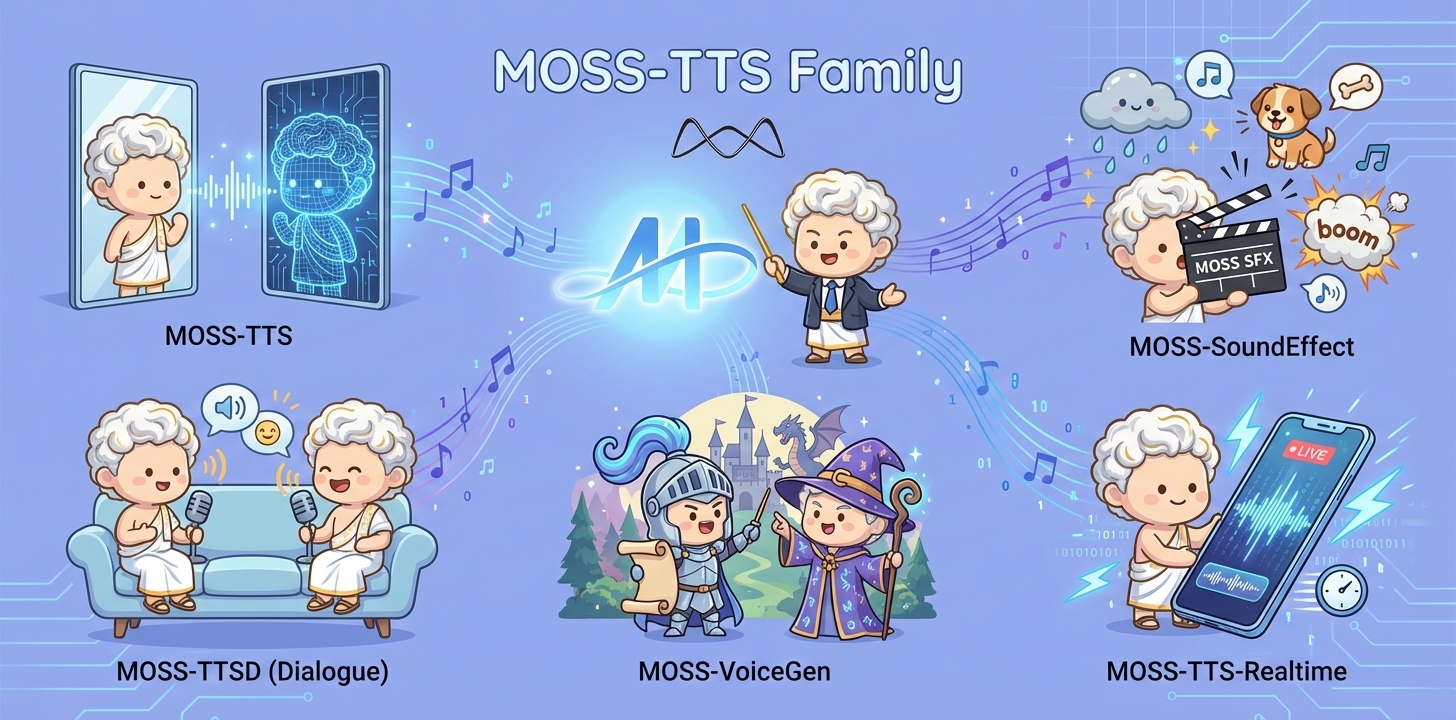
When a single piece of audio needs to sound like a real person , pronounce every word accurately , switch speaking styles across content , remain stable over tens of minutes , and support dialogue, role‑play, and real‑time interaction , a single TTS model is often not enough. The MOSS‑TTS Family breaks the workflow into five production‑ready models that can be used independently or composed into a complete pipeline.
| Model | Architecture | Size | Model Card | Hugging Face |
|---|---|---|---|---|
| MOSS-TTS | MossTTSDelay | 8B | moss_tts_model_card.md | 🤗 Huggingface |
| MossTTSLocal | 1.7B | moss_tts_model_card.md | 🤗 Huggingface | |
| MOSS‑TTSD‑V1.0 | MossTTSDelay | 8B | moss_ttsd_model_card.md | 🤗 Huggingface |
| MOSS‑VoiceGenerator | MossTTSDelay | 1.7B | moss_voice_generator_model_card.md | 🤗 Huggingface |
| MOSS‑SoundEffect | MossTTSDelay | 8B | moss_sound_effect_model_card.md | 🤗 Huggingface |
| MOSS‑TTS‑Realtime | MossTTSRealtime | 1.7B | moss_tts_realtime_model_card.md | 🤗 Huggingface |
MOSS-SoundEffect is the environment sound & sound effect generation model in the MOSS‑TTS Family . It generates ambient soundscapes and concrete sound effects directly from text descriptions, and is designed to complement speech content with immersive context in production workflows.
MOSS-SoundEffect is designed as an audio generation backbone for creating high-fidelity environmental and action sounds from text, serving both scalable content pipelines and a strong research baseline for controllable audio generation.
Design goals
MOSS‑SoundEffect focuses on contextual audio completion beyond speech, enabling creators and systems to enrich scenes with believable acoustic environments and action‑level cues.
What it can generate
Why it matters
MOSS-SoundEffect employs the MossTTSDelay architecture (see moss_tts_delay/README.md ), reusing the same discrete token generation backbone for audio synthesis. A text prompt (optionally with simple control tags such as duration ) is tokenized and fed into the Delay-pattern autoregressive model to predict RVQ audio tokens over time. The generated tokens are then decoded by the audio tokenizer/vocoder to produce high-fidelity sound effects, enabling consistent quality and controllable length across diverse SFX categories.
Recommended decoding hyperparameters
| Model | audio_temperature | audio_top_p | audio_top_k | audio_repetition_penalty |
|---|---|---|---|---|
| MOSS-SoundEffect | 1.5 | 0.6 | 50 | 1.2 |
We recommend a clean, isolated Python environment with Transformers 5.0.0 to avoid dependency conflicts.
conda create -n moss-tts python=3.12 -y
conda activate moss-tts
Install all required dependencies:
git clone https://github.com/OpenMOSS/MOSS-TTS.git
cd MOSS-TTS
pip install --extra-index-url https://download.pytorch.org/whl/cu128 -e .
For better speed and lower GPU memory usage, you can install FlashAttention 2 if your hardware supports it.
pip install --extra-index-url https://download.pytorch.org/whl/cu128 -e ".[flash-attn]"
If your machine has limited RAM and many CPU cores, you can cap build parallelism:
MAX_JOBS=4 pip install --extra-index-url https://download.pytorch.org/whl/cu128 -e ".[flash-attn]"
Notes:
pyproject.toml
, which currently pins
torch==2.9.1+cu128
and
torchaudio==2.9.1+cu128
.
torch.float16
or
torch.bfloat16
.
import os
from pathlib import Path
import torch
import torchaudio
from transformers import AutoModel, AutoProcessor
# Disable the broken cuDNN SDPA backend
torch.backends.cuda.enable_cudnn_sdp(False)
# Keep these enabled as fallbacks
torch.backends.cuda.enable_flash_sdp(True)
torch.backends.cuda.enable_mem_efficient_sdp(True)
torch.backends.cuda.enable_math_sdp(True)


pretrained_model_name_or_path = "OpenMOSS-Team/MOSS-SoundEffect"
device = "cuda" if torch.cuda.is_available() else "cpu"
dtype = torch.bfloat16 if device == "cuda" else torch.float32

processor = AutoProcessor.from_pretrained(
    pretrained_model_name_or_path,
    trust_remote_code=True,
)
processor.audio_tokenizer = processor.audio_tokenizer.to(device)

text_1 = "雷声隆隆,雨声淅沥。"
text_2 = "清晰脚步声在水泥地面回响,节奏稳定。"

conversations = [
    [processor.build_user_message(ambient_sound=text_1)],
    [processor.build_user_message(ambient_sound=text_2)]
]

model = AutoModel.from_pretrained(
    pretrained_model_name_or_path,
    trust_remote_code=True,
    attn_implementation="sdpa",
    torch_dtype=dtype,
).to(device)
model.eval()

batch_size = 1

messages = []
save_dir = Path("inference_root")
save_dir.mkdir(exist_ok=True, parents=True)
sample_idx = 0
with torch.no_grad():
    for start in range(0, len(conversations), batch_size):
        batch_conversations = conversations[start : start + batch_size]
        batch = processor(batch_conversations, mode="generation")
        input_ids = batch["input_ids"].to(device)
        attention_mask = batch["attention_mask"].to(device)

        outputs = model.generate(
            input_ids=input_ids,
            attention_mask=attention_mask,
            max_new_tokens=4096,
        )

        for message in processor.decode(outputs):
            audio = message.audio_codes_list[0]
            out_path = save_dir / f"sample{sample_idx}.wav"
            sample_idx += 1
            torchaudio.save(out_path, audio.unsqueeze(0), processor.model_config.sampling_rate)
UserMessage
| Field | Type | Required | Description |
|---|---|---|---|
ambient_sound
|
str
|
Yes | Description of environment sound & sound effect |
tokens
|
int
|
No | Expected number of audio tokens. 1s ≈ 12.5 tokens . |